anOrdain Watches Review: Scottish Grand Feu Enamel Mastery at $2,000
Where 4,000-hour enamel training meets 4-year waiting lists—Glasgow microbrand reviving centuries-old haute horology craft at microbrand pricing.
Steven Thompson
Independent Watchmaker · 10 Years Experience
Reviewed by Indie Watches
Editorially reviewed for accuracy
⚡ Key Takeaways
- ✓Product designer by trade
- ✓Mechanical watch enthusiast
- ✓No formal watchmaking training initially
- ✓Vision: merge traditional craftsmanship with modern design
📑 Table of Contents
Most affordable mechanical watches use printed lacquer dials. Swiss brands offering grand feu enamel dials charge $30,000-80,000+. Industry rejected enamel as commercially unviable below luxury tier—firing temperatures exceeding 830°C, 80-90% rejection rates, mastery requiring years.
📚 Explore our full watches guide →
anOrdain destroyed that assumption.
Founded 2015 in Glasgow, Scotland by product designer Lewis Heath, anOrdain builds mechanical watches with in-house grand feu vitreous enamel dials priced £1,700-2,500 ($2,200-3,200)—bringing haute horology dial craftsmanship to microbrand pricing through obsessive process refinement, custom typography, and willingness to operate 2-4 year waiting lists rather than compromise quality.
The achievement: Team of 7 enamellers producing ~14-15 handcrafted enamel dials weekly with 30% rejection rate (industry standard 80-90%). World's first fumé (gradient) enamel dials invented 2019. Grand Prix d'Horlogerie de Genève (GPHG) nominations 2019 Model 2 Green Fumé and 2020 Model 1 Grey—recognition typically reserved Swiss manufacture.
The cost: Waiting list extending to Q1 2027-2028. Non-refundable £350 reservation fee. Quarterly production batches ~150 watches. No stock for immediate purchase. Prices may increase 5% annually during wait.
The philosophy: "Old Crafts, New Hands"—reviving traditional British craftsmanship in Scotland (country with virtually no watchmaking infrastructure), training young artisans in dying arts, proving independent microbrands can master complications typically exclusive to haute horology.
From 8 dials weekly in 2018 launch to current ~50 monthly with porcelain dial introduction 2025, anOrdain demonstrates small-batch artisanal watchmaking viability when founder possesses genuine design vision, willingness to develop in-house capabilities rather than outsource, and patience to build brand gradually rather than chase quick Kickstarter cash.
This comprehensive review examines anOrdain's complete collection—exploring grand feu enamel production process, Scottish design influences, waiting list system, build quality, movement choices, and whether 2-4 year waits for $2,000-3,000 watches delivering $30,000+ dial quality justify hype.
Let's explore Britain's most accomplished enamel dial microbrand.
Brand History: From Product Designer to Enamel Revival #
Loch an Ordain Inspiration (2015) #
Lewis Heath background:
- Product designer by trade
- Mechanical watch enthusiast
- No formal watchmaking training initially
- Vision: merge traditional craftsmanship with modern design
The name: Loch an Ordain—remote lochan (small loch) in Scottish Highlands. Rugged beauty, timeless appeal, isolation symbolizing independence from mainstream watchmaking centers (Switzerland, Germany, Japan).
2015 founding: Glasgow, Scotland—city known for Glasgow School of Art and Edinburgh College of Art (influences pervading anOrdain aesthetic).
Founding team:
- Lewis Heath: Designer, founder
- Jewelry designers
- Typographer (custom typeface development)
- Graphic designer
- Product designer
- Chris (watchmaker): Trained British Horological Institute, individually assembles/regulates each watch
Note: Some sources incorrectly credit "Ross Davis" as founder—Lewis Heath is correct verified founder.
The Challenge: Enamel or Nothing (2015-2018) #
Initial vision: Create watches with grand feu (vitreous) enamel dials—centuries-old technique almost extinct in modern watchmaking.
Why enamel abandoned by industry:
- Extreme difficulty: Firing temperatures exceeding 830°C, multiple firings required, each firing risks cracking/warping/bubbling
- Cost prohibitiveness: Swiss brands offering enamel—Patek Philippe ($30,000+), Vacheron Constantin ($40,000+), A. Lange & Söhne ($50,000+), Jaeger-LeCoultre ($25,000+). Seiko Presage enamel ($1,000-2,500) only affordable option—mass-produced in Japan.
The determination: Lewis Heath's approach: "We tried making enamel dials elsewhere in UK and people just couldn't manage tolerances, didn't have passion to do it, so we started doing it ourselves."
3 years development (2015-2018): Perfecting in-house enamel production. Learning through failure. Building team of enamellers. Developing proprietary techniques.
Model 1 Launch & Instant Success (2018) #
First watch: Model 1
Key features:
- 38mm stainless steel case
- Hand-crafted vitreous enamel dial (various colors)
- ETA 2824-2 automatic movement (individually regulated)
- Custom typography based on vintage Ordnance Survey maps of Loch an Ordain Scottish Highlands
- Syringe hands with heat-treated straw finish
- Blade-shaped lugs with arrowhead cutouts
Initial production: 8 dials per week—tiny output reflecting learning curve, high rejection rates.
Market reaction: Instant cult following. Every batch sold out within minutes. Waiting lists formed immediately.
Price (2018): £950-1,200 (~$1,200-1,550)—unprecedented value for genuine grand feu enamel.
Innovation: World's First Fumé Enamel (2019) #
Model 2 Green Fumé launch:
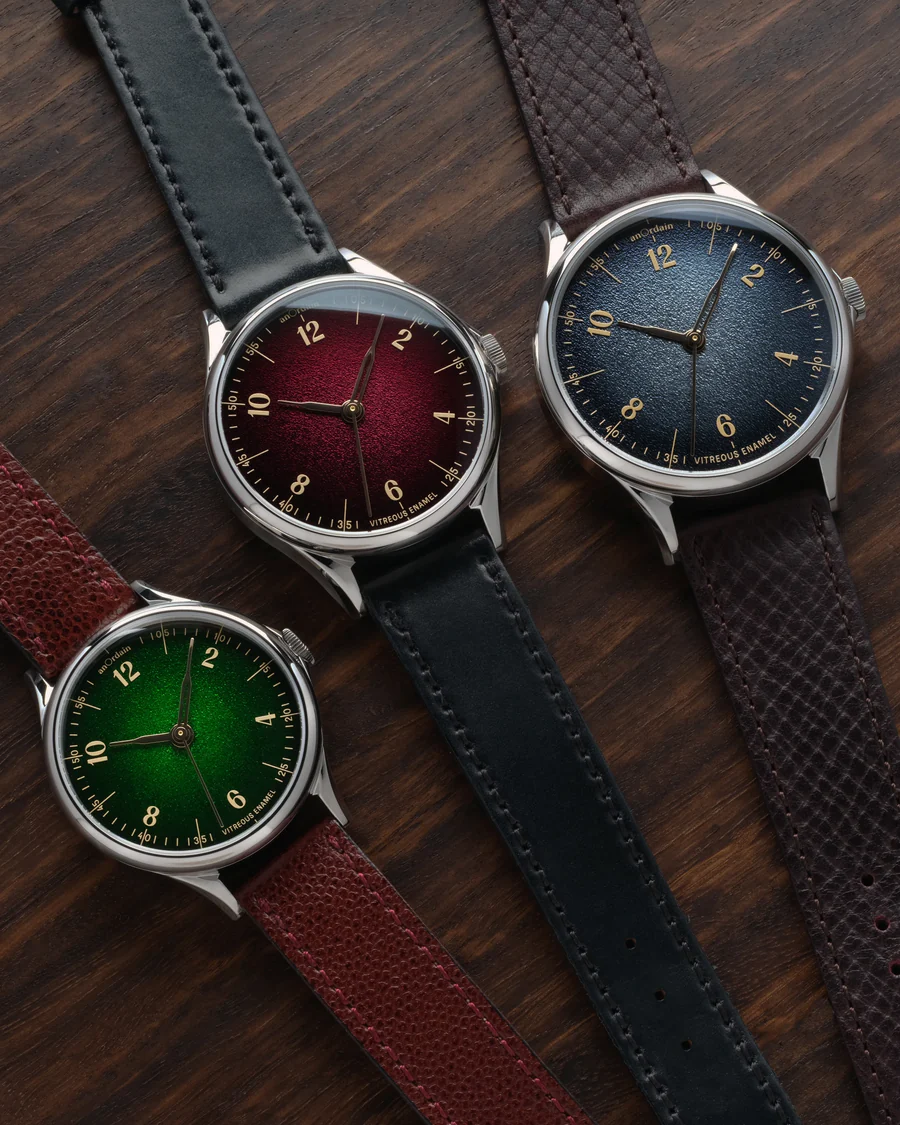
The breakthrough: anOrdain invented fumé (smoky gradient) enamel dials—technique not existing before 2019.
Lewis Heath: "In terms of techniques, we actually invented our own method of making fumé dials. There was no such thing as 'smoky' enamel dials before 2019."
Process: Chance discovery through experimentation. Dogged persistence refining. Creating gradient effect through layered translucent enamel with varying thickness across dial surface.
Result: Deceptively simple aesthetic—grainy texture, flawless translucent finish, gradient shifting beautifully under light.
Recognition:
- GPHG 2019: Model 2 Green Fumé entered Grand Prix d'Horlogerie de Genève—prestigious Geneva Watchmaking Grand Prix (watch industry's "Oscars").
- GPHG 2020: Model 1 Grey pre-selected as finalist in Challenge category—recognition typically reserved for established Swiss manufacturers.
Significance: Scottish microbrand 4 years old nominated alongside Patek Philippe, Vacheron Constantin, A. Lange & Söhne—validating dial craftsmanship rivaling haute horology.
Scaling & Waiting Lists (2020-Present) #
Production evolution:
| Year | Output |
|---|---|
| 2018 | 8 enamel dials/week |
| 2022 | ~14-15 enamel dials/week |
| 2025 | ~50 enamel dials/month (~12/week) + porcelain dials ~30/month |
Rejection rate improvement: 80-90% (industry standard) → 30% (anOrdain current)
Achieved through:
- Research & development on base materials (copper to silver testing)
- 4,000+ hours master enameller training
- Team of 7 enamellers continuously learning
- Proprietary technique refinements
Waiting list implementation (2021):
Why necessary:
- Production ~200 enamel watches/year maximum
- Demand exponentially exceeding supply
- Batch releases selling out seconds (website crashes)
- Unfair advantage to bot users, fastest internet connections
Fair system: First-come, first-served. Chronological order. No dealer allocation games. Transparent quarterly batch structure.
Expansion: Porcelain Dials & Collaborations (2023-2025) #
Model 3 Method (2023): Collaboration with Method Studio (Scottish artisanal woodworking). 3D-scanned hand-chiseled wood texture replicated on dial using stamped silver covered with translucent enamel. Waitlist-only production extending to 2027-2028.
Model 2 Porcelain (2025): Major development: True porcelain dials (not vitreous enamel). 3-year development partnering master potters Stoke-on-Trent, England.
Advantages:
- Easier, quicker production: ~30 dials/month (vs. ~12-15 enamel)
- Similar visual appearance to enamel
- Lower rejection rates
- £1,800 ($2,300) pricing
- 6-month wait (vs. 2-4 years enamel)
Current status (2026):
- Waiting list: Q1 2027-2028 build slots
- £350 non-refundable reservation fee
- Quarterly batches ~150 watches
- Prices capped 5% annual increases
- Workshop: Glasgow, Scotland (visits by appointment)
The Grand Feu Enamel Process: Why It's So Difficult #
What Is Vitreous Enamel? #
Definition: Fusing glass to metal through extreme heat. Powdered glass (silica, red lead, soda ash) applied to metal substrate, fired in kiln 830°C+ (~1,525°F), melts into glassy surface.
"Grand feu" = "great fire": French term for traditional high-temperature enamel firing.
Historical context: 17th-century decorative tradition. Pocket watch dials. Jewelry. Nearly died out mid-20th century as affordable lacquer replaced costly enamel.
anOrdain's 12-Hour Dial Creation Process #
Step 1: Base disc preparation
Hand-cut copper disc (substrate). Why copper? Thermal expansion properties match enamel, preventing cracking. Counter-enameling: Underside coated with enamel layer fired 830°C+. Prevents warping during subsequent firings (thermal stresses balanced).
Step 2: Ground layer application
Powdered enamel (silica, red lead, soda ash) hand-applied to copper disc surface. First firing: 830°C+ in Prometheus kiln (capable 1,100°C max). Enamel melts, fuses to copper.
Step 3: Multiple layers & firings
Each subsequent layer:
- Hand-painted enamel powder
- Sanded to consistent flat finish between firings (belt sanders, wire brushes, toothbrushes)
- Fired 830°C+ again
- Inspected for bubbles, cracks, imperfections
- Defects eliminated through additional firings or dial discarded
Total firings: Varies by complexity—typically 4-8+ firings per dial.
Step 4: Color depth achievement
Challenge: Achieving correct color depth, even thickness across dial surface. anOrdain innovation (fumé dials): Varying enamel thickness across dial creates gradient. Thinner areas = lighter color. Thicker areas = deeper saturation. Uneven surfaces (Model 3 Method): Stamped texture doubles difficulty ensuring consistent enamel coverage.
Step 5: Polishing & finishing
Post-firing polishing creates superb glassy finish—depth, luster impossible with lacquer. Result: Sub-1mm thick dial with mirror-smooth surface, everlasting vibrancy.
Step 6: Dial feet attachment
Feet soldered to dial back (after polishing) enabling attachment to movement.
Step 7: Pad printing & curing
Numerals, text printed using pad printing equipment. Heat-cured. anOrdain custom typography: Bespoke typeface designed in-house by typographer. Inspired by British Ordnance Survey maps—cartographic heritage, Scottish identity.
Step 8: Hand-painting Super-LumiNova
Numerals hand-painted with luminous material. Meticulous application.
Total time: ~12 hours per dial (excluding failures, retries). Master enameller training: 4,000+ hours reaching proficiency level. Team: 7 enamellers working continuously. Weekly output: ~14-15 enamel dials (some weeks more, some fewer depending on rejection rates).
Why 30% Rejection Rate Matters #
Industry standard: 80-90% rejection. Most enamel dials crack, warp, bubble, or develop imperfections during firing. Only 10-20% succeed.
anOrdain: ~30% rejection. Through proprietary techniques, material experimentation (copper vs. silver bases), temperature/timing refinement, 70% success rate.
Impact: Enables $2,000-3,000 pricing vs. $30,000+ Swiss enamel. Without improved yields, anOrdain business model impossible.
The Collection: Complete anOrdain Lineup #
Model 1 — $2,200-2,800+ (Original Design) #
First anOrdain watch (2018 launch):
Specifications:
- Sizes: 35mm, 38mm (original), 41mm (later additions)
- Material: 316L stainless steel
- Lugs: Blade-shaped with arrowhead cutouts where lug meets case
- Crown: Minimalistic, signed anOrdain logo, subtle crown guards
- Crystal: Sapphire, domed, 3-layer anti-reflective coating (2023+ models), 6-layer AR (some variants)
- Caseback: Solid steel, screw-in
- Water resistance: 50m
Dial:
- Type: Vitreous enamel on copper
- Variants: Opaque colors (various), Fumé gradient (premium)
- Typography: Custom typeface based on Ordnance Survey maps, angled Arabic numerals (original), brand name 9 o'clock position
- Minute track: Detailed (original design)
- Super-LumiNova: Hand-painted on numeral tips
Hands:
- Style: Skeletonized syringe hour/minute
- Finish: Heat-treated "straw" (warm golden hue matching dial text/markers)
- Lume: Super-LumiNova tips
Movement:
- Caliber: ETA 2824-2 automatic (original) OR Sellita SW210-1 hand-wound (later option)
- Jewels: 25 (ETA 2824-2), 19 (SW210-1)
- Frequency: 28,800 vph (4Hz)
- Power reserve: 38-42 hours
- Regulation: Individually regulated by Chris (staff watchmaker)
- Personalization: Customers can request specific regulation preferences
Straps:
- Width: 18mm
- Options: Shell cordovan, suede, Russian hatch bovine leather, pin-grain kidskin, natural goatskin, stainless Staib Milanese mesh
- Lengths: Multiple (specify wrist size when ordering)
- Buckles: Custom engraved loop buckle
Popular colorways:
- Ox Blood (deep burgundy enamel)
- Parisian Blue (vibrant blue enamel)
- Iron Cream
- Pink
- Grey (GPHG 2020 finalist)
- Fumé variants (gradient smoke effect—premium pricing)
Pricing: Original (2018): £950 (~$1,200). Current (2026): £1,700-2,200+ (~$2,200-2,800+) depending on dial variant (opaque vs. fumé).
Availability: Waiting list only (Q1 2027-2028 build slots). £350 reservation fee.
Model 1 Fabrik — Price TBD (Immediate Purchase) #
New Variant (2024-2025):
- Key difference: NOT enamel—different dial material enabling immediate purchase without waiting list.
- Purpose: Offer anOrdain aesthetic without multi-year wait. Lower pricing. Faster production.
- Specifications: Similar to Model 1 but different dial construction (details not fully disclosed—likely high-quality lacquer or alternative material).
- Availability: In stock with lead times stated on product page (typically weeks/months vs. years).
Model 2 — $2,200-2,800+ (Sports/Field Watch) #
Launched 2019 as sportier sequel to Model 1:
Case:
- Sizes: 36mm (original 2019), 39.5mm (added 2022)
- Material: 316L stainless steel
- Finish: Brushed or polished (depending on variant)
- Lugs: Integrated design, angled downward
- Crown: Subtle crown guard (utilitarian concept)
- Crystal: Domed sapphire, 6-layer anti-reflective coating
- Caseback: Solid steel, screw-in
- Water resistance: 50m
- Lug-to-lug: 46mm (39.5mm version), ~44mm (36mm version)
- Thickness: ~11mm
Dial:
- Type: Vitreous enamel on copper
- Design evolution: Simpler vs. Model 1—outlined Arabic numerals (not angled—straight), no detailed minute track (removed entirely), brand name above 12 o'clock (moved from 9 o'clock), "VITREOUS ENAMEL" printed below 6 o'clock
- Typography: Updated industrial-equipment-inspired 1950s typeface (vs. Ordnance Survey maps Model 1)
Hands:
- Style: Openworked (skeletonized) with rounded sword-like profile
- Lume: Super-LumiNova tips
Movement:
- Caliber: Sellita SW210-1 hand-winding (original) OR Sellita SW300 automatic (variant) OR La Joux-Perret G101 automatic (Porcelain model)
- Frequency: 28,800 vph
- Power reserve: 42 hours (SW210/SW300), 68 hours (G101)
Popular colorways:
- Torr Blue
- Moss Green
- Grey
- White
- Midnight Green
- Purple
- British Racing Green
- Flax
- Turquoise Smoke (fumé variant—popular)
Field watch inspiration: 36mm size echoes WWII-era military field watch proportions. 39.5mm brings modern wearability while maintaining tool watch character.
Pricing: 36mm: £1,700 (~$2,200). 39.5mm: £1,800 (~$2,300).
Production: ~200 enamel Model 2 watches/year maximum.
Availability: Waiting list only (Q1 2027-2028). £350 reservation fee.
Model 2 Porcelain — £1,800 (~$2,300) [6-Month Wait] #
Major 2025 innovation: Revolutionary approach—true porcelain dials (not vitreous enamel). First anOrdain non-enamel production model offering similar aesthetics.
Development: 3 years partnering master potters Stoke-on-Trent, England (historic ceramics center).
Case:
- Size: 39.5mm × 11mm × 46mm lug-to-lug
- Material: 316L stainless steel, brushed
- Crown: Subtle crown guard
- Crystal: Domed sapphire, 6-layer AR coating
- Caseback: Exhibition sapphire (showing movement—rare for anOrdain)
- Water resistance: 50m
Dial:
- Material: Press-molded porcelain, hand-glazed, kiln-fired
- Finish: Deep black tone via custom high-fire glaze infused iron oxide
- Texture: Natural dimples, specks testifying hand-crafted process
- Typography: Bespoke numeral typeface (anOrdain in-house typographer), hand-painted Super-LumiNova, pad printing
Hands:
- Hour/minute: Gold-plated
- Seconds: Red lacquered central seconds
Movement:
- Caliber: La Joux-Perret G101 automatic
- Jewels: 24
- Frequency: 28,800 vph
- Power reserve: 68 hours
- Complications: Central hours, minutes, seconds
Why porcelain matters:
- Faster production: ~30 dials/month (vs. 12-15 enamel)
- Lower rejection rates
- Easier to master technique
- Similar visual appearance (difficult distinguishing side-by-side)
- Enables shorter waiting times
Production capacity: ~30 porcelain dials/month = ~360/year (vs. ~200 enamel/year).
Pricing: £1,800 + VAT (~$2,300)
Availability: Wait time: 6 months (stated on product page). Production limit: ~30 dials/month. Purchase limit: One watch per customer. 36mm version: Planned later 2025.
Note: anOrdain explicitly states porcelain dials nearly indistinguishable from enamel visually—main differences: production speed, technique, slightly different firing process.
Model 3 Method — Price TBD [2027-2028 Waitlist] #
Launched 2023—most experimental anOrdain:
Collaboration: Method Studio—Scottish artisanal trunk and woodworking company.
The innovation:
- Method Studio hand-chiseled wood blocks creating wave/textured patterns
- 3D light-scanned at Glasgow School of Art (only such machine in UK)
- Pattern scaled down to watch dial size
- Silver disc stamped with chiseled texture
- Multiple layers translucent enamel applied over uneven surface
- Doubled difficulty ensuring consistent enamel color/thickness across peaks/valleys
Result: Flinqué enamel effect (textured base showing through translucent enamel)—depth, dimensionality impossible with flat dials.
Case:
- Size: 39mm × 10.5mm
- Lugs: Thin, straight, angled downward extending from case
- Material: Stainless steel
- Crystal: Sapphire
- Caseback: Solid (movement SW300 lacks visual interest)
Dial:
- Base: Stamped silver with pronounced indentations
- Enamel: Multiple layers translucent colored enamel
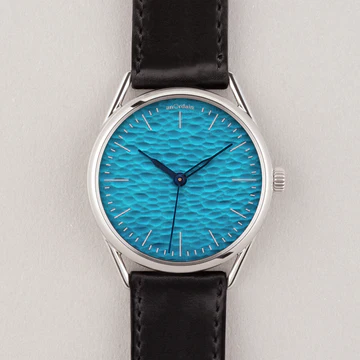
- Colorways: Aqua, Lichen
- Effect: Deep textured finish resembling artistic wood carving
Movement:
- Caliber: Sellita SW300 automatic
- Frequency: 28,800 vph (4Hz)
- Power reserve: 42 hours
- Functions: Hours, minutes, seconds
- Note: Workhorse movement, not haute horology—why solid caseback
Optional extra: Hand-carved mini watch trunk by Method Studio: +£250
Production: Waitlist-only. Only available to customers already holding anOrdain waitlist slots. Current waitlist: Extending to 2027-2028.
Hodinkee Limited Edition: Scarce collaboration produced. Sold out immediately.
Why Model 3 matters: Demonstrates anOrdain's willingness to experiment beyond standard enamel—pushing craft boundaries, collaborating Scottish artisans, creating genuinely novel dial textures.
Build Quality & Finishing #
Case Construction #
Material: 316L stainless steel throughout collection. Why not 904L (Rolex) or titanium? Cost containment enabling enamel dial investment.
Finishing:
- Brushing: Satin directional brushing (clean, professional)
- Polishing: High-polish accents (lugs, crown)
- Mixed finishes: Brushed case sides, polished bevels
- Quality level: Solid microbrand execution—not Grand Seiko Zaratsu but respectable
Design details:
- Model 1 blade-shaped lugs with arrowhead cutouts (signature element)
- Model 2 integrated lugs, crown guards (tool watch aesthetics)
- Model 3 thin straight lugs angled downward (vintage elegance)
Custom furniture: anOrdain workshop features custom-built furniture—workbenches, enameling stations designed specifically for watchmaking/enamel work.
Crystal Quality #
Specification: Domed sapphire crystal standard across collection.
Anti-reflective coating:
- 2023+ models: 3-layer AR coating both sides
- Select models: 6-layer AR coating (Model 2 Porcelain, others)
Why important: Enamel dials intrinsically more reflective than lacquer (highly polished glassy surface). AR coating critical for legibility.
Lewis Heath acknowledgment: "Due to their highly polished finish, enamel dials are intrinsically more reflective than conventional lacquered ones, so there will always be greater amount of reflection visible on our enamel models."
Multi-layer AR coating mitigates but doesn't eliminate enamel reflectivity.
Movement Choices & Regulation #
Available movements:
ETA 2824-2:
- Swiss automatic workhorse
- 25 jewels, 28,800 vph, 38-hour PR
- Reliable, serviceable worldwide
- Used early Model 1 production
Sellita SW210-1:
- Swiss hand-winding
- 19 jewels, 28,800 vph, 42-hour PR
- ETA Peseux 7001 clone
- Popular Model 1 and Model 2 option
Sellita SW300:
- Swiss automatic
- ETA 2892-A2 clone
- 42-hour PR
- Model 3 Method standard
La Joux-Perret G101:
- Swiss automatic
- 24 jewels, 28,800 vph, 68-hour PR
- Premium movement (Model 2 Porcelain)
- Longer power reserve vs. Sellita
Individual regulation: Chris (staff watchmaker): British Horological Institute-trained. Individually assembles and regulates each anOrdain watch. No mass production—every watch hand-built, tested, regulated to spec.
Customization: Customers can request specific regulation preferences (accuracy priorities, wrist storage position consideration).
Why Sellita/ETA vs. in-house? anOrdain focuses resources on dial mastery (core competency). Swiss movements offer proven reliability, global serviceability, cost-effectiveness vs. in-house development, allowing enamel dial investment.
Criticism: Some collectors desire exhibition casebacks showing movements. anOrdain prioritizes solid casebacks (most models) focusing attention on dial artistry. Model 2 Porcelain breaks this with exhibition caseback—La Joux-Perret G101 attractive enough displaying.
Strap Quality #
American Horween leather: Chicago-based tannery legendary for quality. Premium shell cordovan, chromexcel leathers.
Options:
- Shell cordovan
- Suede
- Russian hatch bovine leather (textured finish)
- Pin-grain kidskin leather
- Natural goatskin
- Stainless Staib Milanese mesh
Details:
- Custom engraved buckles (anOrdain logo)
- Multiple length options (specify wrist size)
- Quick-release where applicable
- Supple, high-quality construction
Included extras: Many orders include multiple strap options—customers receive 2-3 straps with purchase enabling easy style changes.
Pricing & Value Assessment #
Current Pricing (2026) #
| Model | Price | Notes |
|---|---|---|
| Model 1 (enamel) | £1,700-2,200+ (~$2,200-2,800+) | Opaque enamel: Lower range. Fumé gradient: Upper range. Wait: 2027-2028 |
| Model 1 Fabrik | Price TBD | Immediate purchase, non-enamel |
| Model 2 36mm (enamel) | £1,700 (~$2,200) | Wait: 2027-2028 |
| Model 2 39.5mm (enamel) | £1,800 (~$2,300) | Wait: 2027-2028 |
| Model 2 Porcelain | £1,800 + VAT (~$2,300) | Wait: 6 months |
| Model 3 Method | Price TBD | Wait: 2027-2028, Waitlist-only |
Reservation fee: £350 + VAT (UK customers) = £420 total. Non-refundable. Deducted from final watch cost. Secures build slot (not specific watch—choose model when slot arrives).
Price increase protection:
- Prices may rise before paying remaining balance (inflation)
- Capped at 5% maximum per year
- Reviewed September annually
- Prices set 2022, not increased 2023
- Average increase <1.5% per year since 2022
Value Comparison #
anOrdain ($2,200-3,000) vs. Swiss enamel ($25,000-80,000+):
Swiss enamel dial watches:
- Patek Philippe Calatrava enamel: $30,000-60,000+
- Vacheron Constantin enamel: $40,000-80,000+
- A. Lange & Söhne enamel: $50,000-100,000+
- Jaeger-LeCoultre Master Ultra Thin Enamel: $25,000-40,000+
What you sacrifice at anOrdain pricing:
- In-house manufacture movements (vs. Sellita/ETA)
- Swiss Made prestige
- Exhibition casebacks (most models—Porcelain exception)
- Precious metal cases (steel only)
- Established vintage market/resale value
What you gain at anOrdain pricing:
- Identical dial technique (grand feu vitreous enamel)
- Better dial innovation (fumé gradients Swiss didn't invent)
- In-house production (not outsourced to Donzé Cadrans or Comblémine—anOrdain owns entire process)
- Custom typography (Ordnance Survey-inspired vs. generic)
- Scottish artisan story (supporting craft revival vs. corporate manufacture)
- Accessible pricing ($2,000-3,000 vs. $30,000-80,000)
Honest assessment: For dial quality specifically, anOrdain delivers 95% of haute horology enamel at 5-10% of price. Movements, finishing, brand prestige reflect $2,000-3,000 tier—but dial artistry genuinely rivals Swiss $30,000+ watches.
anOrdain ($2,200-3,000) vs. Seiko Presage Enamel ($1,000-2,500):
Seiko advantages:
- Immediate availability (no waitlists)
- Japanese in-house movements (6R series)
- Established brand reputation
- Proven resale market
- Global service network
anOrdain advantages:
- In-house enamel (Seiko outsources to specialists)
- More experimental dials (fumé gradients, textured, custom)
- Lower production (artisanal vs. mass-produced)
- Custom typography (vs. Seiko generic)
- Individual regulation (Chris hand-tunes vs. factory spec)
- Scottish craft story
Which wins: Depends on priorities. Want reliable Japanese movement + immediate purchase? Seiko. Want cutting-edge enamel experimentation + artisan connection? anOrdain.
The Waiting List System: What You Need to Know #
How It Works #
- Create anOrdain account: Register at anordain.com (free).
- Pay reservation fee: £350 + VAT (UK) = £420 total. Non-refundable. Counts toward final watch cost.
- Receive build slot assignment: anOrdain assigns quarterly build slot (Q1 2027, Q2 2027, Q3 2027, etc.). Chronological order—first registered, first served.
- Wait: Currently 2-4 years depending on demand.
- Build slot notification: ~3 months before your slot, anOrdain contacts via email confirming readiness.
- Choose your watch: Specify model (1, 2, 3), size (where applicable), dial color, movement choice (where applicable), strap preferences, regulation preferences, engraving (optional).
- Pay remaining balance: Full price minus £350 reservation fee already paid. Must pay within specified timeframe or forfeit slot + lose reservation fee.
- Watch completion & delivery: Watch built, regulated, shipped within your build slot quarter (or earlier).
Current Wait Times (2026) #
Enamel watches (Model 1, Model 2, Model 3):
- Q1 2027 through Q4 2028 build slots available
- 2-3 year wait minimum from reservation
- Quarterly batches: ~150 watches per quarter
- Annual production: ~600 enamel watches total (Models 1, 2, 3 combined)
Model 2 Porcelain:
- 6 months wait (stated on product page)
- ~30 dials/month production capacity
- One watch per customer limit
Model 1 Fabrik:
- Immediate purchase with lead times stated (weeks/months typically)
Price Increase Risk #
The concern: Paying £350-420 reservation fee today, but prices may rise before paying remaining balance 2-4 years later.
anOrdain's protection: 5% annual cap. Prices review September yearly. Maximum 5% increase per year.
Historical context: Prices set 2022. Not increased 2023. Average increase <1.5% annually since 2022.
Example scenario:
- 2024: Pay £420 reservation for Model 2 39.5mm (£1,800 base price)
- 2027: Build slot arrives
- Worst case: £1,800 × 1.05³ = £2,084 (if increased 5% each year)
- Actual likely: £1,800 × 1.015³ = £1,882 (if <1.5% pattern continues)
- You pay: £2,084 - £420 = £1,664 remaining (worst case) OR £1,882 - £420 = £1,462 (likely case)
Total commitment: £420 non-refundable today + ~£1,500-1,700 later = £1,920-2,120 total (~$2,500-2,700).
Risks & Considerations #
Non-refundable deposit: £350-420 lost if:
- You change mind before build slot
- Don't pay remaining balance when slot arrives
- anOrdain goes out of business (unlikely but possible)
Long wait: 2-4 years is substantial commitment. Tastes change. Life circumstances change. Other watches tempt.
Price uncertainty: Even with 5% cap, final price unknown when reserving slot.
No guarantee specific dial: Popular colorways may sell out within your build slot quarter. Choose from available options when slot arrives.
Inflation risk: £1,800 today = £1,800 in 2027 purchasing power. Though anOrdain prices increase to match, your money's value erodes waiting.
Business risk: Small independent brand. No guarantee anOrdain survives 2-4 years (though healthy, growing, GPHG-nominated—low risk).
Who Should Join Waitlist? #
Ideal candidates:
- Enamel enthusiasts valuing dial artistry above all
- Patient collectors viewing watches as long-term acquisitions
- British/Scottish craft supporters wanting support independent artisans
- Those seeking uniqueness vs. mainstream Swiss/Japanese brands
- People who can afford losing £420 if circumstances change
Who should skip:
- Impatient buyers wanting immediate gratification
- Flip/investment focused (uncertain resale market, no vintage track record)
- Movement snobs demanding in-house calibers
- Those needing funds liquid (£420 locked up 2-4 years non-refundable)
- Swiss Made purists insisting on Swiss manufacturing
Criticisms & Concerns #
The Wait Is Too Long #
Common complaint: "4 years for a $2,500 watch is ridiculous."
anOrdain's position: Enamel production limited by physics, not choice. Team of 7 enamellers producing ~50 dials/month = ~600/year max. Demand exceeds supply 10X+. Options:
- Maintain quality, long waits
- Rush production, sacrifice quality, higher rejection rates, business fails
Alternative: Model 2 Porcelain (6 months) or Model 1 Fabrik (immediate) for those unwilling waiting.
Pricing Increased Too Much #
Criticism: Original Model 1 (2018): £950 (~$1,200). Current (2026): £1,700-2,200 (~$2,200-2,800). 80% increase in 8 years.
Context:
- Inflation 2018-2026: ~35-40% (official rates)
- Enamel dial costs increased (materials, labor)
- Demand allowing market pricing
- Still fraction of Swiss enamel ($30,000+)
Counterpoint: If anOrdain charged $30,000 (matching Swiss enamel quality), nobody would complain about value. At $2,500, it's still bargain—just not $1,200 bargain it was 2018.
Movements Too Basic #
Criticism: "Sellita/ETA movements in $2,500 watch? Should be in-house."
anOrdain's logic:
- Core competency: Enamel dials (world-class execution)
- Movement development: Would cost millions, years, reduce enamel investment
- Serviceability: Sellita/ETA serviceable worldwide; in-house movement requires anOrdain service (risky for small brand)
- Cost: In-house would push pricing $5,000-8,000 (losing accessible positioning)
- Comparison: Christopher Ward, Farer, many microbrands use Sellita/ETA at similar pricing. Not unusual.
- Improvement: Model 2 Porcelain uses La Joux-Perret G101 (68-hour PR, 24 jewels)—step up from Sellita SW210. Exhibition caseback.
No Exhibition Casebacks #
Criticism: "Solid casebacks hide movements. Want to see mechanics."
anOrdain's reasoning:
- Sellita/ETA movements not visually stunning (functional workhorses)
- Resources invested in dial (front) vs. movement decoration (back)
- Solid caseback allows custom engraving (personalization option)
Exception: Model 2 Porcelain features exhibition caseback (La Joux-Perret G101 attractive enough displaying).
Possible future: If anOrdain adds higher-end movements or decorates Sellitas, exhibition casebacks may expand.
Resale Value Unknown #
Concern: "No vintage anOrdain market exists. Will I lose money?"
Reality:
- Brand only 11 years old (founded 2015)
- Insufficient time establishing secondary market
- Limited production (600/year) = scarcity
- GPHG nominations = legitimacy
- But no track record proving resale holds
Speculation: Well-cared-for early Model 1s (2018-2019) may appreciate as brand gains recognition. Or depreciate if demand fades. Unknown.
Advice: Buy anOrdain for personal enjoyment, not investment. Treat £2,000-3,000 as sunk cost. If appreciates, bonus.
The Verdict: Britain's Enamel Renaissance #
anOrdain proves affordable grand feu enamel watches commercially viable—bringing centuries-old haute horology craft to $2,000-3,000 pricing through obsessive technique mastery, willingness to operate multi-year waiting lists, and focusing resources entirely on dial perfection rather than in-house movement development.
The achievement:
- World's first fumé enamel dials (2019): Invented gradient technique Swiss hadn't discovered.
- GPHG nominations 2019/2020: Scottish microbrand recognized alongside Patek Philippe, Vacheron Constantin, A. Lange & Söhne—validation dial quality rivals haute horology.
- 30% rejection rate: Improved from 80-90% industry standard through R&D, material experimentation, 4,000-hour enameller training.
- Team of 7 enamellers: Producing ~50 enamel dials/month (~600/year) + ~30 porcelain/month—Scottish craft employment.
- In-house production: Unlike Swiss brands outsourcing enamel to Donzé Cadrans/Comblémine, anOrdain owns entire dial process start to finish.
Quality reality:
- Dial execution: Genuinely world-class. Rivals $30,000+ Swiss enamel. Fumé gradients, custom typography, hand-painted lume, 12-hour creation process = artisan mastery.
- Case finishing: Solid microbrand level. Brushed/polished surfaces, blade-shaped lugs, integrated designs. Not Grand Seiko Zaratsu but respectable $2,000-3,000 execution.
- Movement choice: Sellita/ETA workhorses (reliable, serviceable, cost-effective) vs. in-house manufacture. Pragmatic decision focusing resources on dial excellence.
Value proposition: For $2,200-3,000, you get $30,000+ Swiss dial quality in $2,000 microbrand package. If dial artistry matters most, anOrdain delivers. If movement prestige/in-house calibers matter, look elsewhere.
The waiting list dilemma: 2-4 years is substantial commitment. £350-420 non-refundable deposit. Prices may increase 5% annually (capped). No guarantee specific dial availability within build slot.
Who should wait:
- Enamel dial enthusiasts prioritizing artistry
- Patient collectors viewing watches as long-term acquisitions
Who should skip:
- Impatient buyers wanting immediate purchase
- Movement snobs demanding in-house calibers
- Investment-focused collectors (uncertain resale)
- Those unable risking £420 non-refundable deposit
Alternatives:
Want enamel without wait?
- Seiko Presage Enamel: $1,000-2,500, immediate availability, Japanese quality
- Citizen NB1060: ~$600, lacquer dial (not enamel) but beautiful
- Save for Swiss: Jaeger-LeCoultre Master Ultra Thin Enamel $25,000+
Want anOrdain aesthetic without wait?
- Model 2 Porcelain: 6 months, £1,800, similar visual appearance
- Model 1 Fabrik: Immediate, non-enamel dial
The broader significance:
anOrdain demonstrates:
- Small independent brands can master haute horology techniques typically exclusive to Swiss giants
- Scotland can build watchmaking industry from nothing through artisan training
- Crowdsourced waitlists work when brand delivers genuine quality (vs. Kickstarter vaporware)
- Modern consumers value craft/artistry over brand prestige (willing waiting years for $2,500 watch)
- Enamel dial production commercially viable at accessible pricing with process refinement
Comparison to Swiss brands: Patek Philippe, Vacheron Constantin, A. Lange & Söhne offer superior movements, finishing, prestige—but identical enamel dial quality at 10-30X anOrdain pricing. anOrdain proves you can deliver haute horology dials without corporate infrastructure, centuries history, or $80,000 price tags.
Final recommendation:
Buy anOrdain if:
- Dial artistry your #1 priority
- You appreciate British/Scottish craft revival
- Patient personality accepting multi-year waits
- Want genuinely unique watch vs. mainstream options
- Can afford treating £2,000-3,000 as sunk cost (not investment)
Skip anOrdain if:
- Want immediate gratification (buy Seiko Presage, Citizen, Christopher Ward instead)
- Demand in-house movements (save for Grand Seiko, A. Lange & Söhne)
- Prioritize resale value (stick Rolex, Omega, Tudor)
- Impatient personality unable waiting 2-4 years
- Prefer Swiss Made prestige over independent artisans
anOrdain Watches: Where Glasgow artisans prove affordable grand feu enamel commercially viable, fumé gradients invented, and 4-year waiting lists accepted when brand delivers genuine craft mastery.
❓ Frequently Asked Questions
Q:What Is Vitreous Enamel?
Definition: Fusing glass to metal through extreme heat. Powdered glass (silica, red lead, soda ash) applied to metal substrate, fired in kiln 830°C+ (~1,525°F), melts into glassy surface.
Find Your Perfect Watch
Browse our curated collection of indie and microbrand timepieces.
📚 Related Reading
Handpicked articles from the same topic