Dennison Watches Review: Historic Name Revival with Rolex Designer DNA—But Mixed Execution
When a legendary British casemaker returns with a Rolex/Audemars Piguet designer—beautiful natural stone dials can't hide every compromise. Emmanuel Gueit's design meets microbrand reality at $490-690.
Steven Thompson
Independent Watchmaker · 10 Years Experience
Reviewed by Indie Watches
Editorially reviewed for accuracy
⚡ Key Takeaways
- ✓Founded: 1850s (United States), 1872 (Britain—Dennison Watch Case Company)
- ✓Founder: Aaron Lufkin Dennison—regarded as "Father of American Watchmaking"
- ✓When a legendary British casemaker returns with a Rolex/Audemars Piguet designer—beautiful dials can't hide every compromise.
- ✓Ask most watch enthusiasts "Who made Rolex's cases in the 1950s?" and you'll get blank stares.
- ✓The answer: Dennison.
📑 Table of Contents
Dennison Watches Review: Historic Name Revival with Rolex Designer DNA—But Mixed Execution #
When a legendary British casemaker returns with a Rolex/Audemars Piguet designer—beautiful dials can't hide every compromise.
📚 Explore our full watches guide →
Ask most watch enthusiasts "Who made Rolex's cases in the 1950s?" and you'll get blank stares.
The answer: Dennison.
Rolex, Omega, IWC, Jaeger-LeCoultre, Zenith—for the better part of the 20th century, these brands didn't make their own cases. They bought them from Aaron Lufkin Dennison's watch case company. The British firm that dominated luxury case manufacturing for 50+ years. The cases that went to Mt. Everest's summit with Hillary and Norgay (13 Dennison "Aquatite" cases). The cases on RAF pilots' wrists breaking air speed records.
Then Dennison disappeared. Defunct by the 1960s. Forgotten by the 1980s.
Until 2024, when new ownership revived the name, hired Emmanuel Gueit (the designer behind iconic Audemars Piguet Royal Oak Offshore, Rolex Yacht-Master II, Piaget Polo—son of legendary designer Jean-Claude Gueit), and launched the ALD Collection: mid-century modern watches with natural stone dials priced $490-690.
The result: Some of the most beautiful dial designs under $1,000—attached to watches that feel... inconsistent.
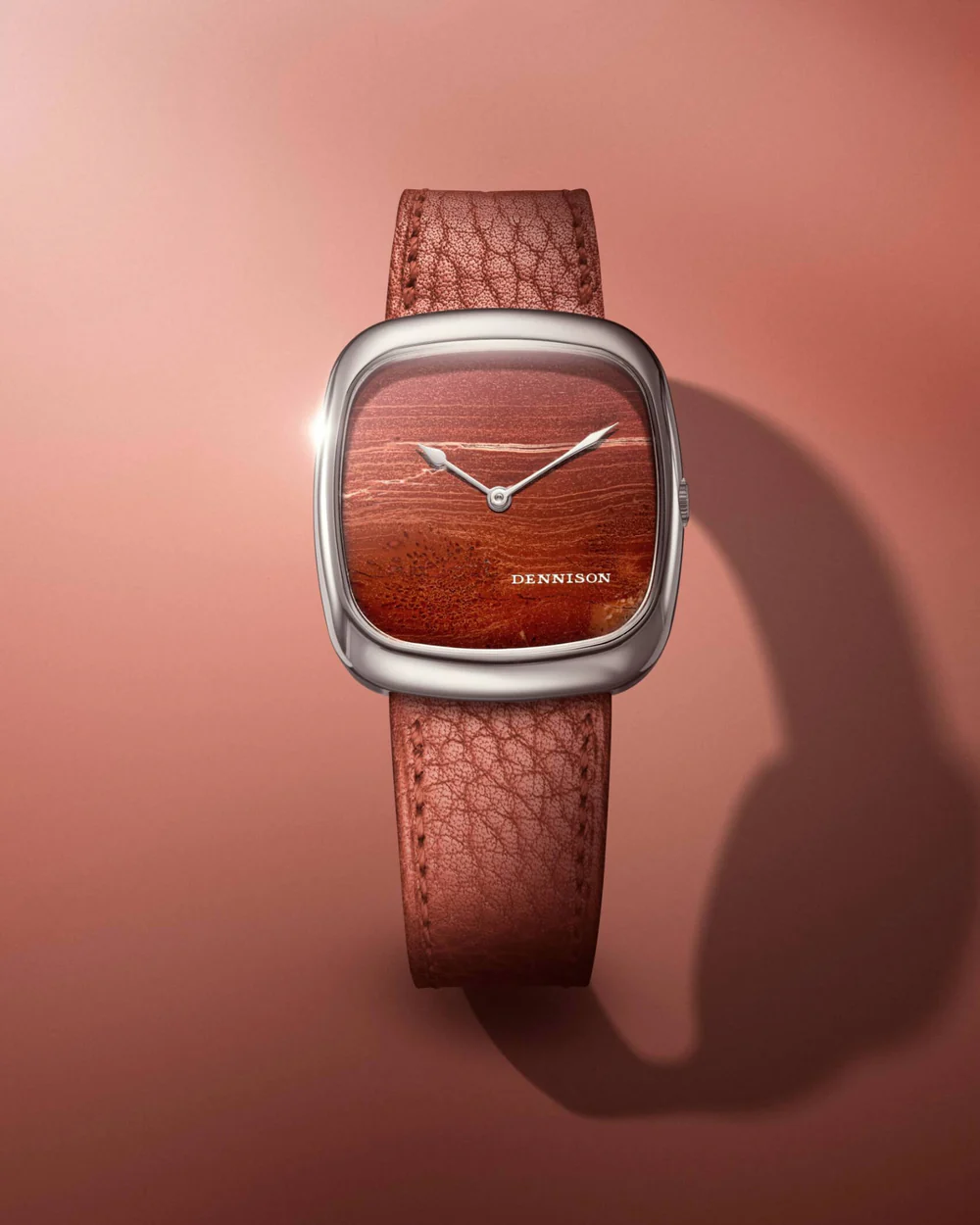
Hold a Dennison with Tiger Eye stone dial. The dial is gorgeous—chatoyant natural stone, hand-applied, stunning depth and shimmer. Then notice the case feels lightweight. The clasp feels hollow. The dial, while beautiful, is tiny—27mm diameter on a 38mm case. The entire package screams "designed by someone with Rolex pedigree" while feeling like it was built to a strict budget.
This is Dennison's paradox: elite design DNA meeting microbrand execution.
Emmanuel Gueit brought decades designing $20,000-80,000 luxury watches to a $690 project. His eye for proportion, case shape, mid-century aesthetic—impeccable. But when rubber meets road, when you actually wear these watches daily, the compromises emerge. Beautiful design can't hide feeling cheap when you compare weight, clasp quality, bracelet finishing to competitors at similar pricing.
This review explores whether historic brand revival + luxury designer credentials justify $490-690 pricing, what "designed by Rolex's designer" actually delivers in practice, why small dials matter (or don't), and whether beautiful stone dials excuse build quality compromises.
Spoiler: If you prioritize dial beauty above all—Dennison's stone dials genuinely exceptional under $1,000. If you want complete package (design + build quality + finishing)—better options exist at this price point.
THE BRAND: HISTORIC GIANT REVIVED BY NEW OWNERSHIP #
The Original Dennison (1850s-1960s): Father of American Watchmaking Becomes British Case King #
- Founded: 1850s (United States), 1872 (Britain—Dennison Watch Case Company)
- Founder: Aaron Lufkin Dennison—regarded as "Father of American Watchmaking"
American legacy:
- Co-founded American Waltham Watch Company (first American factory watch production)
- Pioneered interchangeable parts watchmaking (revolutionary 1850s innovation)
- Created standardized American watch manufacturing
British transformation:
- Dennison moved to Britain, established Dennison Watch Case Company
- Registered Patent No. 356 (1872) for air/watertight watch case backs
- Became one of world's largest watch case manufacturers
Golden era (1900s-1960s):
- Supplied cases to Rolex, Omega, IWC, Jaeger-LeCoultre, Zenith, and others
- Developed "Aquatite" waterproof cases (used on Mt. Everest expedition—13 Smiths watches with Dennison cases reached summit with Hillary/Norgay 1953)
- Manufactured British Military watches/instruments for 50+ years
- Created portfolios of patents—water resistance, case designs, metal alloys
Reputation: Casemakers of Dennison's era didn't just "build to spec"—they led design. Unique case shapes, superior engineering, craft precision. When watches made history, Dennison made the cases.
Decline: Defunct by 1960s—quartz crisis, changing manufacturing economics, consolidation killed independent casemakers.
The Revival (2024): New Ownership + Luxury Designer = Modern Dennison #
- Revived: 2024
- New ownership: Leadership team of "passionate watch lovers" (exact ownership structure unpublished—appears private equity/investment group)
Research process: Team traveled globally studying Dennison archives:
- New York Horological Society archives
- Living room of A.L. Dennison biographer's widow
- Historical artifacts, documents, images from original company
Goal: Honor Dennison's past while creating modern collection
Design hire: Emmanuel Gueit
Emmanuel Gueit: The Designer Bringing Luxury DNA #
Who he is:
- Son of Jean-Claude Gueit (revered watch designer—Gerald Genta contemporary)
- Born and raised in Geneva, Switzerland
- Decades of luxury watch design experience
His portfolio:
- Audemars Piguet: Royal Oak Offshore (iconic 1993 launch—revolutionized sports luxury watches)
- Rolex: Yacht-Master II (regatta chronograph—complex, distinctive)
- Piaget: Polo collection designs
- Others: Created timepieces for multiple luxury Swiss brands
His philosophy: "The shape. The difference between Dennison and other brands is the shape. Bringing the old shape back alive, back upfront again. Something different."
Dennison assignment: Create collection picking up where Dennison left off in 1960s—mid-century modern aesthetic, distinctive case shapes, honoring heritage
THE WATCHES: ALD COLLECTION (Aaron Lufkin Dennison) #
Design Language: Mid-Century Modern Meets 1960s Dennison #
Model Breakdown #
Base pricing:
- Sunray dials (Black, Blue): $490
- Stone dials (Tiger Eye, Malachite, Lapis Lazuli, Aventurine): $690
- Black Marble (Gold-plated variant): $690
- Safari Capsule (Mother-of-pearl with enamel striping): $4,900 (ultra-premium limited edition)
Case materials:
- Stainless steel (standard—brushed/polished mixed finishing)
- Gold-plated brass (some variants—PVD gold coating)
Movement: Miyota 9075 automatic GMT movement (Japanese, reliable workhorse caliber)
Water resistance: 50m (5 ATM—splash/rain resistant, not swimming/diving)
Bracelet: Integrated H-link bracelet (flows from case, no gap) OR leather strap variants
The Dial: Where Dennison Shines #
Natural stone dials (Tiger Eye, Malachite, Lapis Lazuli, Midnight Aventurine):
- Real natural stone: Each dial unique (natural stone variations—no two identical)
- Hand-applied: Stone cut, shaped, fitted to dial individually
- Chatoyancy: Tiger Eye especially shows optical phenomenon (shimmering bands shifting under light—stunning effect)
- Depth: Three-dimensional appearance (stone texture, layers, natural patterns create visual richness impossible with painted dials)
- Rare under $1,000: Natural stone dials typically $2,000-5,000+ watches (Piaget, Rolex, high-end brands)—Dennison offering at $690 exceptional
Sunray dials (Black, Blue—$490):
- Radial brushing: Clean sunburst effect
- Applied indices: Raised markers (not printed—dimensional)
- Simple elegance: Less dramatic than stone but refined, wearable
Dial size controversy: 27mm dial opening on 38mm case = large bezel, small central dial
- Defenders: Mid-century proportion accuracy (1950s-1960s dress watches had thick bezels, small dials—Dennison historically accurate)
- Critics: Feels unbalanced—too much bezel, not enough dial (modern eyes expect larger dial-to-case ratio)
Honest assessment: Stone dials are beautiful—genuinely exceptional for price. But small dial size makes watches feel daintier, less substantial than 38mm suggests. If you love vintage proportions (thick bezels, small dials), you'll appreciate accuracy. If you want modern dial presence, you'll find underwhelming.
THE BUILD QUALITY: WHERE COMPROMISES EMERGE #
What Feels Good #
- ✅ Case shape: Emmanuel Gueit's tonneau design elegant, distinctive—this isn't generic microbrand round case #47
- ✅ Dial beauty: Stone dials genuinely stunning—Tiger Eye chatoyancy, Malachite green patterns, Lapis Lazuli deep blue all exceptional
- ✅ Thinness: 10-11mm profile proper dress watch slimness—slides under cuffs easily
- ✅ Movement reliability: Miyota 9075 proven GMT caliber—not fancy but functional, serviceable
What Feels Cheap (User Feedback Confirmed) #
- ❌ Case weight: Feels lightweight—not substantial. Hold Dennison next to similarly-priced Christopher Ward, Hamilton—Dennison feels hollow-er, less dense. Likely thinner case walls to hit price point.
- ❌ Clasp quality: Integrated bracelet clasp feels flimsy—hollow stamped construction vs. solid milled. Closing clasp produces tinny click rather than solid "thunk." Not confidence-inspiring for $690 watch.
- ❌ Bracelet finishing: H-link bracelet looks good (polished centers, brushed edges) but feels lightweight. Links rattle slightly (not solid throughout). Finishing adequate but not exceptional—expect better $690-900 range.
- ❌ Crystal: Mineral crystal (some models) vs. sapphire—cost-cutting measure. Sapphire standard at $500+ typically. Mineral scratches easier, less premium feel.
- ❌ Pushers (dual-time models): Pusher for jumping local hour feels mushy—not crisp tactile feedback. Works functionally but lacks refinement.
- ❌ Crown: Unsigned crown (no Dennison logo engraving)—small detail but signals budget constraints vs. luxury finishing.
Finishing Quality Assessment #
Case finishing:
- Polished surfaces: 6.5/10 (decent mirrors but not razor-sharp—acceptable microbrand quality)
- Brushed surfaces: 7/10 (clean parallel grain, consistent)
- Transitions: 6/10 (polished/brushed separation adequate but not knife-edge precision)
Bracelet:
- Link finishing: 6.5/10 (looks good from distance, reveals hollowness up close)
- Clasp: 5/10 (functional but flimsy-feeling—major weak point)
- Solidity: 6/10 (slight rattle, not fully solid feel)
Dial:
- Stone dials: 9/10 (genuinely beautiful—hand-applied natural stone exceptional for price)
- Printing: 7/10 (clean text, adequate but not exceptional)
- Applied indices: 7/10 (dimensional, decent polishing)
Overall finishing: 6.5-7/10 (design excellent, execution adequate—Emmanuel Gueit's vision compromised by budget manufacturing)
THE CONTROVERSY: BEAUTIFUL DESIGN VS. BUDGET EXECUTION #
The Paradox Explained #
Emmanuel Gueit designed watches costing $20,000-80,000 at Audemars Piguet, Rolex, Piaget. Those watches used:
- Solid gold/platinum cases (or highest-grade steel)
- In-house movements (or premium ETA/Sellita elaboré grades)
- Hand-finishing throughout (beveling, polishing, decoration)
- Sapphire crystals with multi-layer AR coating
- Solid bracelets with milled clasps
- $5,000-15,000 material + labor costs before markup
Dennison asks him to create $490-690 watches. Those watches must use:
- Budget stainless steel (thinner walls to reduce cost/weight)
- Miyota 9075 movement (~$80-120 wholesale—reliable but industrial)
- Machine finishing (hand-finishing too expensive at volume)
- Mineral crystal (some models—sapphire adds $30-50 cost)
- Stamped/hollow bracelet components (solid milled clasps $100+ alone)
- $200-350 total material + labor budget to hit retail pricing
Result: Gueit's eye for proportion, shape, dial design shines through. But execution quality constrained by economics. It's like hiring Ferrari designer to create $25,000 sports car—design language translates, build quality cannot.
Who This Affects #
Design-first buyers: If you prioritize how watch looks (case shape, dial beauty, aesthetic) over how it feels (weight, clasp solidity, finishing precision)—Dennison delivers. Emmanuel Gueit's design genuinely excellent. Stone dials genuinely beautiful.
Build-quality-first buyers: If you prioritize how watch feels (heft, solidity, finishing sharpness)—Dennison disappoints. Lightweight case, flimsy clasp, hollow bracelet all signal budget constraints.
Complete-package buyers: If you want design + build quality both excellent—look elsewhere at this price (Christopher Ward C63, Hamilton Jazzmaster, Seiko Presage).
SMALL DIAL DEBATE: VINTAGE ACCURACY VS. MODERN EXPECTATIONS #
The 27mm Dial on 38mm Case #
Measurements:
- Case diameter: 38mm (lug-to-lug ~45mm—wearable)
- Dial diameter: 27mm (actual timekeeping surface)
- Bezel width: 5.5mm each side (11mm total bezel thickness)
Visual impact: Large chunky bezel, small central dial—polarizing aesthetic
Why Dennison Chose Small Dial #
Historical accuracy: 1950s-1960s dress watches (Dennison's original era) featured:
- Thick bezels (5-7mm typical)
- Small dials (25-30mm common on 34-38mm cases)
- Emphasis on case design vs. dial dominance
Emmanuel Gueit's vision: "Bringing the old shape back alive"—small dial = period-correct mid-century proportion
Intentional choice: This isn't cost-cutting (larger dial wouldn't cost more)—deliberate aesthetic decision honoring Dennison heritage
Arguments For Small Dial #
- ✅ Vintage authenticity: Genuinely accurate 1960s proportions—collectors appreciating period-correct design love this
- ✅ Case emphasis: Thick bezel highlights Gueit's tonneau case shaping—design becomes about case not just dial
- ✅ Feminine/unisex appeal: Smaller dial makes 38mm case work for smaller wrists, women buyers (modern 38mm typically too large for many women—small dial reduces visual weight)
- ✅ Distinctive: Every microbrand makes 40mm watches with 36mm dials—Dennison different
Arguments Against Small Dial #
- ❌ Feels unbalanced: Modern eyes conditioned expect larger dial-to-case ratios—Dennison feels "off" to many
- ❌ Legibility sacrifice: Smaller dial = smaller hands, smaller markers—harder to read quickly
- ❌ Wasted case space: 38mm case could house 32-34mm dial comfortably—11mm bezel thickness feels excessive to modern tastes
- ❌ Niche appeal: Limits buyer pool to vintage proportion enthusiasts—mainstream buyers expect larger dials
The Verdict on Dial Size #
If you love vintage watches: Small dial proportion feels correct, authentic, charming—you'll appreciate Dennison's accuracy
If you expect modern proportions: Small dial feels weird, unbalanced, disappointing—you'll find frustrating
No middle ground exists—this is love-it-or-hate-it design choice
VALUE PROPOSITION: DESIGNER PEDIGREE VS. BUILD REALITY #
What You're Paying For (Dennison $690 Stone Dial Example) #
Materials + manufacturing:
- Miyota 9075 movement: ~$100 wholesale
- Stainless steel case (lightweight construction): ~$80-120
- Natural stone dial (hand-applied): ~$100-150 (significant cost—stone sourcing, cutting, fitting labor-intensive)
- Integrated H-link bracelet: ~$80-120
- Assembly, QC, packaging: ~$50-80
Brand operations:
- Emmanuel Gueit design fees (amortized across production): ~$30-50 per watch
- Dennison brand licensing/revival costs: ~$20-40 per watch
- Marketing, distribution, warranty: ~$80-120
Total attributable cost: ~$540-780 (retail $690 = tight margin OR slight loss leader pricing)
What You're NOT Paying For #
- ❌ Swiss Made (Japanese Miyota movement, likely Chinese case manufacturing)
- ❌ In-house movement (Miyota reliable but mass-produced)
- ❌ Hand-finishing (machine polishing, industrial production)
- ❌ Solid bracelet construction (cost-optimized hollow components)
- ❌ Premium materials (budget steel, mineral crystal some models)
Comparison: Dennison vs. Competitors #
Dennison $690 Tiger Eye vs. Seiko Presage $400-600:
- Dennison wins: Natural stone dial, Emmanuel Gueit case design, historic brand heritage
- Seiko wins: Better movement finishing (Seiko decorates movements beautifully), better build quality (heavier, more solid feel), better value (lower price for comparable features)
Dennison $690 vs. Christopher Ward C63 Sealander GMT $1,595:
- Dennison wins: Much cheaper ($900 less), natural stone dials more unique than CW standard dials
- CW wins: True GMT (caller GMT vs. Dennison's jump hour local time), superior build quality (solid bracelet, better finishing), better case size (40mm feels more substantial), better movement (Sellita SW330-2 vs. Miyota 9075)
Dennison $690 vs. Hamilton Jazzmaster $800-1,200:
- Dennison wins: More distinctive case shape (Gueit's tonneau vs. Hamilton round), natural stone dials, lower entry price
- Hamilton wins: Swiss Made (vs. Japanese movement), better brand recognition (Swatch Group vs. unknown revival), better build solidity, global service network
WHO SHOULD BUY DENNISON? #
Perfect Buyer Profile #
- ✅ Dial beauty prioritizers: If you value stunning dials above all else—Dennison's natural stone dials genuinely exceptional $690
- ✅ Design enthusiasts: Appreciate Emmanuel Gueit pedigree, mid-century modern aesthetic, tonneau case shaping
- ✅ Vintage proportion lovers: Small dial on larger case feels authentic, period-correct, charming (not awkward)
- ✅ Historic brand fans: Dennison's case-making legacy for Rolex/Omega resonates, revival story appeals
- ✅ Conversation piece seekers: Natural stone dials, historic brand name, designer credentials create talking points
- ✅ Budget under $1,000: Want luxury design DNA without luxury pricing
Wrong Buyer Profile #
- ❌ Build quality prioritizers: If you value heft, solidity, premium feel—Dennison's lightweight case, flimsy clasp disappoint
- ❌ Modern proportion fans: If you expect 38mm case = large dial presence—27mm dial feels unbalanced, disappointing
- ❌ Investment focus: Unknown revival brand, limited secondary market = poor resale (buy Grand Seiko, Tudor for value retention)
- ❌ Want complete package: If you need design + build + movement all excellent—better options exist (Christopher Ward, Hamilton, Seiko Presage offer more complete execution)
- ❌ Serious GMT users: Dennison's jump-hour "dual time" less functional than true GMT (CW, Tudor, Grand Seiko better for actual travel)
- ❌ Expect Rolex designer = Rolex quality: Emmanuel Gueit's design pedigree cannot overcome $690 budget constraints—this is NOT $8,000 Rolex Yacht-Master II execution
BUYING DENNISON: PRACTICAL GUIDE #
Where to Buy #
- Official: dennisonwatch.com (direct from brand)
- Authorized retailers: Limited global distribution (Hodinkee featured, some boutique retailers)
- Secondary market: Too new for robust secondary (launched 2024)
- IndieWatches.store: Check availability: indiewatches.store/marketplace
Expected depreciation: 30-50% likely (new brand, unknown resale, microbrand typical depreciation)
FINAL VERDICT: DESIGNER VISION COMPROMISED BY MICROBRAND REALITY #
What Dennison Gets Right #
- ✅ Emmanuel Gueit's design genuinely excellent (tonneau case, proportions, mid-century aesthetic impeccable)
- ✅ Natural stone dials exceptional for price ($690 for hand-applied Tiger Eye/Malachite/Lapis rare value)
- ✅ Historic brand revival well-researched (not cynical cash-grab—genuine effort honoring Dennison legacy)
- ✅ Distinctive aesthetic (small dial vintage proportions, tonneau shaping different from generic microbrands)
- ✅ Miyota 9075 reliable (Japanese GMT movement proven, serviceable globally)
- ✅ Reasonable pricing ($490-690 fair for design pedigree + natural stone dials)
What Dennison Gets Wrong #
- ❌ Build quality underwhelming (lightweight case, flimsy clasp, hollow bracelet feel cheap—user feedback accurate)
- ❌ Small dial polarizing (27mm dial on 38mm case vintage-accurate but modern buyers often disappointed)
- ❌ Finishing inconsistent (design excellent, execution adequate—gap between vision and reality)
- ❌ Clasp major weakness (hollow stamped construction feels budget—should be solid at $690)
- ❌ Brand unknown (Dennison historic name means nothing to most buyers—no recognition/prestige)
- ❌ Limited functionality (jump-hour "dual time" less useful than true GMT—niche complication)
The Recommendation #
Buy Dennison if:
- Natural stone dials captivate you (Tiger Eye chatoyancy, Malachite patterns genuinely beautiful)
- You appreciate Emmanuel Gueit design pedigree (Rolex/AP designer credentials matter)
- You love vintage proportions (small dial on larger case feels authentic, not awkward)
- You prioritize aesthetic over build quality (how it looks > how it feels)
- Budget under $1,000 for distinctive dress watch
Skip Dennison if:
- You prioritize build quality (lightweight feel, flimsy clasp frustrate)
- You want modern dial proportions (27mm dial on 38mm case feels unbalanced)
- You need complete package (design + build + movement all excellent—CW/Hamilton/Seiko better execution)
- You want recognized brand (Dennison unknown to 99% of people)
- You're serious GMT user (true GMT better than jump-hour local time)
The Bottom Line #
Dennison represents luxury watch design meeting microbrand budgets—beautiful concept partially realized.
Emmanuel Gueit's vision for mid-century tonneau watches with natural stone dials is excellent. His case shaping, proportions, aesthetic choices all showcase decades designing for Rolex, Audemars Piguet, Piaget. The stone dials genuinely stunning—hand-applied Tiger Eye, Malachite, Lapis Lazuli exceptional at $690.
But vision alone doesn't make great watches. Execution matters.
The lightweight case, flimsy clasp, hollow bracelet all betray budget constraints. When you pick up Dennison expecting "designed by Rolex's designer" quality, the reality disappoints. It's designed with luxury pedigree but built like a microbrand.
If you buy Dennison, buy for the dial. Buy because chatoyant Tiger Eye stone mesmerizes you. Buy because Emmanuel Gueit's tonneau shaping feels special. Buy because historic Dennison name (even if nobody recognizes it) appeals.
Don't buy expecting Rolex Yacht-Master II execution at 1/10 the price. Emmanuel Gueit's genius cannot overcome $690 manufacturing budgets. Beautiful design—compromised delivery.
Find Your Perfect Watch
Browse our curated collection of indie and microbrand timepieces.
📚 Related Reading
Handpicked articles from the same topic