In-House vs. Third-Party Movements: What You're Really Paying For
The watch industry's greatest marketing triumph: convincing collectors that "manufacture" movements justify premium pricing. This guide cuts through the BS with real cost analysis, service comparisons, and performance data.
Steven Thompson
Independent Watchmaker · 10 Years Experience
Reviewed by Indie Watches
Editorially reviewed for accuracy
⚡ Key Takeaways
- ✓Tudor MT5612 = Made by Kenissi (also supplies Breitling, Chanel, Norqain)
- ✓Longines "exclusive" movements = Made by ETA, just not sold to others
- ✓Breitling B20 = Tudor MT5612 rebadged
- ✓Omega Co-Axial = Built on ETA base architectures
📑 Table of Contents
A $3,600 Tudor Black Bay with in-house MT5612 movement costs the same as the older ETA-powered version sold for. A $2,000 Longines with in-house L888 costs what Longines with ETA 2892 cost a decade ago. A $600 Hamilton Khaki Field Mechanical with ETA 2804-2 delivers accuracy matching $6,000 watches with proprietary calibers.
📚 Explore our full watches guide →
The watch industry's greatest marketing triumph: Convincing collectors that "manufacture" and "in-house" movements justify premium pricing—when the reality is far more nuanced.
The dirty secret: A $200 ETA 2824-2 movement in a $2,000 watch isn't a compromise. It's often the smarter choice. More reliable (40+ years proven design), easier to service ($150–$300 vs. $500–$1,000+ for proprietary movements), parts available worldwide (independent watchmakers can service anywhere), and accuracy frequently matches or exceeds in-house alternatives.
The counter-argument: In-house movements enable innovation (Rolex Paraflex shock absorption, Omega Co-Axial escapement, Grand Seiko Spring Drive), vertical integration (control over entire production), and long-term parts availability (brands commit to supporting proprietary movements for decades). They represent watchmaking ambition beyond assembly.
But here's what the marketing doesn't tell you:
"In-house" is often misleading #
- Tudor MT5612 = Made by Kenissi (also supplies Breitling, Chanel, Norqain)
- Longines "exclusive" movements = Made by ETA, just not sold to others
- Breitling B20 = Tudor MT5612 rebadged
- Omega Co-Axial = Built on ETA base architectures
Service costs reveal the truth #
- ETA 2824-2 service: $150–$450 (independent watchmakers worldwide)
- Rolex 3135 service: $800–$1,200 (manufacturer-only servicing)
- Omega Co-Axial service: $600–$900 (specialized servicing required)
- Tudor MT5612 service: Tudor replaces entire movement rather than servicing individual components
Reliability proves the opposite of marketing #
- ETA 2824-2: 40+ years proven, billions of examples, failure modes documented and understood
- Tudor MT5652 GMT: Notorious reliability issues years after launch, widespread date-change problems
- Omega 8500 Co-Axial: Early models prone to failures, required redesigns
This comprehensive guide cuts through marketing and reveals what you're actually paying for when you buy in-house vs. third-party movements.
Part 1: Definitions and Misconceptions #
What "In-House" Actually Means (And Doesn't Mean) #
An in-house movement (also called "manufacture" or "proprietary") is a caliber designed, developed, and produced by the watch brand itself, with minimal or no reliance on external suppliers for core components.
The Reality: Almost no watch brand produces 100% in-house movements. Even Rolex, Patek Philippe, and other manufacture leaders outsource components:
- Hairsprings: Nivarox (Swatch Group monopoly) supplies ~95% of Swiss hairsprings
- Balance wheels: Specialized suppliers for Glucydur, beryllium alloys
- Jewels: Synthetic ruby production concentrated in few suppliers
- Mainsprings: Often Nivaflex (Swatch Group)
The "In-House" Spectrum #
Level 1 — Marketing "In-House": Brand assembles and regulates third-party movement, adds proprietary rotor/decoration. Example: Frederique Constant "FC-303" = rebadged ETA 2824-2.
Level 2 — Modified Third-Party: Brand extensively modifies base movement (new escapement, regulator, complications). Example: Omega 1120 = heavily modified ETA 2892-A2 with Co-Axial escapement.
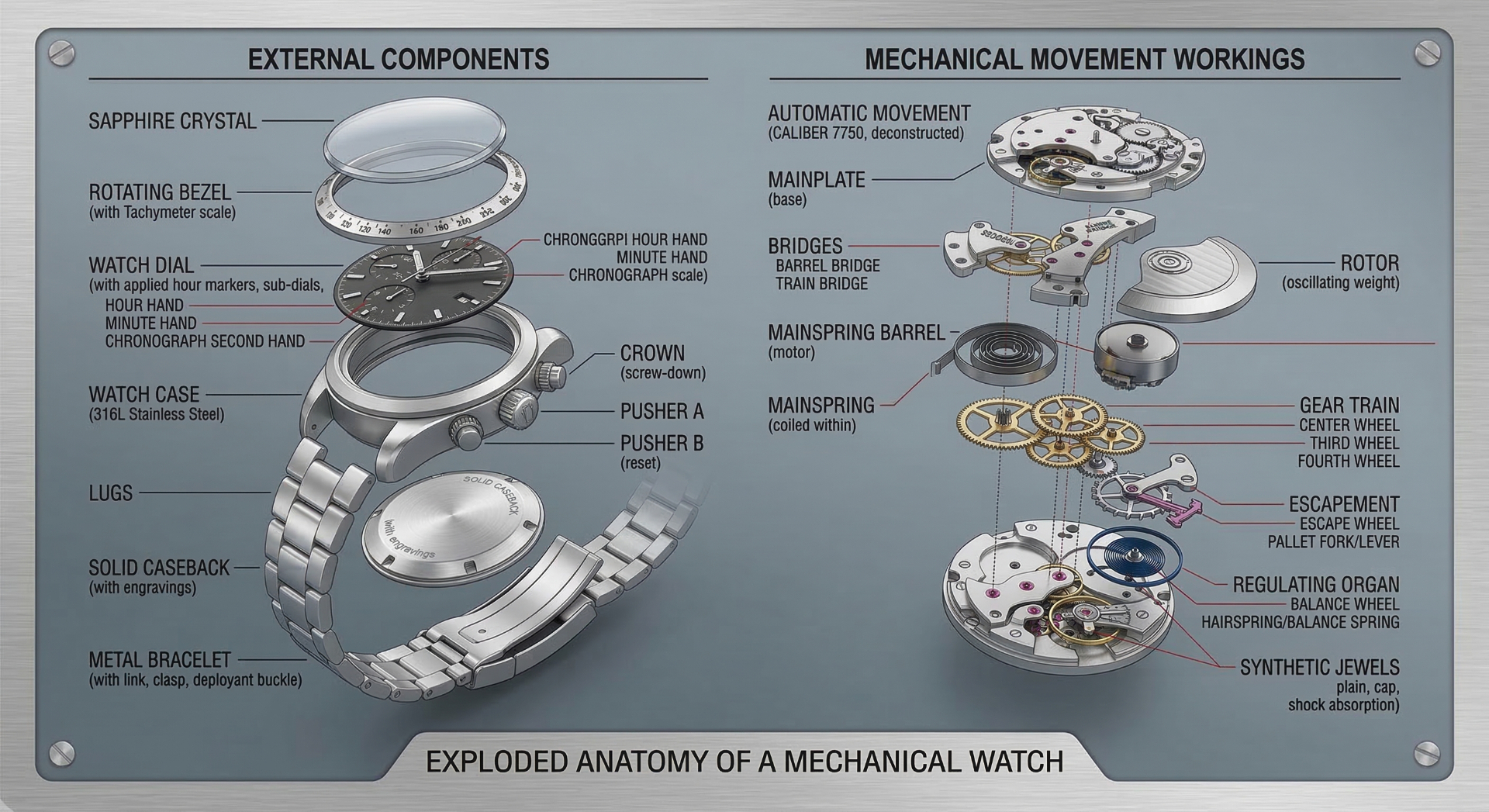
Level 3 — Shared Manufacture: Movement designed in-house but manufactured by affiliated company supplying multiple brands. Example: Tudor MT5612 made by Kenissi (also supplies Breitling, Chanel, Norqain).
Level 4 — Dedicated In-House: Movement designed and manufactured by brand exclusively for own watches. Example: Rolex 3235, Grand Seiko 9S85.
Level 5 — Vertically Integrated Manufacture: Brand produces majority of components including hairsprings, escapements, balance wheels. Example: Patek Philippe, Rolex (post-Aegler acquisition), Seiko/Grand Seiko.
The Misleading Marketing #
- "Swiss Made" ≠ In-House: Swiss Made only requires 60% value added in Switzerland.
- "Manufacture" ≠ Exclusive: Tudor calls MT5612 "manufacture" despite Kenissi producing it for multiple brands.
- "In-House" ≠ Superior: ETA 2824-2 has 40+ years proven reliability. "In-house" is an origin claim, not a quality guarantee.
Part 2: The Major Third-Party Movement Suppliers #
1. ETA (Switzerland, Swatch Group) #
The largest Swiss movement manufacturer, owned by Swatch Group. Founded 1856 as Eterna, became ETA 1932. In 2020, Swatch Group stopped selling ETA movements to non-Swatch brands.
ETA 2824-2 (Workhorse Automatic)
- Specs: 25.6mm diameter, 4.6mm thick, 28,800 vph (4Hz), 38-hour power reserve, 25 jewels
- Features: Automatic winding, hacking seconds, quickset date, hand-winding capable
- Grades: Standard (±12 to ±30 sec/day), Elaborated (±7 to ±20), Top (±4 to ±15), Chronometer (COSC: -4/+6)
- Cost: $200–$300 replacement movement
- Service: $150–$450 depending on watchmaker
- Brands: Longines, Tissot, Hamilton, TAG Heuer, Frederique Constant, Glycine, countless microbrands
ETA 2892-A2 (Thin Automatic)
- Specs: 25.6mm diameter, 3.6mm thick, 28,800 vph, 42-hour power reserve
- Features: Thinner profile for dress watches, modular (accepts complications easily)
- Brands: Omega (base for many calibers), IWC, Breitling (historical)
ETA Valjoux 7750 (Chronograph Workhorse)
- Specs: 30mm diameter, 7.9mm thick, 28,800 vph, 48-hour power reserve
- Features: Automatic chronograph, day-date complication, cam-actuated
- Brands: IWC, TAG Heuer, Breitling, Panerai, Hamilton, Sinn, Oris
- Cost: $400–$600 replacement
ETA Powermatic 80
- Specs: Based on 2824-2 architecture, reduced beat rate (21,600 vph), 80-hour power reserve
- Trade-off: Lower beat rate = less smooth seconds sweep, but extended power reserve
- Brands: Tissot, Mido, Hamilton, Certina (all Swatch Group)
The ETA Advantage
- Proven reliability: 40–70+ years in production
- Universal servicing: Any competent watchmaker can service ETA
- Parts availability: Readily available worldwide for decades
- Cost-effective service: $150–$450 vs. $600–$1,200 for proprietary
The ETA Disadvantage
- "Commodity" perception among enthusiasts
- Limited customization for brands
- Swatch Group monopoly post-2020
- Marketing challenge: Harder to justify $3,000+ watches with $200 movements
2. Sellita (Switzerland, Independent) #
The largest ETA alternative, independent of Swatch Group. Founded 1950, became independent movement maker in the 2000s. Business model: ETA clones (patents expired).
Sellita SW200-1 (ETA 2824-2 Clone)
- Specs: Virtually identical to ETA 2824-2, drop-in replacement
- Brands: Christopher Ward, Oris, Bremont, Norqain, Formex, Baltic
- Quality: Comparable to ETA Top grade, some argue superior finishing
- Cost: $250–$350 replacement, service same as ETA ($150–$450)
3. Miyota (Japan, Citizen Group) #
Japanese movement manufacturer, largest Asian supplier to global market.
Miyota 9015 (Premium Automatic)
- Specs: 27mm diameter, 3.9mm thick, 28,800 vph, 42-hour power reserve, 24 jewels
- Brands: Halios, Astor & Banks, Dan Henry, affordable microbrands
- Cost: $80–$150 replacement
- Disadvantage: No quickset date (must advance hands through 24-hour cycle)
Miyota 8215 (Budget Automatic)
- Specs: 26mm diameter, 21,600 vph, 40-hour power reserve, no hacking
- Cost: $20–$40 replacement
4. Seagull (China) #
Seagull ST19 (Venus 175 Column-Wheel Chronograph)
- Specs: Manual-wind chronograph, column-wheel, 21,600 vph
- Appeal: Column-wheel chronograph (typically $3,000+ Swiss feature) at $200–$300 price
- Disadvantage: Quality control variability, basic finishing, limited Western servicing
5. Soprod (Switzerland, Festina Group) #
- Key movements: Soprod A10 (ETA 2824-2 alternative), M100 (modular base)
- Position: Swiss quality, smaller market share, harder to source parts long-term
Part 3: The Major In-House Movement Makers #
1. Rolex (Switzerland) #
100% vertical integration post-2004 (acquired Aegler movement supplier).
Rolex Caliber 3235 (Current Generation)
- Specs: 28,800 vph, 70-hour power reserve, -2/+2 sec/day (Superlative Chronometer)
- Innovations: Chronergy escapement (+15% efficiency), Paraflex shock absorbers, Paramagnetic blue Parachrom hairspring, 70-hour power reserve
- Service: $800–$1,200 (Rolex service centers only)
- Longevity: Rolex commits to servicing movements 50+ years post-production
Rolex Caliber 4130 (Daytona Chronograph)
- Specs: Automatic chronograph, vertical clutch, fully in-house
- Superiority: Vertical clutch eliminates chrono hand flutter
- Service: $1,200–$1,800
Real-World Rolex Value
$10,000 Submariner + $1,000 service every 5–7 years = $12,000–$13,000 over 15 years. Compare: $2,000 watch with ETA 2824-2 + $300 service every 5 years = $2,900 total. Is the Rolex movement worth $7,000 premium? Depends on what you value.
2. Omega (Switzerland, Swatch Group) #
Omega Caliber 8800/8900 (Co-Axial Master Chronometer)
- Specs: 28,800 vph, 60-hour power reserve, METAS Master Chronometer certified
- Innovations: 15,000 gauss magnetic resistance (industry-leading), Co-Axial escapement, METAS 0/+5 sec/day accuracy
- Service: $600–$900
- Controversy: Co-Axial escapement non-serviceable, must be replaced as unit
Real-World Omega Value
$5,500 Seamaster 300M + $700 service every 7–10 years = $6,900–$7,600 over 20 years. 15,000 gauss magnetic resistance = genuine everyday advantage.
3. Grand Seiko / Seiko (Japan) #
Complete vertical integration — produces hairsprings, balance wheels, entire movements in-house.
Grand Seiko Caliber 9S85 (Hi-Beat Automatic)
- Specs: 36,000 vph (highest beat rate in industry), 55-hour PR, -3/+5 sec/day
- Finishing: Zaratsu polishing, hand-assembled, exceeds Swiss luxury finishing
- Service: $500–$800
Grand Seiko Spring Drive
- Specs: Unique hybrid (mechanical mainspring + quartz regulation), ±1 sec/day
- Innovation: Only production watch combining mechanical and quartz advantages
- Glide motion seconds: Perfectly smooth sweep (no stepping)
Seiko 4R36 / 6R35 (Affordable In-House)
- Specs: 21,600 vph, 41–70 hour power reserve, hacking, hand-winding
- Cost: $100–$200 movement, watches $300–$800
- Advantage: In-house at affordable price, reliable, serviceable
4. Tudor / Kenissi (Switzerland, Rolex Group) #
Tudor Caliber MT5612 (Black Bay, Pelagos)
- Specs: 28,800 vph, 70-hour power reserve, -2/+4 sec/day
- Features: Silicon balance spring (Rolex-licensed), free-sprung balance, variable inertia balance wheel
- Controversy: Tudor service centers reportedly replace entire movement rather than servicing components
Tudor Caliber MT5652 (GMT)
- Issues: Widespread date-change problems reported years after launch
ETA vs. In-House Tudor Debate
Collectors often prefer the older ETA Black Bay for: proven ETA reliability, serviceable anywhere $150–$300, aesthetics (rose logo, "smiley" text), and no warranty concerns on in-house long-term reliability.
5. Jaeger-LeCoultre (Switzerland, Richemont Group) #
- Legacy: "Watchmaker's watchmaker," produced over 1,200 calibers, historically supplied Patek Philippe, Vacheron Constantin, AP
- Key movements: JLC Caliber 899 (ultra-thin, 3.3mm), Caliber 751 (manual-wind)
- Service: $800–$1,500+ depending on complication
Part 4: What You're Actually Paying For #
The Movement Cost Reality #
Third-Party Movement Costs (to manufacturers)
| Movement | Cost |
|---|---|
| ETA 2824-2 Standard | $150–$250 |
| ETA 2824-2 Top | $250–$350 |
| Sellita SW200-1 | $200–$300 |
| Miyota 9015 | $70–$120 |
| Seagull ST2130 | $40–$80 |
| ETA Valjoux 7750 | $350–$500 |
In-House Movement Costs (estimated manufacturing)
| Movement | Estimated Cost |
|---|---|
| Rolex 3235 | $800–$1,200 |
| Omega 8900 | $500–$800 |
| Tudor MT5612 | $400–$600 |
| Grand Seiko 9S85 | $600–$900 |
The Markup Reality #
$2,000 watch with ETA 2824-2: Movement $250 + Case/bracelet/dial $400–$600 + Marketing/distribution/retail $1,000–$1,200 + Brand premium $150–$350.
$10,000 Rolex Submariner with 3235: Movement $1,000 + Case/bracelet/dial $1,500–$2,000 + Marketing/distribution/retail $4,000–$5,000 + Brand premium/demand $2,000–$3,000.
The counterintuitive truth: Movement cost represents only 10–25% of watch retail price, even for in-house movements.
Part 5: Performance Analysis #
Accuracy Comparison #
| Movement | Specification | Real-World |
|---|---|---|
| ETA 2824-2 Standard | ±12 to ±30 sec/day | +5 to +20 sec/day (after regulation) |
| ETA 2824-2 COSC | -4 to +6 sec/day | Achievable with Top grade |
| Sellita SW200-1 | Similar to ETA | +3 to +15 sec/day (often better out of box) |
| Miyota 9015 | ±30 sec/day | +5 to +15 sec/day |
| Rolex 3235 | -2 to +2 sec/day | -1 to +3 sec/day typical |
| Omega 8900 | 0 to +5 sec/day (METAS) | +1 to +4 sec/day typical |
| Tudor MT5612 | -2 to +4 sec/day | 0 to +5 sec/day typical |
| Grand Seiko 9S85 | -3 to +5 sec/day | -2 to +4 sec/day |
| Grand Seiko Spring Drive | ±15 sec/month | ±10 sec/month typical |
The accuracy verdict: Accuracy differences between properly regulated ETA 2824-2 Top and Rolex 3235 = marginal in daily use. A ±3 sec/day ETA vs. ±1.5 sec/day Rolex = 21 seconds per week difference. Imperceptible in practice.
Reliability Comparison #
Proven long-term (30–40+ years data): ETA 2824-2, Rolex 3135, Valjoux 7750 — decades of proven reliability.
Strong medium-term (15–25 years): Grand Seiko 9S85, Omega 8900, ETA 2892-A2 — reliable with some data gaps.
Insufficient long-term data (under 10 years): Rolex 3235, Tudor MT5612/MT5652, latest Omega 8900 variants — early reports positive but insufficient time to prove 30–50 year longevity.
The new movement risk: Every new caliber is beta-tested on customers. Tudor MT5652 GMT = perfect example. $4,400 watch, date-change problems years after launch. Early adopters = guinea pigs.
Part 6: The Value Proposition by Price Tier #
Under $500: Third-Party (or Affordable In-House) #
Winner: Seiko 4R36. $300–$400 Seiko Prospex/Presage delivers in-house movement, good finishing, Japanese reliability. Best value mechanical watch on the market.
$500–$1,500: Third-Party Optimal #
Winner: ETA 2824-2 / Sellita SW200-1. Proven, serviceable, excellent value. Save money for case/bracelet quality — Longines, Oris, Hamilton deliver.
$1,500–$3,500: The Debate Begins #
Third-party saves ~$1,800 over 20 years ($3,200 total for Sellita Oris vs. $5,000 for Caliber 400 Oris). But: If you value innovation (Oris 120-hour PR, antimagnetic escapement, 10-year service intervals), in-house begins making sense.
$3,500–$6,000: In-House Becomes Standard #
Winner: Omega 8900 Co-Axial. 15,000 gauss magnetic resistance = real-world benefit every day. METAS testing rigorous. $5,500 price justified by innovation.
$6,000+: In-House Mandatory, Innovation Expected #
At this price, demand: genuine innovation (not just in-house assembly), superior finishing, extended service intervals, and lifetime parts commitment (50+ years).
Part 7: The Collector's Decision Matrix #
When Third-Party Makes Sense #
- Budget is priority ($500–$2,000): Save on movement, invest in case/bracelet quality
- Serviceability matters: Independent watchmaker access, $150–$300 costs, global parts
- Proven reliability: 40+ years ETA track record over unproven in-house
- Watch rotation: ETA's 38–42 hour PR sufficient when rotating
- Travel/relocation: ETA serviceable anywhere in the world
- Risk aversion: Avoid being guinea pig for new movements
When In-House Makes Sense #
- Innovation is priority: Omega 15,000 gauss, Grand Seiko 36,000 vph, Rolex Chronergy
- Extended power reserve: 70–120 hour PR for daily wear without rotation
- Resale value (luxury): Rolex, Patek hold value; ETA watches depreciate 30–50%
- Magnetic environment: Electronics, medical equipment, speakers
- Long-term heirloom: Buy once, keep decades, pass to children
- Supporting innovation: Funding R&D, encouraging watchmaking advancement
Part 8: The Future of Movements #
ETA's Decline and Alternatives #
With Swatch Group restricting ETA sales, brands scramble: Sellita (largest beneficiary), Soprod, STP, in-house development (Tudor/Kenissi, Omega), and Asian suppliers (Miyota, Seagull) gaining share.
The Tudor Movement Replacement Controversy #
Reports indicate Tudor replaces entire MT5612/MT5652 movements rather than servicing. Faster for Tudor, but wasteful, changes provenance (serial number), and raises long-term availability questions.
The Movement Hierarchy: A Collector's Guide #
Tier 1 — Proven Workhorses (Best Value, Lowest Risk): ETA 2824-2, Sellita SW200-1, ETA 2892-A2, Seiko 4R/6R, Miyota 9015. Why: 40+ years proven, serviceable anywhere, $150–$300 service.
Tier 2 — Premium In-House (Innovation Justified): Omega 8900 Co-Axial, Grand Seiko 9S85 Hi-Beat, Grand Seiko Spring Drive, Oris Caliber 400. Why: Genuine innovation, measurable improvements.
Tier 3 — Luxury Standard (Brand Prestige, Resale): Rolex 3235/3135, JLC movements, Patek Philippe. Why: Resale value, heirloom quality, 50+ year support.
Tier 4 — Promising But Unproven: Tudor MT5612 (excellent specs, insufficient long-term data), Tudor MT5652 GMT (avoid until reliability resolved). Proceed with caution.
Tier 5 — Questionable Value: Brands charging $3,000–$6,000 for basic in-house without genuine innovation. Buy proven ETA/Sellita instead.
Conclusion: What You're Really Paying For #
You're not paying for movement quality. A $200 ETA 2824-2 performs within 5–10 seconds per day of a $1,000 Rolex 3235 in real-world use.
You are paying for:
- Innovation (sometimes): Omega 15,000 gauss, Grand Seiko Spring Drive, Rolex Chronergy
- Brand prestige: The Rolex logo adds $2,000–$3,000 to Submariner price
- Finishing (luxury segment): Grand Seiko zaratsu, JLC hand-polished bevels
- Resale value: Rolex holds value, ETA watches depreciate 30–50%
- Service ecosystem: Rolex services watches 50+ years post-production
- Psychological satisfaction: "Manufacture" pride of ownership
What you're NOT getting:
- Dramatically better accuracy (28 seconds per week difference = imperceptible)
- Better reliability (necessarily — ETA has 40 years of data, new in-house doesn't)
- Lower service costs (in-house is always more expensive)
- Universal serviceability (ETA wins everywhere)
A $200 ETA 2824-2 in a $1,200 Longines delivers 95% of the performance of a $1,000 Rolex 3235 in a $10,000 Submariner — at 12% of the price.
But that missing 5%? For some collectors, it's worth $8,800. For others, it's not.
Choose based on what you value: Proven reliability (ETA), genuine innovation (Omega Co-Axial, Grand Seiko Spring Drive), brand prestige (Rolex), or value (Longines, Hamilton, Oris with third-party).
Because in the end, the best movement is the one in the watch you'll actually wear.
And the worst movement? The one sitting in a safe because you're afraid to service it.
Find Your Perfect Watch
Browse our curated collection of indie and microbrand timepieces.
📚 Related Reading
Handpicked articles from the same topic