The Complete Microbrand Watch Glossary: Every Term Explained
From NH35 to Zaratsu polishing — your comprehensive guide to understanding watch terminology, movements, finishing, complications, materials, and specifications in the microbrand watch world.
Steven Thompson
Independent Watchmaker · 10 Years Experience
Reviewed by Indie Watches
Editorially reviewed for accuracy
⚡ Key Takeaways
- ✓✅ Movements — NH35 vs. Miyota 9015 vs. Sellita SW200 (and why it matters)
- ✓✅ Finishing Techniques — What makes a $3,000 watch look better than a $300 one
- ✓✅ Complications — GMT, chronograph, annual calendar (and the difference between "true" and "caller" GMT)
- ✓✅ Materials — 316L vs. 904L stainless steel, titanium grades, bronze alloys
- ✓✅ Dial Terms — Fumé, guilloché, sector dial, flinqué enamel
📑 Table of Contents
From NH35 to Zaratsu polishing—your comprehensive guide to understanding watch terminology, movements, finishing, and specifications.
📚 Explore our full watches guide →
Walk into any microbrand watch discussion and you'll encounter a bewildering array of technical terms: "NH35 movement," "Zaratsu polishing," "BGW9 lume," "120-click bezel," "fumé dial," "caller GMT," "flinqué enamel." What does it all mean?
This glossary demystifies every term you'll encounter in the microbrand watch world. Organized by category (not alphabetically) for logical learning, this guide explains:
- ✅ Movements — NH35 vs. Miyota 9015 vs. Sellita SW200 (and why it matters)
- ✅ Finishing Techniques — What makes a $3,000 watch look better than a $300 one
- ✅ Complications — GMT, chronograph, annual calendar (and the difference between "true" and "caller" GMT)
- ✅ Materials — 316L vs. 904L stainless steel, titanium grades, bronze alloys
- ✅ Dial Terms — Fumé, guilloché, sector dial, flinqué enamel
- ✅ Case & Crystal — Sapphire vs. mineral, AR coating, water resistance ratings
- ✅ Lume — Super-LumiNova grades (C3, BGW9, Old Radium)
- ✅ Bracelet & Clasp — Oyster vs. Jubilee, micro-adjustments, quick-release
- ✅ Manufacturing — Swiss Made vs. Swiss Movement, in-house vs. third-party
- ✅ Brand & Community — Microbrand, independent watchmaker, crowdfunding terms
Whether you're buying your first microbrand or your fiftieth, this glossary ensures you understand exactly what you're getting—and why certain features command premium pricing.
MOVEMENTS (The Engine Inside Your Watch) #
Movement Basics #
Movement (Caliber): The mechanism that powers the watch and keeps time. Also called "caliber" or "calibre" (French spelling). Example: "This watch uses the NH35 movement."
Automatic (Self-Winding): Mechanical movement that winds itself as you wear it. A rotor (weighted disc) spins with wrist motion, winding the mainspring automatically. You never need to manually wind it if worn regularly. Example: Seiko NH35, Miyota 9015.
Manual-Wind (Hand-Wound): Mechanical movement requiring daily winding via the crown. Traditional, romantic—you physically wind the spring each day. Example: Sellita SW210-1, ETA 6498.
Quartz: Battery-powered movement using quartz crystal vibrations for accuracy. More accurate than mechanical (+/- 15 seconds/month vs. +/- 20 seconds/day mechanical). Lower maintenance, less romantic. Example: Miyota 2035, Ronda 715.
Meca-Quartz: Hybrid combining quartz accuracy with mechanical chronograph module. Battery powers time, mechanical module operates chronograph pushers (gives satisfying tactile feel). Popular in affordable chronographs. Example: Seiko VK63, VK64.
Power Reserve (PR): How long the watch runs when fully wound before stopping. Measured in hours. Entry movements: 38-42 hours. Premium: 68-80 hours.
Hacking: Ability to stop seconds hand by pulling crown out. Allows precise time-setting (synchronizing to exact second). Most modern movements hack. Budget movements (DG2813) don't. Critical feature for serious timekeeping.
Hand-Winding: Ability to manually wind automatic movement via crown. Some automatics are automatic-only (no manual wind). Most quality movements offer both automatic + manual winding option.
Popular Entry Movements ($40–70 wholesale) #
Seiko NH35 / NH36:
- Type: Japanese automatic
- Specs: 24 jewels, 21,600 vph, 41hr PR, hacking, manual wind
- Difference: NH35 = no-date, NH36 = date complication
- Why it's popular: Reliable workhorse, easy servicing globally, proven track record
- Found in: VAER, Nodus, Zelos, most entry microbrands
- Cost: $40-70 wholesale, $5-15 service parts
Seiko NH38:
- Type: Japanese automatic
- Specs: Same as NH35 but no-date version with cleaner dial
- Why it matters: Some collectors prefer clean dial without date window
- Found in: VAER no-date models, minimalist microbrands
Seiko 4R35 / 4R36:
- Type: Japanese automatic (premium version of NH35)
- Specs: 24 jewels, 21,600 vph, 41hr PR, hacking, manual wind
- Difference from NH35: Better finishing, tighter tolerances, improved accuracy
- Why it's better: More accurate (+/- 15 sec/day vs. +/- 20 for NH35), smoother rotor
- Found in: Seiko's own watches (not typically microbrands—NH35 more cost-effective)
Miyota 8215 / 8315:
- Type: Japanese automatic
- Specs: 21 jewels, 21,600 vph, 40hr PR, NO hacking, manual wind
- Why it's cheaper: No hacking seconds (can't stop seconds hand)
- Sound: Louder rotor than Seiko NH35 (some find annoying)
- Found in: Budget microbrands, older watch designs
- Cost: $25-40 wholesale
Chinese Movements (PT5000, DG2813, ST1612):
- PT5000: Clone of ETA 2824, decent quality ($15-30)
- DG2813: Budget automatic, no hacking, mediocre accuracy ($8-15)
- ST1612 (Seagull): Chinese automatic, better than DG2813 ($12-20)
- Reputation: Improving quality but still behind Japanese/Swiss reliability
- Service: Harder to find watchmakers servicing Chinese movements
Popular Mid-Tier Movements ($100–250 wholesale) #
Miyota 9015:
- Type: Japanese automatic
- Specs: 24 jewels, 28,800 vph, 42hr PR, 3.9mm thin, hacking, manual wind
- Why it's special: Ultra-thin (enables slim dress watches), smooth sweeping seconds (28,800 vph vs. 21,600)
- Accuracy: +/- 10-30 sec/day (better than NH35)
- Found in: Furlan Marri, Laine, Baltic dress watches
- Cost: $100-140 wholesale
Miyota 9039:
- Type: Japanese automatic (no-date version of 9015)
- Why it matters: Clean dial, no date complication (minimalist aesthetic)
- Found in: Furlan Marri Serie 2116, minimalist dress watches
Miyota 9075:
- Type: Japanese automatic GMT
- Specs: 26 jewels, 28,800 vph, GMT complication
- GMT type: Caller GMT (local hour jumps, GMT hand continuous)
- Found in: Zelos Wilder GMT, budget GMT watches
- Cost: $150-200 wholesale
Premium Movements ($250–500+ wholesale) #
Sellita SW200-1:
- Type: Swiss automatic
- Specs: 26 jewels, 28,800 vph, 38hr PR, hacking, manual wind
- Why it's premium: Swiss Made, clone of legendary ETA 2824-2
- Serviceability: Excellent—most watchmakers can service
- Found in: Christopher Ward, Fears, premium microbrands
- Cost: $150-220 wholesale
Sellita SW210-1:
- Type: Swiss manual-wind
- Specs: 17 jewels, 28,800 vph, 42hr PR
- Why hand-wound: Romantic daily ritual, thinner case possible
- Found in: anOrdain Model 1, Laine Sutton, dress watches
- Cost: $120-180 wholesale
Sellita SW300:
- Type: Swiss automatic (upgraded SW200)
- Specs: 25 jewels, 28,800 vph, 42hr PR, improved finishing
- Why it's better: Longer power reserve, better decoration potential
- Found in: anOrdain Model 2, premium microbrands
- Cost: $180-250 wholesale
Soprod P024:
- Type: Swiss automatic
- Specs: 25 jewels, 28,800 vph, 42hr PR
- Why it's special: Independent Swiss manufacturer (not Sellita/ETA)
- Quality: Excellent finishing, reliable
- Found in: Baltic, Serica, Atelier Wen
- Cost: $180-250 wholesale
ETA 2824-2:
- Type: Swiss automatic
- Specs: 25 jewels, 28,800 vph, 38hr PR
- History: Legendary movement (used in Rolex, Omega historically)
- Availability: ETA restricts sales to non-Swatch Group brands (harder for microbrands to source)
- Replacement: Most microbrands use Sellita SW200-1 instead (nearly identical)
La Joux-Perret G101:
- Type: Swiss automatic
- Specs: 27 jewels, 28,800 vph, 68hr PR
- Why it's special: Long power reserve (68 hours vs. typical 38-42)
- Found in: anOrdain Model 2 Porcelain, premium microbrands
- Cost: $350-450 wholesale
Valjoux 7750:
- Type: Swiss automatic chronograph
- Specs: 25 jewels, 28,800 vph, chronograph complication
- History: Legendary chronograph movement (industry standard since 1973)
- Why it's special: Proven reliability, serviceable globally
- Found in: Fears chronographs, premium chrono microbrands
- Cost: $400-600 wholesale
Soprod C125:
- Type: Swiss automatic chronograph
- Specs: Chronograph complication, 28,800 vph
- Why choose over Valjoux: More compact, modern design
- Found in: Serica chronograph
- Cost: $350-500 wholesale
Chronograph & Specialty Movements #
Seiko VK63 / VK64 (Meca-Quartz):
- Type: Hybrid quartz + mechanical chronograph
- How it works: Battery powers time, mechanical module for chronograph
- Advantages: Accurate timekeeping, mechanical chrono feel, affordable
- Chrono hand: Smooth sweeping (mechanical module)
- Found in: Brew, Zelos, Baltic chronographs under $1,000
- Cost: $30-50 wholesale
Seiko VH31 (Sweeping Quartz):
- Type: Quartz with sweeping seconds hand
- Why it matters: Smooth sweep like mechanical (not stepping quartz)
- Accuracy: Quartz precision (+/- 15 sec/month)
- Found in: Some fashion watches, budget microbrands
Movement Terminology #
Jewels: Synthetic rubies used as bearings in movement. Reduce friction, increase longevity. More jewels ≠ always better (17-25 jewels typical for quality automatics). Marketing often inflates jewel count with non-functional jewels.
VPH (Vibrations Per Hour) / BPH (Beats Per Hour): Frequency of balance wheel oscillation. Higher = smoother seconds hand sweep.
- 21,600 vph: Entry movements (NH35, Miyota 8215) — visible "ticking" steps
- 28,800 vph: Premium movements (Miyota 9015, Sellita SW200) — smoother sweep
- 36,000 vph: High-frequency (Grand Seiko, some haute horology) — buttery smooth
Accuracy / Rate: How much the watch gains or loses per day. Measured in seconds/day.
- Budget mechanical: +/- 20-40 sec/day
- Quality mechanical: +/- 10-20 sec/day
- Chronometer certified: -4/+6 sec/day (COSC standard)
- Quartz: +/- 15 sec/month (much more accurate than mechanical)
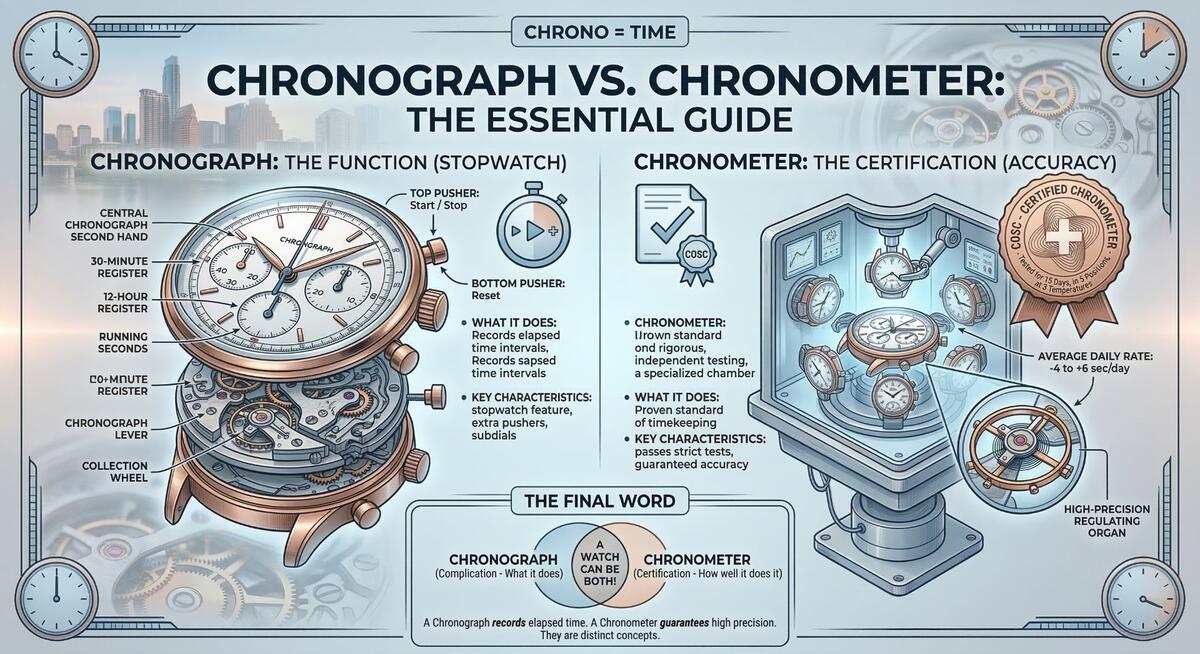
COSC (Contrôle Officiel Suisse des Chronomètres): Swiss organization certifying chronometer-grade movements. Tests accuracy over 15 days in 5 positions at 3 temperatures. Standard: -4/+6 seconds/day. Adds $200-400 to watch cost. Rare in microbrands (Christopher Ward offers on some models).
Rotor: Weighted semicircular disc that spins with wrist motion, winding the mainspring in automatic watches. Can be decorated (engraved, skeletonized, custom designs).
Exhibition Caseback: Transparent caseback (usually sapphire crystal) revealing movement. Allows viewing rotor, bridges, finishing. Adds $10-30 cost but massive aesthetic value.
Solid Caseback: Opaque metal caseback. More affordable, better water resistance, allows caseback engraving.
FINISHING TECHNIQUES (What Makes Watches Look Expensive) #
Case Finishing #
Brushing (Satin Finish): Linear grain texture applied to case surfaces. Hides scratches better than polishing. Applied with abrasive pads in single direction. Found on: tool watch cases, bracelet links.
Polishing (Mirror Finish): Reflective mirror surface. Shows every scratch (downside). Requires skilled hand-polishing or buffing wheels. Found on: dress watch cases, beveled edges, bracelet center links.
Mixed Finishing: Combination brushing + polishing on different case surfaces. Creates visual interest, dimensional depth. Example: Brushed case top, polished beveled edges. Requires skilled execution—poor mixed finishing looks cheap.
Zaratsu Polishing: Japanese mirror-polishing technique creating ultra-flat, distortion-free reflective surface. Developed by Seiko. Achieved with rotating tin plate pressed flat against metal. Results: razor-sharp bevels, perfectly flat surfaces, zero distortion in reflection. Found in: Grand Seiko, Kurono Tokyo (Hajime Asaoka technique). Extremely labor-intensive—adds significant cost.
Beveling: Angled edges between case surfaces. Creates shadow lines, visual definition. Hand-beveling requires skilled finishing. Sharp, crisp bevels = premium quality. Soft, rounded bevels = budget execution.
Sunburst Brushing (Radial Finishing): Circular brushed pattern radiating from center. Common on dials, bezels, rotors. Creates dynamic light play (appearance changes with angle). Applied with rotary brushing or laser texturing.
Movement Finishing & Decoration #
Geneva Stripes (Côtes de Genève): Parallel wave pattern applied to movement bridges and rotors. Traditional Swiss finishing technique. Applied with rotating abrasive wheel. Found in: decorated Sellita movements (Fears, anOrdain custom decoration). Adds visual interest to otherwise plain movement.
Perlage (Circular Graining): Overlapping circular pattern resembling fish scales. Applied to movement plates (base). Created with rotating peg tool. Covers machining marks, adds texture. Found in: most decorated movements.
Anglage (Beveling/Chamfering): Hand-polished beveled edges on movement components (bridges, levers). Creates bright polished line along component edges. Extremely labor-intensive—sign of haute horology. Found in: high-end independent watchmaking, rarely microbrands (too expensive).
Blued Screws: Heat-treated screws turning deep blue color. Traditional decoration technique. Functional (heat-treating strengthens steel) + aesthetic. Found in: premium movements, custom-decorated Sellita. Budget alternative: Painted blue (fake bluing—avoid).
Rhodium Plating: Silver-white plating applied to brass movement components. Creates bright, premium appearance. Standard in Swiss movements. Alternative: Gilt (gold-plated) for vintage aesthetic.
Dial Finishing #
Sunburst (Radial Brushing): Radiating brush pattern from dial center. Creates dynamic appearance (changes with light angle). Applied via radial brushing or stamping. Quality indicator: fine, even lines (not chunky). Found in: most quality watches.
Fumé (Gradient): Color gradient from center to edge (light to dark). Creates depth, dimension.
- Lacquer fumé: Sprayed paint gradient (budget method, $5-15/dial)
- Enamel fumé: Varying enamel thickness creates natural gradient (anOrdain technique, expensive, $200+/dial)
- Print fumé: UV-printed gradient (mid-tier, $8-15/dial)
Guilloché: Engine-turned geometric pattern (waves, grids, basket weave). True guilloché: Hand-engraved using rose engine lathe (extremely expensive, $500-2,000+/dial). Stamped guilloché: Machine-pressed pattern (affordable, $20-50/dial). Printed guilloché: Fake (avoid—no depth). Tells: real guilloché has depth, shadow, dimension. Fake is flat printed image.
Sector Dial: Dial divided into sectors (often time markers + clear outer track). Common in 1930s-40s military/pilot watches. Creates symmetry, balance. Found in: field watches, vintage-inspired designs.
Enamel (Vitreous Enamel / Grand Feu): Powdered glass fired in kiln at 800-900°C, fusing to metal dial. Creates glassy, luminous surface with unique depth. Advantages: Won't fade/age, incredible depth and luster, premium appearance. Disadvantages: Expensive (labor-intensive), fragile (can chip if struck), 30%+ rejection rate. Process: Apply enamel powder → fire kiln → repeat 3-10 layers → hand-polish. Found in: anOrdain ($2,200-3,500), Kurono Tokyo ($4,000+). Types: Opaque (solid colors), fumé (gradient thickness), champlevé (carved recesses), cloisonné (wire partitions).
Porcelain Dial: Ceramic dial pressed from clay, glazed, kiln-fired. Similar appearance to enamel (glassy, luminous) but different material/process. anOrdain developed porcelain dials with Stoke-on-Trent potters—faster production than enamel (30/month vs. 15 enamel), slightly lower cost.
Flinqué Enamel: Translucent enamel applied over textured metal base (engine-turned/engraved pattern shows through). Creates depth, shimmer, dimension. Extremely difficult technique. Found in: anOrdain Model 3 Method, haute horology.
Meteorite Dial: Genuine meteorite slice (typically Muonionalusta meteorite from Sweden, 4.5 billion years old). Displays Widmanstätten pattern (crystalline structure visible after etching). Advantages: Every dial genuinely unique, conversation piece. Disadvantages: Expensive ($100-300/dial), can oxidize over time. Found in: Zelos meteorite models ($1,650).
Mother of Pearl (MOP / Nacre): Iridescent shell interior (oyster, abalone). Creates shimmering, organic luster that changes with light angle. Quality tells: Thick MOP (1-2mm) = premium. Thin MOP veneer = budget. Found in: dress watches, some microbrands ($30-80/dial).
COMPLICATIONS (Beyond Basic Time Display) #
Time-Related Complications #
Date Complication: Window displaying current date (1-31). Most common complication. Quickset allows independent date adjustment. Positioning: Typically 3 o'clock (sometimes 4:30, 6 o'clock).
Day-Date: Displays day of week + date. Larger dial real estate requirement. Found in: larger watches (40mm+), vintage-inspired designs.
Annual Calendar: Automatically accounts for months with 30 vs. 31 days. Only requires manual correction once yearly (February → March). Significant complication (adds $1,000-2,000 to watch cost). Found in: Kurono Tokyo Calendrier ($4,500).
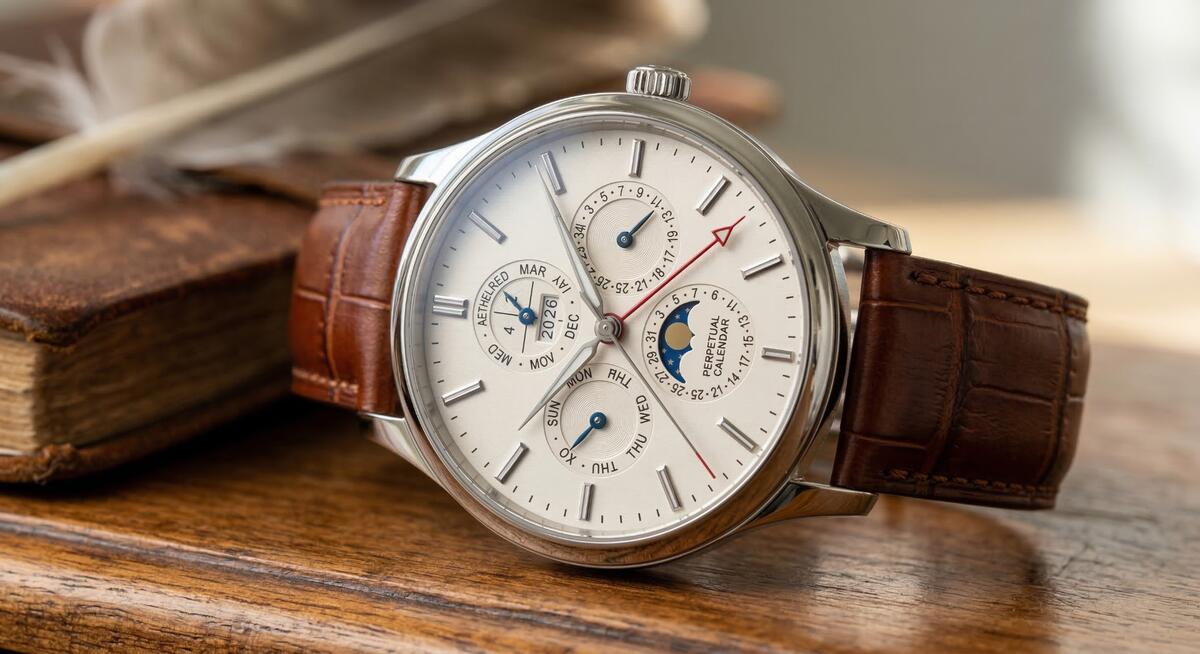
Perpetual Calendar: Accounts for different month lengths AND leap years. Won't need date correction for decades/centuries. Extremely complex complication—typically $10,000+ watches. Rare in microbrands.
Travel & Multi-Time Complications #
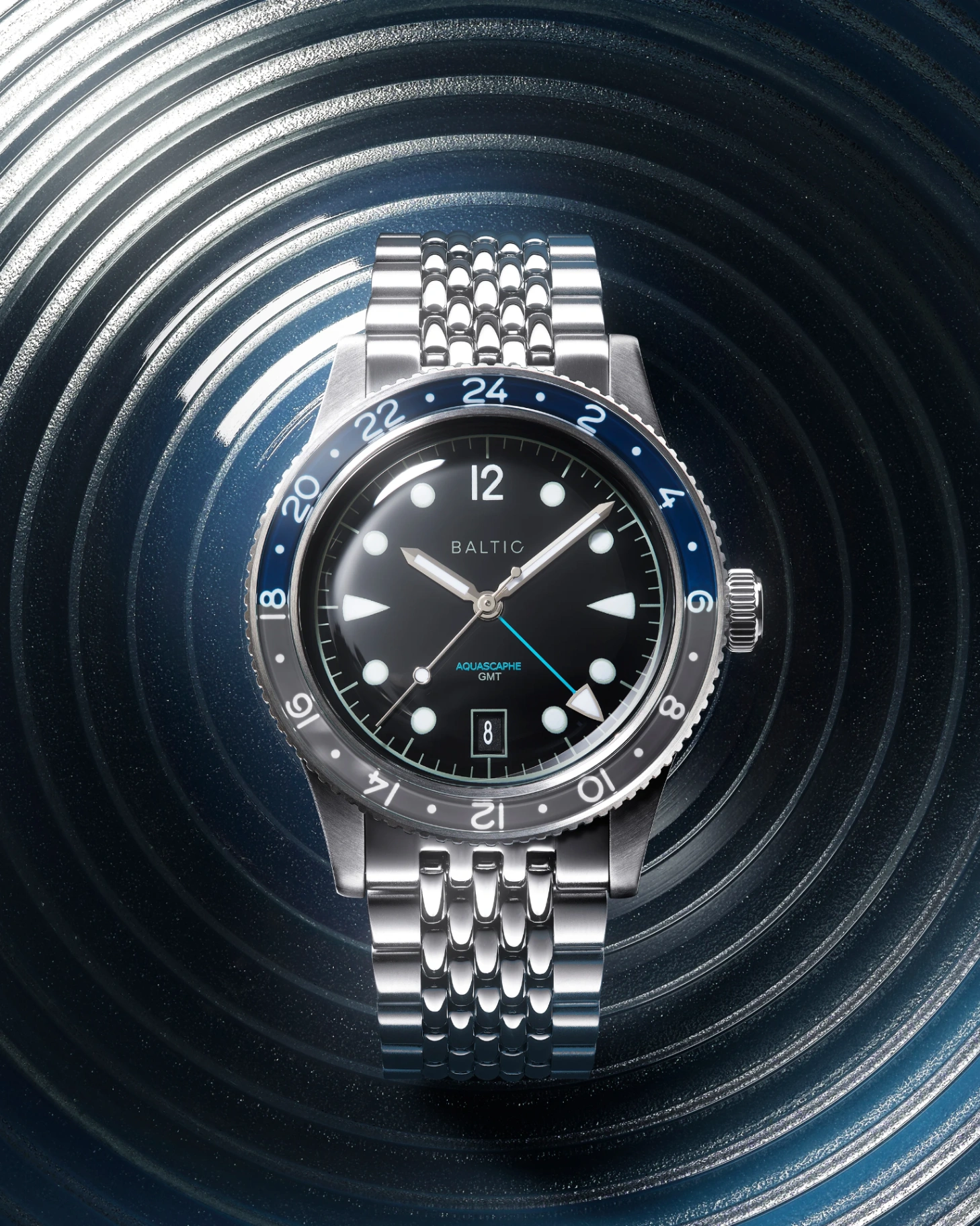
GMT (Greenwich Mean Time): Displays second time zone via additional hour hand (completes rotation every 24 hours). 24-hour scale on bezel or chapter ring.
True GMT (Flyer GMT / Office GMT): Local hour hand jumps independently (1-hour increments). GMT hand + minutes continue running. Use case: Frequent travelers. Found in: Baltic Aquascaphe GMT, Christopher Ward C63 Sealander GMT.
Caller GMT (Traveler GMT): GMT hand jumps independently, local hour hand linked to minutes. Use case: Track second time zone from home. Found in: Miyota 9075-based GMTs, budget GMT watches.
Dual Time / Second Time Zone: Separate subdial showing second time zone (often 12-hour format). Different from GMT (which uses 24-hour hand).
World Time: Displays time in all 24 time zones simultaneously via rotating city disc. Complex complication—rare in microbrands.
Measurement Complications #
Chronograph: Stopwatch function. Start/stop/reset via pushers. Subdials register elapsed time (30 minutes, 12 hours typical).
- Mechanical Chronograph: Gear-driven module. Complex, expensive (adds $300-800 wholesale). Smooth sweeping seconds. Found in: Valjoux 7750, Soprod C125 watches.
- Quartz Chronograph: Battery-powered. Accurate, affordable, stepping seconds hand. Found in: budget chronographs.
- Meca-Quartz: Hybrid—quartz timekeeping, mechanical chronograph module. Smooth sweeping chrono seconds, satisfying pushers. Best of both worlds under $1,000. Found in: Seiko VK63/VK64 chronographs (Brew, Baltic Bicompax, Zelos).
- Flyback Chronograph: Returns chrono to zero and immediately restarts with single pusher press. Complex, expensive—rare in microbrands.
Tachymeter: Scale for measuring speed based on elapsed time over known distance. Found in: racing chronographs.
Telemeter: Measures distance to event based on time between seeing and hearing it. Historic complication—rarely used today.
Other Complications #
Moon Phase: Displays lunar cycle via rotating disc. Poetic, romantic complication. Requires adjustment ~every 2.5 years. Adds $300-1,000 to cost.
Power Reserve Indicator: Gauge showing remaining power reserve. Useful for manual-wind watches. Found in: premium microbrands, haute horology.
Small Seconds: Seconds subdial (typically at 6 o'clock) instead of central seconds hand. Classic complication. Found in: dress watches, vintage-inspired designs.
Jumping Hours: Hour displayed in window (digital-style), not via hand. Visually striking, unusual. Rare in microbrands.
MATERIALS (What Your Watch Is Made From) #
Steel Alloys #
316L Stainless Steel: Standard watch steel. Composition: Iron + 16-18% chromium + 10-14% nickel + 2-3% molybdenum. Properties: Corrosion-resistant, hypoallergenic, durable, affordable. Hardness: ~200 Vickers. Found in: 95%+ of all watches including microbrands.
904L Stainless Steel: Premium steel alloy. Advantages: Superior corrosion resistance, higher polish achievable, slightly more scratch-resistant. Disadvantages: Harder to machine (increases manufacturing cost 30-50%), minimal real-world benefit vs. 316L. Marketing: Rolex uses 904L—creates "premium" perception. Reality: 316L perfectly adequate for 99% of users.
Tool Steel (Hardened Steel): Heat-treated steel (Vickers hardness: 600-800+). Advantages: Highly scratch-resistant. Disadvantages: Brittle, difficult to polish if scratched.
Titanium #
Titanium (Grade 2): Commercially pure titanium. Properties: 40% lighter than steel, hypoallergenic, corrosion-proof, warmer feel. Hardness: ~150 Vickers (softer than 316L). Color: Matte grey. Found in: budget titanium watches.
Titanium (Grade 5 / Ti-6Al-4V): Titanium alloy (6% aluminum, 4% vanadium). Properties: 30% stronger than Grade 2, better scratch resistance (~300 Vickers), still 40% lighter than steel. Found in: Zelos Abyss, premium titanium microbrands. Cost: 2-3X steel case manufacturing.
DLC (Diamond-Like Carbon) Coating: Carbon coating applied via PVD process. Hardness: 2,000-3,000 Vickers (nearly scratch-proof). Disadvantages: If scratched through coating, reveals base metal underneath (irreparable). Color: Matte black.
PVD (Physical Vapor Deposition): Process for applying thin hard coating. Can be DLC, titanium nitride (gold color), chromium nitride. Durability variable depending on coating material and thickness. Colors: Black, gold, grey, bronze.
Bronze & Brass #
Bronze (CuSn8): Copper-tin alloy (92% copper, 8% tin). Develops patina (oxidation) over time—greenish-brown coloring. Each watch ages uniquely. Advantages: Beautiful aging, unique character, antimicrobial. Disadvantages: Patina can stain skin/clothing initially, heavier than steel. Found in: Zelos Swordfish Bronze, bronze dive watches.
Aluminum Bronze: Bronze with aluminum content (creates different patina color—golden vs. green). Slower patina development. Found in: premium bronze watches.
Brass: Copper-zinc alloy. Cheaper than bronze, develops patina. Disadvantage: Can turn skin green. Less desirable than bronze.
Ceramic & Carbon #
Ceramic (Zirconia): Highly scratch-resistant (hardness ~1,200 Vickers). Advantages: Nearly scratch-proof, hypoallergenic, lightweight, color won't fade. Disadvantages: Brittle (can crack if struck), expensive. Found in: bezel inserts (common), full ceramic cases (rare in microbrands).
Forged Carbon (Carbon Fiber): Aerospace composite. 50% lighter than steel, extremely strong, unique pattern each piece. Found in: Zelos Wilder GMT ($1,350—rare under $2,000).
CRYSTALS & COATINGS #
Crystal Types #
Acrylic (Hesalite / Plastic): Plastic crystal. Advantages: Cheap ($1-3), won't shatter, vintage aesthetic, polishable (scratches buff out with Polywatch). Disadvantages: Scratches easily, degrades over time. Modern use: Rare in quality microbrands.
Mineral Glass (Hardened Glass): Tempered glass (hardness ~500 Vickers). Advantages: Scratch-resistant (better than acrylic), cheap ($2-5). Disadvantages: Can scratch, can't be polished. Quality indicator: Microbrands using mineral glass instead of sapphire = cost-cutting.
Sapphire Crystal: Synthetic sapphire (aluminum oxide, hardness ~2,000-2,300 Vickers). Advantages: Virtually scratch-proof, crystal clear, doesn't yellow. Disadvantages: Can shatter if struck hard, expensive ($8-40). Expectation: Sapphire should be standard in any microbrand $500+.
Sapphire Crystal Shapes:
- Flat: Standard, cheapest ($8-15)
- Domed: Curved top surface, vintage aesthetic ($15-25)
- Double-domed: Curved top AND bottom, maximum vintage character ($25-40)
- Box-shaped: Tall flat crystal with beveled edges, 1940s style ($20-35)
Crystal Coatings #
AR Coating (Anti-Reflective): Thin coating reducing light reflection. Application: Underside = standard. Both sides = premium. Advantages: Dramatically improves readability in sunlight, gives "invisible" crystal appearance. Quality indicator: AR coating should be standard on $500+ watches.
WATER RESISTANCE (Understanding the Ratings) #
| Rating | Description | Reality | Found In |
|---|---|---|---|
| 30m / 3 ATM | Splash resistant only | NOT suitable for swimming. Handwashing, rain only. | Dress watches, leather strap watches |
| 50m / 5 ATM | Light water contact | Brief swimming okay, NOT diving. Avoid shower. | Many dress watches, some field watches |
| 100m / 10 ATM | Swimming safe | Suitable for swimming, snorkeling (no diving). | Most field watches, casual watches |
| 200m / 20 ATM | Dive watch standard | Recreational scuba diving. ISO 6425 minimum. | Dive watches |
| 300m / 30 ATM | Professional dive | Serious diving, professional use. | Christopher Ward C63, Serica TXD |
| 500m+ / 50+ ATM | Extreme diving | More than necessary for 99.9% of users. | Serica TXD (500m) |
Water Resistance Features #
Screw-Down Crown: Crown threads into case tube, compressing gasket for water seal. Advantages: Superior water resistance, prevents accidental crown pulling. Quality indicator: Dive watches MUST have screw-down crown for 200m+ rating.
Screw-Down Caseback: Caseback threads into case (vs. snap-on press-fit). Better water resistance, more secure. Requires caseback wrench for opening.
Gaskets (O-Rings): Rubber seals preventing water ingress. Located at: crown, caseback, crystal. Materials: Silicone (standard), nitrile (oil-resistant), fluoroelastomer/Viton (premium). Maintenance: Replace every 2-3 years.
LUMINOUS MATERIALS (Glow in the Dark) #
Super-LumiNova Types #
C1 (White/Blue): Standard white lume, glows blue-green. Weakest glow, shortest duration. Found in: budget watches.
C3 (Green/Green): Most popular. Green-white color (daylight), glows bright green (dark). Strong, long-lasting glow. Found in: most microbrands, tool watches. Why it's standard: Best brightness-to-cost ratio.
BGW9 (White/Blue): Pure white (daylight), glows bright blue-green (dark). Premium appearance (no green tint in daylight). Slightly weaker than C3 but preferred for dress watches. Found in: Christopher Ward, higher-end microbrands.
Old Radium (Cream/Green): Cream/beige color (daylight) mimicking aged vintage radium lume. Glows green (dark). Aesthetic choice for vintage reissues. Performance: Same as C3, just different color.
Grade X1: Brightest Super-LumiNova available. 60% brighter than standard C3. Disadvantages: Expensive, slight green tint even in BGW9 white. Found in: premium microbrands.
Tritium #
Tritium Gas Tubes (T100, GTLS): Self-luminous tubes filled with tritium gas + phosphor coating. Advantages: Glows constantly (doesn't need light charging), consistent brightness 24/7, lasts 10-25 years. Disadvantages: Expensive ($20-50 per dial), eventually dims (half-life 12.3 years), regulated (radioactive). Found in: Ball watches, Marathon military watches. Colors: Green (brightest), orange, yellow, blue, white.
Lume Application Methods #
Painted Lume: Lume paint applied to dial/hands. Quality tells: Thick, even application = quality. Thin, patchy = budget. Found in: most watches.
Lumed Inserts: Physical inserts filled with lume. Creates 3D effect, depth. More lume volume = brighter, longer glow. Found in: premium dive watches.
BEZELS & INSERTS #
Bezel Types #
Fixed Bezel: Non-rotating decorative bezel. Found in: dress watches, field watches.
Unidirectional Rotating Bezel: Rotates counterclockwise only (prevents accidentally increasing dive time—safety feature). Uses: Track elapsed time. Clicks: 60 = 1 click per minute (rare, premium). 120 = 1 click per 30 seconds (standard). Standard: Dive watches must have unidirectional bezel per ISO 6425.
Bidirectional Rotating Bezel: Rotates both directions. Uses: Track second time zone (paired with GMT hand). Found in: GMT watches, some pilot watches.
Internal Rotating Bezel: Bezel inside crystal, rotated via second crown. Advantages: Protected from damage, no accidental rotation. Disadvantages: Requires second crown. Found in: Some dive watches, pilot watches.
Bezel Insert Materials #
Aluminum: Lightweight, affordable, easy to color (anodizing). Advantages: Cheap ($3-8), vintage aesthetic (wears/fades over time). Disadvantages: Scratches easily, color fades with UV exposure. Found in: budget dive watches, vintage reissues.
Ceramic: Highly scratch-resistant (hardness ~1,200 Vickers). Advantages: Won't fade, scratch-proof, premium appearance. Disadvantages: Can chip if struck, expensive ($15-40). Found in: quality dive watches $500+. Expectation: Ceramic bezel should be standard in dive watches $800+.
Sapphire Insert: Transparent or colored sapphire bezel insert. Advantages: Scratch-proof, clear for printing underneath (won't wear off). Disadvantages: Very expensive ($30-60+). Found in: premium microbrands.
BRACELETS & STRAPS #
Bracelet Types #
Oyster: Three-link flat bracelet (most common modern design). Clean, versatile, professional aesthetic. Found in: most sport watches, dive watches.
Jubilee: Five-link bracelet with center polished links. Dressier than oyster, more visual interest. Found in: dress-sport watches.
Engineer / Beads-of-Rice: Small round-link bracelet (retro aesthetic). Vintage character, comfortable. Found in: vintage reissues, retro-inspired watches.
Milanese (Mesh): Woven metal mesh bracelet. Advantages: Infinitely adjustable, elegant, vintage appeal. Disadvantages: Hair pulling, less secure than link bracelets. Found in: dress watches, dive watches (historically).
Shark Mesh: Heavy-duty mesh (thicker links than Milanese). Originally designed for dive watches over wetsuits. Found in: dive watches, tool watches.
Bracelet Quality Indicators #
Solid End Links (SEL): End links machined from solid metal (no gap between case and bracelet). Quality indicator: tight fit, no rattle, seamless case integration. Expectation: Standard in watches $800+.
Solid vs. Hollow Links:
- Solid links: Machined from solid metal. Heavy, premium feel, no flex. Quality indicator: pick up bracelet—solid links feel substantial.
- Hollow links: Stamped sheet metal folded into shape. Lightweight, cheap feel, can dent. Quality indicator: pick up bracelet—hollow links feel tinny.
Screw Pins vs. Pin-and-Collar vs. Friction Pins:
- Screw pins: Screws into link (most secure, easy sizing). Premium.
- Pin-and-collar: Pin secured by small collar (standard, reliable).
- Friction pins: Press-fit (cheapest, least secure). Budget indicator.
Clasp Types #
Deployant (Butterfly) Clasp: Opens via push-buttons. Advantages: Easy on/off, no wear on strap holes. Disadvantages: Slightly bulky. Found in: dress watches, some bracelets.
Fold-Over Clasp: Simple folding clasp with snap closure. Budget option.
Screw-Down Safety Clasp: Deployant with additional safety lock. Advantages: Prevents accidental opening (important for divers).
Micro-Adjustments: Small adjustments in clasp (typically 5-8 positions, 2-3mm increments). Allows fine-tuning fit. Types: Tool-less (press-button or slide), tool (requires screwdriver). Quality indicator: Expected in watches $800+.
Quick-Adjust (Ratchet Extension): Allows instant bracelet extension (5-15mm) without tools. Useful for wrist swelling, diving over wetsuit. Found in: Rolex Glidelock, some premium microbrands.
Strap Types #
Leather: Traditional watch strap material. Types: Calfskin (standard, $8-40), Horween Chromexcel (premium American leather, $20-60+), Shell Cordovan (luxury horse leather, $60-200+), exotic (ostrich, alligator, $40-300+). Quality tells: hand-stitched = premium, burnished edges = quality.
NATO Strap: Single-piece nylon strap passing under watch case. Advantages: Secure (if spring bar fails, watch stays on strap), military aesthetic, affordable ($5-30), quick-change. Disadvantages: Adds thickness.
Rubber/Silicone: Waterproof strap. Types: FKM fluoroelastomer (premium, $30-80), silicone (budget, $8-25), rubber (mid, $15-40). Found in: dive watches, sport watches.
Perlon: Woven nylon strap. Advantages: Breathable, lightweight, vintage aesthetic, infinitely adjustable.
Quick-Release Spring Bars #
Standard Spring Bars: Require spring bar tool for removal.
Quick-Release Spring Bars: Lever allows tool-less strap changes in 10 seconds. Quality indicator: Should be standard in modern watches—increases versatility dramatically.
CASE & SIZE TERMINOLOGY #
Case Diameter: Width of case measured at widest point (not including crown). Standards: 36-38mm = vintage/small. 40-42mm = modern standard. 44mm+ = large/oversized.
Lug-to-Lug (LTL): Distance from top lug tip to bottom lug tip. Critical measurement: Determines if watch fits wrist properly. Rule: LTL should be ≤ wrist width.
Lug Width: Space between lugs (where strap/bracelet attaches). Standards: 18mm, 20mm, 22mm most common.
Case Thickness: Height of case from caseback to crystal top. Standards: <10mm = thin (dress). 10-13mm = standard (sport). 13mm+ = thick (dive, chronograph). Note: Thickness affects comfort more than diameter.
Drilled Lugs: Holes drilled through lugs for easy spring bar access. Advantage: Easier strap changes.
Crown Position: 3 o'clock (standard), 4 o'clock (prevents wrist dig), 9 o'clock ("destro" for left-handed wear).
Crown Guards: Protective shoulders flanking crown. Protect from impacts. Found in: dive watches, tool watches.
MANUFACTURING & CERTIFICATION TERMS #
Swiss Made: Watch meeting Swiss legal requirements: Swiss movement, cased up in Switzerland, final inspection in Switzerland, 60%+ production value from Switzerland. Note: Doesn't guarantee quality—just origin.
Swiss Movement: Movement manufactured in Switzerland, but watch cased elsewhere. Common: Microbrands using Sellita/Soprod movements cased in China = "Swiss Movement" (not "Swiss Made"). Lower cost than Swiss Made.
In-House Movement: Movement designed and manufactured by watch brand itself. Examples: Rolex 3235, Seiko 6R15. Advantages: Brand controls entire process, prestigious. Disadvantages: Expensive R&D, harder serviceability. Microbrands: Extremely rare—costs $2-5 million developing in-house movement.
Third-Party Movement: Movement purchased from specialist manufacturer (Seiko, Miyota, Sellita, ETA). Advantages: Proven reliability, affordable, global serviceability. Reality: Third-party movements often more reliable than proprietary calibers.
Modified Movement: Third-party movement with custom modifications (custom rotor decoration, Geneva stripes added to bridges, custom finishing). Examples: anOrdain custom rotor typography, Fears decorated Sellita SW200.
ISO 6425: International standard for dive watches. Requirements: 200m+ WR, unidirectional bezel, visible in darkness, legible dial, shock/magnetic resistance testing. Certification: Expensive ($300-1,000). Many watches meet specs without formal certification.
BRAND & COMMUNITY TERMINOLOGY #
Microbrand: Small, independent watch company (typically 1-50 employees). Characteristics: Direct-to-consumer, third-party movements, limited production (100-5,000 units annually), affordable pricing ($300-3,000), strong community engagement. Examples: Baltic, VAER, Zelos, Nodus, Furlan Marri.
Independent Watchmaker: Individual watchmaker or tiny workshop producing bespoke watches, often with custom/in-house movements. Extremely limited production (10-100 pieces annually), high pricing ($10,000-300,000+). Examples: Hajime Asaoka (Kurono Tokyo parent), Philippe Dufour, F.P. Journe.
Kickstarter / Crowdfunding: Funding model where customers pre-order before production. Advantages: Low startup capital needed, validates demand, builds community. Risks: Production delays, quality issues, potential scams. Red flags: Unrealistic pricing, no physical prototypes, anonymous founders.
Batch Production: Producing watches in limited batches (200-500 pieces). Creates scarcity, allows design iteration. Found in: Furlan Marri, Zelos. Effect: Drives hype (FOMO), secondary market value.
Waitlist: Pre-order queue for production capacity. Examples: anOrdain (2-4 years), Kurono Tokyo (release batches). Purpose: Manage limited capacity, create scarcity.
Secondary Market: Resale market for pre-owned watches. Platforms: IndieWatches.store marketplace, Chrono24, eBay, WatchUSeek, r/WatchExchange. Most microbrands lose 20-40% immediately. Exceptions: Kurono Tokyo, anOrdain limited editions often trade above retail.
WATCH COLLECTING TERMINOLOGY #
Grail Watch: Collector's ultimate dream watch (often unattainable). Personal to each collector. Microbrand examples: Kurono Tokyo Grand Akane.
Beater: Inexpensive, durable daily watch worn without concern for damage. Examples: Seiko 5, VAER field watches, any tough watch under $500.
GADA (Go Anywhere, Do Anything): Versatile watch suitable for any situation. Characteristics: 38-40mm, dress-sport hybrid, neutral colors, 100m+ WR, bracelet option. Examples: Christopher Ward C63 Sealander, Baltic Aquascaphe, Serica 5303.
Wrist Roll / Wrist Shot: Photo/video showing watch on wrist (demonstrates size, fit, appearance).
SOTC (State of the Collection): Photo displaying entire watch collection.
NWA (New Watch Alert): Announcement of new purchase.
WRUW (What Are You Wearing): Daily thread in forums—collectors share what watch they're wearing today.
Patina: Aging character on watches. Positive: Bronze oxidation, dial aging. Negative: Rust, crystal yellowing. Artificial patina controversial.
Tropical Dial: Dial that aged from black/blue to brown/chocolate due to UV exposure. Vintage phenomenon—modern dials don't age this way. Genuine tropical dials highly collectible.
Panda Dial: Chronograph dial with opposite-color subdials. Standard panda: White dial, black subdials. Reverse panda: Black dial, white subdials.
Gilt: Gold-colored text/indices on dial. Vintage aesthetic (common 1950s-60s). Typically paired with warm dial colors.
Fauxtina: Fake patina—intentionally aged appearance mimicking vintage watches. Controversy: Purists hate it, fans love it.
DESIGN & AESTHETIC TERMS #
Homage: Watch design clearly inspired by/copying another watch (typically luxury). Spectrum: Respectful homage (tweaked proportions, unique details) → shameless copy. Community consensus: Good homages add unique twist.
Frankenwatch: Custom watch built from parts of multiple watches. Common in Seiko modding. Purpose: Create unique piece, personalization.
Dial Symmetry: Balanced dial layout. Good symmetry: Christopher Ward (shifted logo to 12 o'clock for balance). Importance: Subconscious—most people can't articulate why dial feels "wrong," but symmetry issues cause discomfort.
Legibility: How easily you can read time at glance. Good: High contrast, large indices, clear hand separation. Dive watches: Legibility paramount (ISO 6425 requires reading in darkness).
Bauhaus Design: German minimalist design philosophy. Characteristics: Clean, functional, no ornamentation, geometric forms. Watch examples: Nomos.
Vintage-Inspired / Retro / Reissue: Modern watches designed to evoke vintage era (typically 1940s-70s). Characteristics: Domed crystals, smaller sizes (36-38mm), warm dial colors, retro fonts. Difference: "Reissue" = brand recreating its own historical model. "Vintage-inspired" = modern design with vintage cues.
HOW TO USE THIS GLOSSARY #
Reading Product Descriptions #
Now when you see "40mm case, Miyota 9015, sapphire crystal with AR coating, 100m WR, ceramic bezel, 120-click unidirectional, BGW9 lume," you understand:
- 40mm case: Modern standard size
- Miyota 9015: Mid-tier Japanese automatic, thin (3.9mm), smooth (28,800 vph)
- Sapphire + AR: Scratch-proof crystal with anti-reflective coating (premium)
- 100m WR: Swimming safe (not dive-rated)
- Ceramic bezel: Scratch-resistant (premium over aluminum)
- 120-click: Standard bezel (1 click per 30 seconds)
- BGW9 lume: White color daylight, bright blue-green glow (premium over C3 green)
Evaluating Value #
You can now spot cost-cutting vs. premium features:
- $500 watch with mineral crystal: Red flag (should be sapphire)
- $300 watch with NH35 + sapphire: Good value
- $1,500 watch with Miyota 8215: Questionable (no hacking seconds, outdated)
- $1,200 watch with Soprod P024: Excellent value (Swiss movement)
Asking Better Questions #
Instead of "Is this watch good?", ask:
- "Does this watch offer sapphire crystal at this price point?"
- "Is NH35 appropriate for $700, or should I expect Miyota 9015?"
- "Are hollow links acceptable at $900?"
- "Does this watch meet ISO 6425 dive standards despite 200m rating?"
Understanding Trade-Offs #
Every watch balances compromises:
- Budget movements (NH35) vs. premium (Sellita): NH35 perfectly reliable—Sellita smoother, better finishing. Is 28,800 vph worth $200 premium?
- Mineral vs. sapphire crystal: Sapphire worth $15-30 premium (scratch-proof). No excuse skipping sapphire on $500+ watches.
- Solid vs. hollow bracelet links: Solid adds $30-50 cost but transforms wearing experience. Worth it at $800+ price points.
Where to Continue Learning #
- IndieWatches.store: indiewatches.store/community (microbrand-focused discussions)
- r/Watches: Reddit community (250K+ members, beginners welcome)
- WatchUSeek: Largest watch forum (500K+ users, technical deep-dives)
- YouTube: TGV, Teddy Baldassarre, Just One More Watch (reviews, education)
- Hands-On: Visit watch meetups, wind-up fairs (feeling quality differences teaches more than reading)
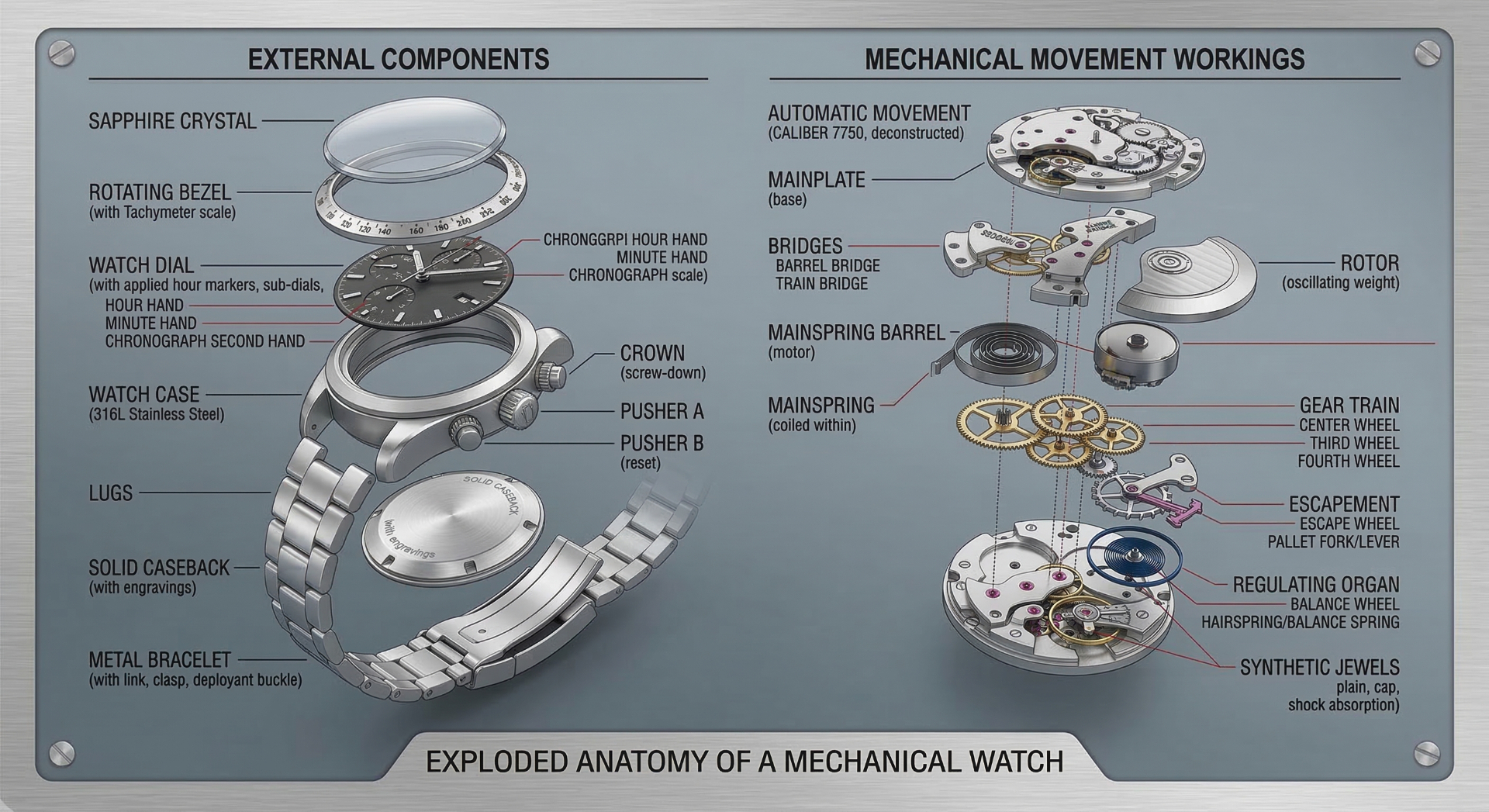
Embed This Infographic #
Share this infographic on your site. Copy the code below. Attribution link back to Indie Watches is required and must not be removed.
<a href="https://indiewatches.store/articles/watches/microbrand-watch-glossary" target="_blank" rel="noopener"><img src="https://lefggcfprztgqcbikmgj.supabase.co/storage/v1/object/public/community-images/covers%2Fmicrobrand-watch-glossary.jpg" alt="Exploded Anatomy of a Mechanical Watch" style="max-width:100%" /></a><p style="font-size:12px;text-align:center;margin-top:4px">Source: <a href="https://indiewatches.store/articles/watches/microbrand-watch-glossary" target="_blank" rel="noopener">Indie Watches</a></p>Where to Continue Learning #
Community Resources #
- IndieWatches.store: indiewatches.store/community (microbrand-focused discussions)
Hands-On Learning #
- Handle watches: Visit watch meetups, wind-up fairs (feeling quality differences teaches more than reading)
- Buy budget first: Start with $300–500 microbrands (VAER, Brew). Learn what you value before spending $2,000+.
- Strap experimentation: Buy cheap NATO/leather straps ($10–30). Discover how straps transform watches.
The Journey #
This glossary provides the foundation. Real learning happens wearing watches, reading forums, making mistakes (buying wrong sizes, movements you don't like, styles you outgrow). That's okay — it's part of the journey.
Welcome to the microbrand world. You're now equipped to speak the language.
Find Your Perfect Watch
Browse our curated collection of indie and microbrand timepieces.
📚 Related Reading
Handpicked articles from the same topic