DuFrane Watches Review: Austin-Assembled Swiss Tool Watches with Texas Heart
Every DuFrane watch is assembled, timed, and regulated by Steven personally in his Austin, Texas workshop. Swiss Sellita movements, DLC coating, quick-adjust clasps — all under $1,000.
Steven Thompson
Independent Watchmaker · 10 Years Experience
Reviewed by Indie Watches
Editorially reviewed for accuracy
⚡ Key Takeaways
- ✓Swiss Sellita movements (hand-regulated to ±4 seconds/day by Steven)
- ✓DLC-hardened cases (1200 Vickers—5X scratch resistance vs. untreated steel/titanium)
- ✓Quick-adjust clasps (10mm on-the-fly micro-adjustment—no tools required)
- ✓Tool-free strap changes (swap bracelet to NATO in 10 seconds)
- ✓Hand-assembly quality control (Steven personally inspects/times every watch)
📑 Table of Contents
DuFrane Watches Review: Austin-Assembled Swiss Tool Watches with Texas Heart #
When a watch collector quits corporate life to hand-assemble Swiss-powered watches in Austin—then prices them under $1,000.
📚 Explore our full watches guide →
Most American watch brands are marketing companies. Design in California, manufacture in China, assemble nowhere specific, slap "Designed in USA" on the dial. Call it a day.
Steven DuFrane does it differently.
Every DuFrane watch is assembled, timed, and regulated by Steven personally in his Austin, Texas workshop. Not "American brand that outsources assembly." Not "designed by Americans, made elsewhere." Actual hand-assembly by the founder himself—every single watch.
Hold a DuFrane dive watch. Check the case back engraving. It says "Assembled in Austin, TX" because Steven literally put this exact watch together at his workbench in southwest Austin. He installed the movement. He regulated the timekeeping. He tested water resistance. He packaged it for you.
This is craft watchmaking—Texas style.
Founded 2016, named after his mother's maiden name (DuFrane), every model named after Austin landmarks: Lake Travis, Barton Springs, Camp Mabry, Bergstrom Airport, the Waterloo district, Littlefield Building. Each watch tells Austin stories while delivering Swiss reliability at accessible prices.
$815-999 gets you:
- Swiss Sellita movements (hand-regulated to ±4 seconds/day by Steven)
- DLC-hardened cases (1200 Vickers—5X scratch resistance vs. untreated steel/titanium)
- Quick-adjust clasps (10mm on-the-fly micro-adjustment—no tools required)
- Tool-free strap changes (swap bracelet to NATO in 10 seconds)
- Hand-assembly quality control (Steven personally inspects/times every watch)
Compare that to mass-produced microbrands using same Sellita movements—Hamilton ($600-1,200), Oris ($2,000-4,000), Swiss brands charging premiums for Swiss Made labels. DuFrane offers Swiss movements, American assembly, superior features (DLC coating, quick-adjust, tool-free changes) at microbrand pricing.
This review explores whether one-man Austin operations can compete with established Swiss/Japanese brands, what $815-999 buys in build quality, how DuFrane's personal touch affects ownership experience, and whether American microbrand watchmaking has a future.
Spoiler: When the founder personally assembles your watch—and you can visit his Austin showroom to watch him work—it changes everything.
THE BRAND: FROM WATCH COLLECTOR TO AUSTIN WATCHMAKER #
Origins: Passion Project Becomes Business #
- Founded: 2016
- Founder: Steven (last name DuFrane—mother's maiden name)
- Location: Southwest Austin, Texas (edge of Texas Hill Country)
- Original career: Pilot (commercial aviation—Steven's first career before watches)
- Turning point: Lifelong watch collector, childhood fascination (bought first watch age 8), inherited grandfather's Wyler mechanical watch from mother, traveled Europe studying watchmaking history
- Decision: 2016—quit corporate career, launched DuFrane Watches to share passion with others
- Production philosophy: Hand-assembly, personal quality control, one-man operation scaling slowly, direct-to-consumer sales model
What "DuFrane" Means #
Name origin: Founder's mother's maiden name (paying homage to early influence on watch love)
Austin connection: Every model named after Austin landmarks/historical figures:
- Travis (Lake Travis—Austin reservoir)
- Barton Springs (natural spring-fed pool, Austin icon)
- Mabry (Camp Mabry—Texas military installation founded 1892)
- Bergstrom (Austin-Bergstrom Airport—formerly military base)
- Waterloo (original Austin settlement name before becoming Austin)
- Littlefield (Littlefield Building—historic Austin structure)
Motto: "History remembers those who are a little bit different"
Philosophy: Fusion of classic design, modern reliability, Austin essence—watches rooted in present, honoring past, inspiring future
The One-Man Assembly Line #
Steven's role:
- Designs every watch (in-house design, personally sketches/refines)
- Sources all components (cases, movements, crystals, bracelets)
- Assembles every watch by hand (dial installation, hand-setting, casing)
- Regulates every movement (times each watch to ±4 seconds/day minimum)
- Tests water resistance (pressure-tests every piece)
- Packs/ships orders personally
Workshop: Private facility, southwest Austin (showroom available by appointment—watch Steven work)
Annual output: Estimated hundreds annually (exact numbers unpublished—small-batch operation)
Quality control: 100% inspection (Steven personally checks each watch before shipping—no mass production QC failures)
THE DIFFERENTIATORS: FEATURES OTHER MICROBRANDS DON'T OFFER #
Feature #1: DLC Coating (1200 Vickers Hardness) #
The problem: Stainless steel scratches easily (200 Vickers typical). Titanium even softer (170 Vickers untreated). Daily desk diving, door frame bumps, accidental drops = scratches accumulating.
Industry solutions:
- PVD coating (black coating, 1500-2500 Vickers but wears through exposing base metal)
- Ceramic cases (hard but brittle—shatters if dropped)
- Accept scratches (polish out later—tedious)
DuFrane's solution: DLC coating (Diamond-Like Carbon) applied to all tool watch cases—Travis divers, Mabry field watches, Bergstrom pilots
How DLC works:
- Carbon atoms bonded to metal surface at molecular level
- Creates extremely hard surface layer (1200 Vickers hardness)
- 5-6X harder than untreated stainless steel/titanium
- Bonded permanently (won't wear through like PVD—no two-tone effect from coating loss)
Real-world results:
- Desk diving scratches minimal (hairline scratches other watches accumulate don't appear)
- Accidental impacts resistant (DLC absorbs abuse that would mar standard steel)
- Not invincible (deliberate abrasion still scratches—concrete, sandpaper—but massively better than untreated)
Price impact: DLC coating adds ~$100-150 to manufacturing cost. DuFrane includes it standard on tool watches—no upcharge. Competitors (Sinn, Formex, Damasko) charge $200-400 premiums for similar hardening.
Feature #2: Quick-Adjust Clasp (10mm On-the-Fly Micro-Adjustment) #
The problem: Wrists swell/shrink throughout day (temperature changes, activity, hydration). Traditional bracelets require tools to add/remove links—tedious. Micro-adjustment clasps offer 3-5mm adjustment typically—insufficient for significant swelling.
DuFrane's solution: Proprietary quick-adjust clasp with 10mm total micro-adjustment range—adjust on-the-fly without removing watch.
How it works:
- Push button on clasp side
- Slide adjustment mechanism (expands/contracts bracelet length)
- Release button (locks in position)
- Total range: 10mm (vs. typical 3-5mm micro-adjustments)
Real-world utility:
- Morning: Wrist cold, contracted—tighten bracelet 5mm
- Afternoon: Wrist swollen from heat/activity—loosen bracelet 8mm
- No tools required, adjust while wearing watch
Why this matters: Most people experience 5-10mm wrist size variance daily. Traditional micro-adjustments (3-5mm) insufficient. DuFrane's 10mm handles full daily variance without removing links.
Feature #3: Tool-Free Strap Changes #
The problem: Changing straps on traditional watches requires:
- Spring bar tool (risk scratching lugs)
- 5-10 minutes fumbling with spring bars
- Risk dropping/losing spring bars
- Intimidating for non-enthusiasts
DuFrane's solution: Quick-release system—swap bracelet to NATO strap in 10 seconds, no tools
How it works:
- Push buttons on lug undersides
- Spring-loaded bars retract
- Remove bracelet/strap
- Insert new strap, release buttons (bars extend, lock in place)
Real-world utility:
- Formal event: Wear bracelet
- Gym: Swap to NATO strap (2 button presses, 10 seconds)
- Beach: Rubber strap (no tools, instant change)
Why this matters: Strap versatility transforms watch wearability. One watch becomes 5+ different looks (bracelet, leather, NATO, rubber, hook-and-loop). DuFrane makes swapping effortless—encourages experimentation vs. intimidation.
THE WATCHES: KEY MODELS #
DuFrane Travis MkII (39mm Dive Watch) #
- Price: $899
- Case size: 39mm diameter × 12mm thickness
- Lug-to-lug: ~46mm (wears well on 6.5-7.5" wrists)
- Movement: Sellita SW200-1 elaboré grade (Swiss automatic, 28,800 bph, 38-hour power reserve)
- Water resistance: 200m (20 ATM—genuine dive watch rating, ISO 6425 compliant)
- Bezel: Unidirectional 120-click diving bezel (ceramic or hardened steel insert depending on variant)
- Case material: Marine-grade 316L stainless steel + DLC coating (1200 Vickers hardness)
Dial variants:
- 40 Acres (turquoise/teal—inspired by Austin's Zilker Park "40 Acres")
- Saddle Brown (brown sunburst—Texas heritage aesthetic)
- Slate Grey (grey dial—versatile daily wear)
- Lagoon (blue—classic dive watch)
DuFrane Travis MkII (DLC Coated Dive Watch) — Signature features:
- DLC coating (5X scratch resistance)
- Quick-adjust clasp (10mm micro-adjustment on-the-fly)
- Tool-free strap changes (10-second bracelet swaps)
- Flat sapphire crystal (3mm thick, 5-layer anti-reflective coating underneath)
- Swiss Super-LumiNova C3 (green lume, applied indices + hands)
Includes: 5-link solid bracelet (brushed + polished finishing) + premium seatbelt nylon passthrough strap
Named after: Lake Travis (Austin's main reservoir, created 1942 by Mansfield Dam, 600+ miles Colorado River, Highland Lakes region)
Why it's special:
- ✅ 39mm sizing rare (most divers 42mm+—Travis fits smaller wrists perfectly)
- ✅ DLC coating standard (competitors charge $200-400 extra for similar hardening)
- ✅ Quick-adjust clasp (10mm range exceeds typical 3-5mm micro-adjustments)
- ✅ Hand-regulated ±4 seconds/day (Steven personally times each watch—better than stock Sellita ±12 sec/day)
- ✅ Austin showroom access (visit Steven's workshop, watch assembly process)
Weaknesses:
- ❌ Brand unknown (zero recognition outside Texas watch enthusiasts)
- ❌ 39mm small for modern tastes (buyers wanting 42mm+ wrist presence may find too compact)
- ❌ Sellita SW200 ubiquitous (same movement as $500-2,000 competitors—no exclusivity)
Comparison:
- Seiko SPB143 ($1,050): Similar 39mm diver, no DLC coating, no quick-adjust, Japanese vs. Swiss movement
- Sinn 104 ($1,400-2,000): German tool watch, 41mm, similar hardening (tegiment), higher price
- Christopher Ward C60 Trident Pro ($1,000-1,300): 40mm, lacks DLC/quick-adjust, more established brand
Who should buy Travis MkII:
- 39mm dive watch seekers (perfect 6.5-7.5" wrists—rare sizing)
- Buyers prioritizing features over brand (DLC + quick-adjust + tool-free changes = exceptional value)
- Texas residents (visit Austin showroom, support local watchmaker)
- People wanting personal connection (Steven assembles your watch—direct relationship with maker)
DuFrane Mabry MkII (Titanium Field Watch with Compass Bezel) #
- Price: $999
- Case size: 39mm diameter × 11mm thickness (field watch proportions—slim, wearable)
- Movement: Sellita SW200-1 elaboré grade
- Water resistance: 100m (10 ATM—splash/rain resistant, light swimming acceptable)
- Case material: Titanium Grade 2 + DLC coating (1200 Vickers hardness)
- Bezel: Bidirectional compass bezel (N/S/E/W markings—functional navigation tool, not just aesthetic)
Dial variants:
- Field White (white dial, black numerals—classic field watch legibility)
- Service Blue (blue dial—military-inspired)
- Shadow Black (black dial—tactical aesthetic)
Signature features:
- Titanium construction (40% lighter than steel—68g vs. 110g+ steel divers)
- DLC-coated titanium (1200 Vickers hardness—titanium naturally soft at 170 Vickers untreated)
- Compass bezel functionality (align sun position with hour hand, rotate bezel to determine cardinal directions—survival tool)
- Applied ceramic numerals (3/6/9/12 positions—raised, dimensional)
- Swiss X1 grade SuperLumiNova (brightest lume available—brighter than standard C3)
- Engraved case back (Texas Military Wreath—honoring Camp Mabry heritage)
Includes: Full titanium Grade 2 bracelet (DLC-coated, quick-adjust clasp) + hook-and-loop strap (field watch practicality)
Named after: Camp Mabry (Austin military installation founded 1892, Texas' third-oldest military base, headquarters Texas Military Department, home to Texas Military Museum)
Why it's special:
- ✅ Titanium at $999 (competitors charge $1,500+ for titanium tool watches)
- ✅ Functional compass bezel (actual navigation utility—not decorative, instructions provided for using sun/hour hand method)
- ✅ Lightest DuFrane (68g titanium vs. 110g+ steel—all-day comfort)
- ✅ Military heritage (engraved Texas Military Wreath case back—unique regional pride)
- ✅ Brightest lume (X1 SuperLumiNova outperforms standard C3—critical for low-light fieldwork)
Weaknesses:
- ❌ Compass bezel learning curve (sun-position navigation requires understanding—not instant GPS)
- ❌ 100m WR only (field watches traditionally higher—150-200m better for outdoor abuse)
- ❌ Titanium finishing challenges (titanium harder to polish perfectly than steel—slight finishing variations possible)
Comparison:
- Sinn 556 ($1,200-1,600): Titanium field/tool watch alternative, no compass bezel, German vs. American assembly
- Hamilton Khaki Field Titanium ($800-1,000): Similar concept, lacks DLC coating/quick-adjust, established brand
- VAER D5 Titanium ($549): Budget titanium field watch, inferior finishing, no quick-adjust/DLC
Who should buy Mabry MkII:
- Outdoor enthusiasts (compass bezel functional for hiking/camping navigation)
- Titanium lovers (lightweight comfort, DLC-hardened scratch resistance)
- Field watch collectors (titanium field watches rare under $1,000)
- Texas military appreciation (Camp Mabry heritage, engraved case back)
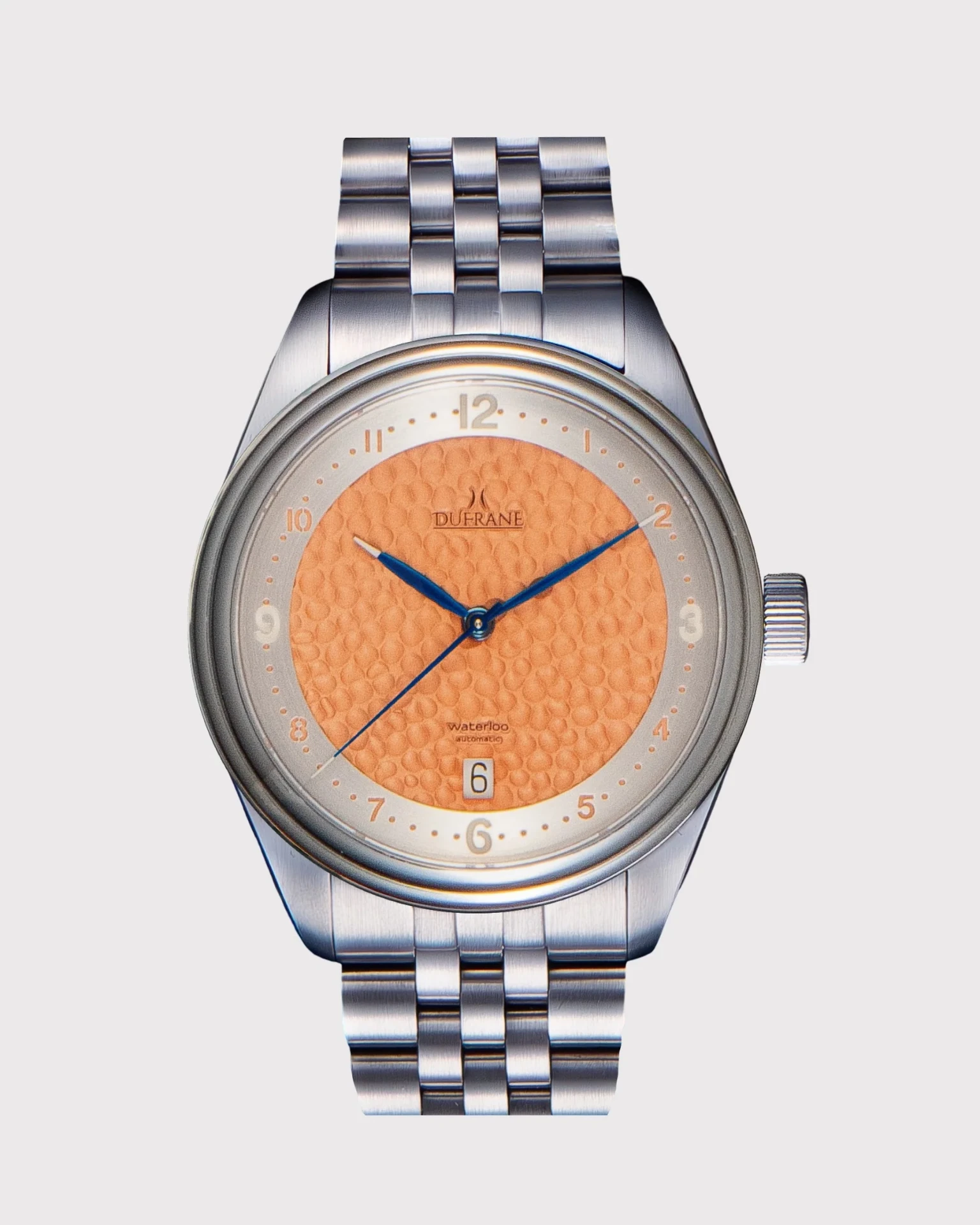
DuFrane Waterloo (Sporty Dress Watch) #
- Price: $815-999 (varies by configuration—bracelet vs. strap, dial variants)
- Case size: 38mm diameter × 10.6mm thickness (slim dress watch profile—slides under cuffs)
- Movement: Sellita SW200-1 elaboré grade
- Water resistance: 100m (10 ATM—suitable office/daily wear, light swimming)
- Case material: 316L stainless steel (polished + brushed mixed finishing—no DLC on dress model)
Dial variants:
- Blue dial (sunburst radial brushing)
- White/silver dial (classic elegance)
- Black dial (sporty-dress)
Signature features:
- Thermally blued hands (heat-treated steel—deep blue color, traditional watchmaking technique)
- Stepped bezel (Art Deco inspired geometric detailing—adds dimension vs. flat bezel)
- Linen textured dial (unique tactile surface—not typical sunburst/matte)
- Flat sapphire crystal (6 layers anti-reflective coating—exceptional clarity)
- Slim profile (10.6mm thin—proper dress watch proportions)
Includes: 5-link bracelet (solid links, mixed polished/brushed finishing) OR leather strap variants (depending on configuration)
Named after: Waterloo (original Austin settlement name before renamed Austin after Stephen F. Austin—Texas founding heritage)
Why it's special:
- ✅ Slim dress watch under $900 (10.6mm thin—genuine dress proportions vs. bloated "dress" watches)
- ✅ Thermally blued hands (traditional heat-treatment technique—luxury detail at accessible price)
- ✅ 38mm vintage sizing (dress watches should be restrained—Waterloo appropriately sized)
- ✅ Linen textured dial (unique surface treatment—not generic sunburst)
Weaknesses:
- ❌ No DLC coating (dress watch finishing prioritizes polish over hardness—scratches more easily)
- ❌ Limited versatility (dress-focused—not sports/casual crossover like Travis/Mabry)
- ❌ 38mm small for modern tastes (buyers wanting 40mm+ may find underwhelming)
Comparison:
- Seiko Presage Cocktail Time ($400-600): Similar dress aesthetic, 40mm, Japanese movement, lower price
- Hamilton Intra-Matic ($1,000-1,500): Swiss dress watch alternative, similar sizing, higher price
- Longines Master Collection ($1,800-2,500): Luxury dress watch, superior finishing/brand, 2-3X price
Who should buy Waterloo:
- Dress watch needs (formal occasions, business professional, weddings)
- Slim watch fans (10.6mm thin—proper dress proportions appreciated)
- Vintage sizing enthusiasts (38mm appropriate dress watch size)
- Budget under $1,000 (Swiss dress watch, thermally blued hands, quality finishing)
DuFrane Bergstrom MkIV (Pilot Watch) #
- Price: $999+
- Case size: 40mm+ (pilot watch proportions—larger dial, high legibility)
- Movement: Sellita SW200-1 elaboré grade
- Water resistance: 100m+
- Signature: Pilot watch design (large Arabic numerals, high-contrast dial, aviation heritage)
- Named after: Bergstrom Airport (Austin-Bergstrom International Airport, formerly Bergstrom Air Force Base—military aviation heritage)
Why it's special: First DuFrane model (hand-wound original Bergstrom symbolized early pilots strapping pocket watches to wrists—Steven's pilot background evident)
DuFrane Barton Springs III (Second Dive Watch Option) #
- Price: $899
- Variants: Quartz (Swiss Ronda R150) OR Automatic (Sellita SW200-1)—buyer choice
- Named after: Barton Springs Pool (natural spring-fed pool, Austin icon, 68-70°F year-round, Zilker Park location)
Why it's special: Date/no-date options, quartz alternative for buyers preferring battery accuracy
DuFrane Littlefield GMT #
- Price: TBD (pre-order/upcoming release)
- Complication: GMT (dual timezone functionality)
- Named after: Littlefield Building (historic Austin structure)
Why it's special: DuFrane's first GMT complication—expanding lineup beyond dive/field/dress
FINISHING QUALITY: HONEST MICROBRAND ASSESSMENT #
Case Finishing #
Polished surfaces:
- Mirror quality: 7/10 (good microbrand polishing—clean mirrors, not Grand Seiko/luxury Swiss perfection)
- Consistency: 7/10 (hand-assembly allows attention but also slight variance piece-to-piece)
Brushed surfaces:
- Grain uniformity: 8/10 (parallel brushing well-executed, consistent directionality)
Mixed finishing transitions:
- Polish/brush separation: 7/10 (clean transitions, not knife-edge precision but properly executed)
DLC coating:
- Scratch resistance: 9/10 (1200 Vickers demonstrably superior—desk diving, daily wear shows minimal scratching)
- Appearance: 8/10 (DLC adds slight grey tint vs. raw steel/titanium—acceptable trade-off for hardness)
Overall case finishing: 7.5/10 (good microbrand quality—exceeds $500 budget brands, below $2,000+ established Swiss)
Dial Finishing #
Printing:
- Sharpness: 8/10 (clean text, crisp logo/model names, minimal bleeding)
- Alignment: 8/10 (proper centering, straight marker placement)
Lume application:
- Coverage: 8/10 (even lume thickness, clean edges)
- Brightness: 8/10 (C3 standard bright, X1 grade exceptional on Mabry)
- Duration: 7/10 (4-6 hour glow typical—not extended 8+ hour lume)
Applied indices/numerals:
- Application: 8/10 (securely applied, proper alignment)
- Polishing: 7/10 (polished facets catch light well—not razor-sharp)
Overall dial finishing: 7.5-8/10 (clean, professional, legible—appropriate quality for price point)
Bracelet Finishing #
Link finishing:
- Polished sections: 7/10 (good mirrors initially—hairline scratches accumulate over time, typical steel bracelets)
- Brushed sections: 8/10 (consistent grain, quality execution)
- Solid construction: 9/10 (solid links throughout, zero rattle, substantial feel)
Clasp:
- Quick-adjust mechanism: 9/10 (smooth operation, secure locking, 10mm range exceptional)
- Finishing: 7/10 (functional, clean—not exceptional but adequate)
- Durability: 8/10 (reports of thousands of adjustments without failure)
Overall bracelet: 8/10 (excellent functionality via quick-adjust, good finishing, solid construction)
Movement Performance #
Sellita SW200-1 elaboré grade:
- Base movement: 7/10 (reliable Swiss workhorse, industry standard, proven track record)
- Steven's regulation: 8/10 (hand-regulated to ±4 seconds/day vs. stock ±12 sec/day—genuine improvement)
- Decoration: 6/10 (industrial Swiss movement—functional, not decorated with perlage/Côtes de Genève)
Real-world accuracy: Customer reports consistently cite ±2-5 seconds/day (Steven's regulation effective—exceeds stock Sellita performance)
Overall movement: 7.5/10 (reliable Swiss caliber, improved regulation, lacks decorative finishing)
VALUE PROPOSITION: WHAT $815-999 BUYS #
Component Breakdown (Travis MkII $899 Example) #
Materials + manufacturing:
- Sellita SW200-1 elaboré: ~$250 wholesale
- 316L steel case + DLC coating: ~$150-200
- Sapphire crystal (3mm, 5-layer AR): ~$50
- 5-link bracelet (solid): ~$100-150
- Quick-adjust clasp mechanism: ~$50
- Dial, hands, assembly hardware: ~$50-100
Labor + overhead:
- Steven's hand-assembly time: ~2-3 hours per watch
- Movement regulation + timing: ~1 hour per watch
- Water resistance testing: ~30 minutes per watch
- Total labor: ~4+ hours × $50/hour = ~$200 labor value
- Workshop overhead, packaging, shipping: ~$100-150
Total attributable cost: ~$950-1,200 (retail $899 = slim margin OR slight loss on introductory pricing)
Comparison pricing transparency: DuFrane pricing appears fair-to-generous. Swiss brands (Hamilton, Oris) with same Sellita movements charge $1,200-2,400. DuFrane adds DLC coating + quick-adjust clasp + personal assembly at lower pricing.
The Personal Assembly Premium #
What you're NOT paying for:
- ❌ Luxury brand heritage (DuFrane founded 2016—no centuries of history)
- ❌ Global marketing campaigns (zero advertising—word-of-mouth only)
- ❌ Celebrity endorsements (no athletes, no influencers)
- ❌ Retail boutique network (direct-to-consumer only—Austin showroom appointment-based)
What you ARE paying for:
- ✅ Steven's personal assembly (founder literally builds your watch—direct relationship)
- ✅ Hand-regulation (every movement timed/regulated individually—not batch QC)
- ✅ Proprietary features (DLC coating, quick-adjust, tool-free changes—competitors charge premiums)
- ✅ Texas craftsmanship (supporting American microbrand watchmaking vs. corporate imports)
- ✅ Austin showroom access (visit workshop, meet Steven, watch assembly process)
THE AUSTIN SHOWROOM EXPERIENCE #
Location: Southwest Austin (edge of Texas Hill Country—private workshop)
Appointment booking: dufranewatches.com/showroom (schedule private viewing)
What happens:
- Meet Steven personally (founder greets, discusses watch passion)
- See entire collection (try all models, compare sizing/aesthetics)
- Watch assembly process (Steven demonstrates dial installation, hand-setting, movement regulation if timing allows)
- Ask technical questions (Steven answers directly—no sales staff intermediary)
- Custom requests possible (discuss dial preferences, bracelet options, special orders)
Why this matters: Buying watches from corporations = transactional. Buying DuFrane = meeting the person who will assemble your watch. This personal connection transforms ownership experience—you're supporting craftsman directly, not enriching shareholders.
COMPARISONS: DUFRANE VS. COMPETITORS #
DuFrane vs. Hamilton (Swiss Brand, American Heritage) #
Similarities:
- Swiss movements (both use Sellita/ETA calibers)
- American connections (Hamilton Pennsylvania heritage, DuFrane Austin assembly)
- Similar pricing ($800-1,200 range overlap)
Differences:
- DuFrane: Hand-assembled by founder, DLC coating standard, quick-adjust clasp, Austin showroom access, unknown brand
- Hamilton: Mass-produced (Swatch Group owned), no DLC coating, standard clasps, global retail network, established brand (130+ years)
When to choose DuFrane:
- Want personal assembly (Steven builds your watch vs. factory production)
- Prioritize features (DLC coating, quick-adjust worth more than brand recognition)
- Prefer supporting independents (one-man operation vs. corporate conglomerate)
When to choose Hamilton:
- Want established brand (Hamilton globally recognized, 130+ year heritage)
- Need global service network (Swatch Group worldwide support vs. DuFrane limited)
- Value aviation heritage (Hamilton's military/aviation history deeper than DuFrane)
DuFrane vs. Christopher Ward (UK Direct-to-Consumer) #
Similarities:
- Direct-to-consumer model (both cut retail middlemen)
- Swiss movements (Sellita calibers)
- Value proposition (quality exceeding price points)
- Under-the-radar brands (minimal mainstream recognition)
Differences:
- DuFrane: American assembled (Austin, TX), DLC coating, quick-adjust, tool-free changes, $815-999 pricing
- Christopher Ward: UK/Swiss hybrid, light-play case finishing, twin-flag logo, $800-1,500 pricing, more established (20+ years)
When to choose DuFrane:
- Want American assembly (vs. CW UK design/Swiss manufacturing)
- Prioritize DLC coating + quick-adjust (CW lacks both)
- Prefer Austin showroom access (meet Steven personally vs. CW online-only)
When to choose Christopher Ward:
- Want distinctive design (CW twin-flag logo, light-play cases more recognizable)
- Prefer established microbrand (CW 20+ years, larger production, proven track record)
- Value case finishing (CW light-play finishing technique superior to DuFrane standard polishing)
DuFrane vs. Seiko (Japanese Mass Production) #
Similarities:
- Reliable movements (Seiko in-house, DuFrane Sellita—both proven)
- Tool watch focus (divers, field watches, sports watches)
- Value pricing ($500-1,500 range)
Differences:
- DuFrane: Hand-assembled (Steven personally), Swiss movements, DLC coating, quick-adjust, American craftsmanship, $815-999
- Seiko: Mass-produced (factory assembly), Japanese movements (in-house 4R/6R), no DLC, standard clasps, global brand, $200-1,500 wide range
When to choose DuFrane:
- Want Swiss movements (Sellita vs. Seiko 4R/6R—different character, not necessarily better)
- Prioritize DLC coating (Seiko lacks on most sub-$1,000 models)
- Value personal assembly (Steven builds vs. factory production)
- Need quick-adjust clasp (Seiko standard micro-adjustments only)
When to choose Seiko:
- Want in-house movements (Seiko manufactures own calibers—vertical integration)
- Prefer Japanese finishing (Grand Seiko lineage, zaratsu polishing techniques filter down)
- Need budget options (Seiko $200-500 models competitive, DuFrane starts $815)
- Value global brand (Seiko worldwide recognition/service vs. DuFrane Texas-focused)
WHO SHOULD BUY DUFRANE? #
Perfect Buyer Profile #
- ✅ Texas residents: Austin showroom access, support local craftsmanship, regional pride (Austin landmarks naming)
- ✅ Personal connection seekers: Value knowing who assembled watch, direct relationship with maker
- ✅ Feature prioritizers: DLC coating + quick-adjust clasp + tool-free changes matter more than brand logos
- ✅ Swiss movement fans on budget: Want Sellita reliability under $1,000 (vs. $1,200+ established Swiss brands)
- ✅ 39mm sizing fans: Travis/Mabry 39mm perfect for 6.5-7.5" wrists (modern watches too large)
- ✅ Tool watch users: Actually dive/hike/work in watches (DLC coating, quick-adjust, tool-free changes genuinely useful)
- ✅ Microbrand supporters: Appreciate one-man operations, craft watchmaking, independent alternatives to corporate brands
- ✅ Austin landmark enthusiasts: Lake Travis, Barton Springs, Camp Mabry, Waterloo historical connections resonate
Wrong Buyer Profile #
- ❌ Brand prestige seekers: Nobody recognizes DuFrane (wear to impress = buy Omega, Tudor, Rolex)
- ❌ Investment focus: DuFrane resale value unknown (buy established brands for value retention)
- ❌ Global travel frequent: Limited service network (Austin-based—international travel = service challenges)
- ❌ Movement decoration fans: Sellita SW200 industrial (buy Grand Seiko, luxury Swiss for exhibition caseback beauty)
- ❌ Large wrist owners: 7.5-8"+ wrists may find 39mm Travis/Mabry too small (need 42mm+ wrist presence)
- ❌ Established brand comfort: Prefer known quantities (Hamilton, Seiko, Oris = safer choices for risk-averse)
- ❌ Budget under $800: DuFrane entry $815 (buy Seiko, Orient, Citizen for sub-$500 options)
BUYING DUFRANE: PRACTICAL GUIDE #
Where to Buy #
- Official DuFrane website: dufranewatches.com (primary sales channel—direct from Steven)
- Austin showroom: Schedule private appointment (dufranewatches.com/showroom—meet Steven, try watches)
- Secondary market: Minimal (brand too new/small for robust secondary market—occasional WatchExchange Reddit listings)
- IndieWatches.store: Check availability: indiewatches.store/marketplace
Recommendation: Buy direct from dufranewatches.com OR visit Austin showroom (supports Steven directly, warranty included, personal experience)
Pricing Guide #
| Model | Price (USD) |
|---|---|
| Waterloo dress | $815-999 (varies by configuration) |
| Travis MkII dive | $899 |
| Barton Springs III dive | $899 (quartz or automatic options) |
| Mabry MkII titanium field | $999 |
| Bergstrom MkIV pilot | $999+ |
| Littlefield GMT | TBD (pre-order) |
What's Included #
All models ship with bracelet + secondary strap (NATO, rubber, leather, or hook-and-loop depending on model)
- Warranty: 2 years (standard microbrand warranty—Steven services personally)
- Shipping: Free domestic (US), flat-rate international
What to Inspect Before Buying #
- ✅ Quick-adjust clasp function: Test adjustment mechanism—should operate smoothly, lock securely across 10mm range
- ✅ Tool-free strap change: Test quick-release buttons—should retract/extend spring bars easily, no sticking
- ✅ DLC coating consistency: Inspect under light—should be uniform grey-tinted finish, no coating gaps/inconsistencies
- ✅ Movement timing: Request timing info (Steven provides regulation results—should be ±4 seconds/day or better)
- ✅ Crystal clarity: Check sapphire for distortion/defects (5-layer AR coating should show minimal reflections)
- ✅ Bracelet solid link quality: Shake watch—should be zero rattle (solid links throughout, not hollow)
FINAL VERDICT: CRAFT WATCHMAKING WITH TEXAS HEART #
What DuFrane Gets Right #
- ✅ Personal assembly by founder (Steven hand-builds every watch—genuine craft watchmaking, not marketing claim)
- ✅ Proprietary features at accessible pricing (DLC coating + quick-adjust clasp + tool-free changes = $200-400 value vs. competitors)
- ✅ Swiss movements hand-regulated (Sellita SW200-1 timed to ±4 seconds/day—exceeds stock performance)
- ✅ Austin showroom experience (meet Steven, watch assembly, ask technical questions—personal connection)
- ✅ Texas landmark heritage (every model named after Austin icons—regional pride, storytelling)
- ✅ 39mm sizing options (Travis/Mabry perfect for smaller wrists—rare in modern market)
- ✅ DLC coating standard (competitors charge $200-400 premiums—DuFrane includes no upcharge)
- ✅ Honest pricing (slim margins, fair component value, direct-to-consumer savings passed to buyers)
What DuFrane Gets Wrong #
- ❌ Brand unknown (zero recognition outside Texas watch community—wear for yourself only)
- ❌ Limited production capacity (Steven assembles personally—hundreds annually, not thousands—availability sporadic)
- ❌ Service network small (Austin-based operation—international buyers face service logistics challenges)
- ❌ Movement finishing industrial (Sellita SW200 functional, not decorated—exhibition caseback disappointing)
- ❌ Resale value uncertain (new brand, small production = limited secondary market, steep depreciation likely)
- ❌ 39mm too small for some (modern buyers wanting 42mm+ wrist presence may find underwhelming)
- ❌ Texas-centric naming (Austin landmarks resonate locally, less meaningful internationally)
The Recommendation #
Buy DuFrane if:
- You value personal craftsmanship (knowing Steven assembled your watch matters)
- Features justify price (DLC + quick-adjust + tool-free changes worth $899-999)
- You're Texas resident (showroom access, support local, Austin landmark appreciation)
- Swiss movements under $1,000 priority (Sellita reliability at accessible pricing)
- 39mm sizing preference (smaller wrists, vintage proportions)
- Microbrand philosophy appeals (supporting one-man operations vs. corporations)
Skip DuFrane if:
- Brand recognition matters (nobody knows DuFrane—buy Hamilton, Seiko, Oris instead)
- Investment focus (buy Rolex, Omega, Tudor for value retention)
- Want movement finishing (buy Grand Seiko for exhibition casebacks)
- Need global service network (established brands = worldwide support)
- Prefer larger watches (42mm+ modern sizing—DuFrane focuses 38-39mm)
- Budget under $800 (buy Seiko, Orient, Citizen for entry pricing)
The Bottom Line #
DuFrane represents American craft watchmaking at its purest: one watchmaker, one workshop, one watch at a time.
Is it better than established Swiss/Japanese brands? Not objectively—Hamilton has 130 years heritage, Seiko has in-house movements, Grand Seiko has superior finishing. But DuFrane offers something they can't: Steven's personal assembly, hand-regulation, and direct relationship with the maker.
When you buy DuFrane, you're not buying logo prestige. You're supporting Austin craftsmanship. You're getting Swiss reliability with American assembly. You're joining a community of watch enthusiasts who value personal connection over corporate brands.
And if that resonates—if you'd rather shake Steven's hand in his Austin workshop than browse sterile boutiques—DuFrane delivers exceptional value at honest pricing.
Find Your Perfect Watch
Browse our curated collection of indie and microbrand timepieces.
📚 Related Reading
Handpicked articles from the same topic