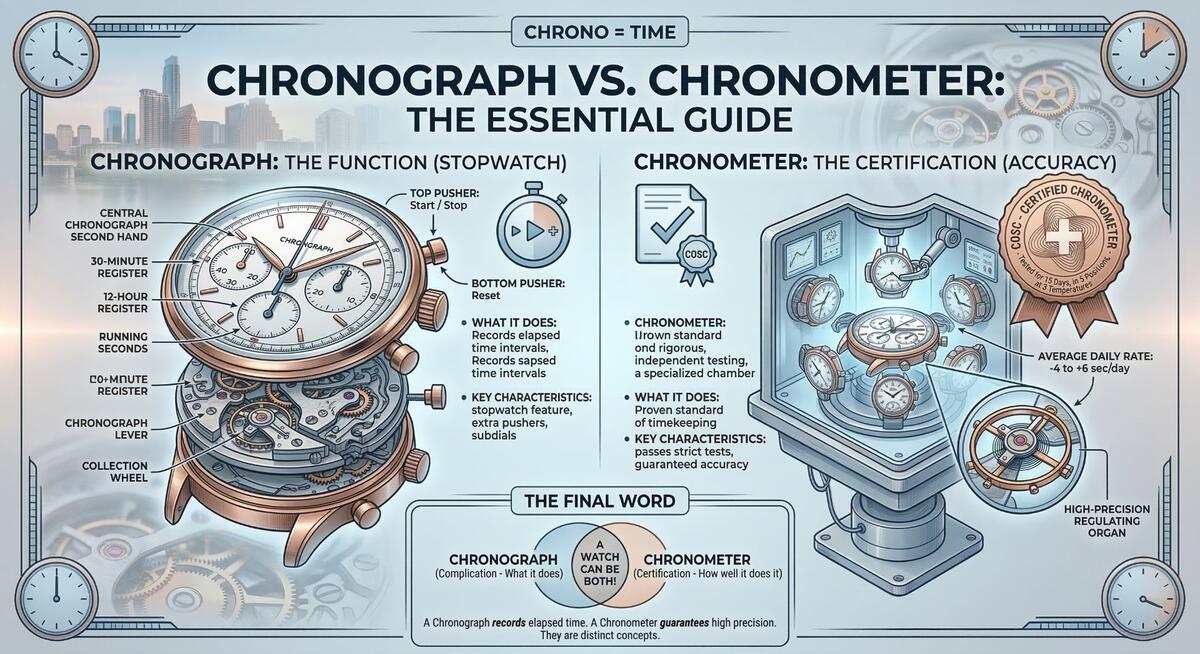
Chronograph vs. Chronometer: What's the Difference?
One's a stopwatch. One's an accuracy certification. Both get confused constantly. This guide ends the confusion forever.
Steven Thompson
Independent Watchmaker · 10 Years Experience
Reviewed by Indie Watches
Editorially reviewed for accuracy
⚡ Key Takeaways
- ✓Chronograph = Stopwatch complication (function you can see and use—pushers, subdials, sweeping hand)
- ✓Chronometer = Accuracy certification (invisible quality standard—movement tested for precision)
- ✓You're shopping for watches online
- ✓Your brain: Aren't those the same thing? Is this redundant marketing speak?
- ✓Yet 70% of watch buyers confuse these terms
📑 Table of Contents
One's a stopwatch. One's an accuracy certification. Both get confused constantly.
📚 Explore our full watches guide →
You're shopping for watches online. The description reads: "Swiss chronograph movement, COSC chronometer certified."
Your brain: Aren't those the same thing? Is this redundant marketing speak?
No. They're completely different.
Definitions #
- Chronograph = Stopwatch complication (function you can see and use—pushers, subdials, sweeping hand)
- Chronometer = Accuracy certification (invisible quality standard—movement tested for precision)
A watch can be:
- Chronograph only (stopwatch function, not certified for accuracy)
- Chronometer only (certified accurate, no stopwatch)
- Both (chronograph stopwatch that's also accuracy-certified)
- Neither (simple time-only watch, standard accuracy)
Yet 70% of watch buyers confuse these terms. Ask ten people "What's a chronometer?" and seven will say "the thing with the stopwatch buttons." Wrong. That's a chronograph.
This confusion is understandable—the words sound identical (both start "chrono," both end similarly). But mixing them up is like confusing "horsepower" (engine capability) with "emissions certified" (environmental standard). Related to cars, completely different meanings.
This guide ends the confusion forever.
We'll explain exactly what each term means, how they work, their histories, real-world examples, pricing implications, and—most importantly—which actually matters when buying a watch.
By the end, you'll understand:
- ✅ Chronograph mechanisms (how stopwatch complications work, mechanical vs. meca-quartz)
- ✅ Chronometer certifications (COSC standards, testing procedures, what accuracy means)
- ✅ Real-world examples — Omega Speedmaster = chronograph; Rolex Submariner = chronometer
- ✅ Pricing impact — Does chronograph or chronometer add more value?
- ✅ Which matters more — For YOUR needs—do you need stopwatch or guaranteed accuracy?
Let's eliminate this confusion once and for all.
THE SIMPLE ANSWER (If You Only Read One Section) #
Chronograph = Stopwatch Function #
What it is: A complication (additional function beyond telling time) that lets you measure elapsed time—like a stopwatch.
How you know a watch has it: #
- Two or three pushers on case side (usually 2 o'clock and 4 o'clock positions)
- Subdials on main dial (small circles showing elapsed seconds, minutes, hours)
- Large central seconds hand that starts/stops/resets when you press pushers
What you can do with it: #
- Time your run (press start, run, press stop, read elapsed time)
- Time cooking (boil eggs exactly 7 minutes)
- Measure meeting length (see how long that pointless presentation lasted)
- Calculate speed (using tachymeter scale—more on this later)
Examples: #
- Omega Speedmaster Professional (NASA moon watch—famous chronograph)
- Rolex Daytona (racing chronograph, $30,000+)
- Seiko Prospex chronographs ($400-800)
- Baltic Bicompax ($1,695—vintage-inspired chronograph)
Price impact: #
Chronograph adds $200-500 to watch cost (vs. time-only version, same brand/quality)
Chronometer = Accuracy Certification #
What it is: A certification that the watch movement has been tested and proven to keep time extremely accurately.
How you know a watch has it: #
- "Chronometer" or "Superlative Chronometer" printed on dial (often at 6 o'clock or 12 o'clock)
- COSC certification mentioned in specs (Contrôle Officiel Suisse des Chronomètres)
- Accuracy specification: -4/+6 seconds per day (COSC standard)
What it means: #
- Your watch won't gain/lose more than 4-6 seconds daily (very accurate for mechanical watch)
- Movement tested 15 days in 5 positions at 3 temperatures (rigorous testing)
- Quality assurance (manufacturer cared enough to certify accuracy)
What you can't see: #
- Nothing. Chronometer certification is invisible—no buttons, no subdials, no moving parts you interact with
- It's a guarantee of accuracy, not a feature you use
Examples: #
- Rolex Submariner (COSC chronometer certified—"Superlative Chronometer" on dial)
- Omega Seamaster (COSC + METAS chronometer certified—dual standards)
- Breitling Navitimer (chronograph that's ALSO chronometer—both terms apply)
- Grand Seiko (many models chronometer-level accuracy without COSC certification)
Price impact: #
Chronometer certification adds $200-400 to watch cost (testing, regulation, quality control)
Can a Watch Be Both? #
Yes. Absolutely.
Example: Breitling Navitimer #
- Chronograph? YES (has stopwatch function—pushers, subdials, timing capability)
- Chronometer? YES (COSC certified for accuracy—tested, guaranteed ±4-6 sec/day)
The Navitimer is a chronometer-certified chronograph. It's a stopwatch (chronograph) that's also accuracy-certified (chronometer).
Example: Omega Speedmaster Professional (Moonwatch) #
- Chronograph? YES (famous stopwatch—NASA used it to time moon missions)
- Chronometer? NO (not COSC certified—Omega chose not to certify it, though accuracy is good)
The Speedmaster is a chronograph without chronometer certification. It has stopwatch function but isn't accuracy-certified.
Example: Rolex Submariner #
- Chronograph? NO (no stopwatch function—just time, date, rotating bezel)
- Chronometer? YES (COSC "Superlative Chronometer"—certified accurate)
The Submariner is a chronometer without chronograph. It's certified accurate but has no stopwatch.
Example: Seiko SKX007 #
- Chronograph? NO (no stopwatch)
- Chronometer? NO (not certified—though accuracy decent for price)
The SKX is neither. It's a simple dive watch—tells time, has date, rotating bezel. No stopwatch, no certification.
PART 1: CHRONOGRAPH IN DEPTH #
What Chronograph Means (Literally) #
Etymology: #
- Chrono = Greek for "time"
- Graph = Greek for "writing" or "recording"
Chronograph = "time writer" or "time recorder"
Early chronographs literally wrote time—Louis Moinet's 1816 invention used pen marking paper dial. Press button, pen drops onto rotating dial, marks time. Primitive but functional.
Modern chronographs don't write—they display elapsed time via hands moving around subdials. But the name stuck.
How Chronographs Work (Mechanical) #
The challenge: Adding stopwatch to watch without interfering with timekeeping.
The solution: Separate gear train (chronograph mechanism) that engages/disengages from main timekeeping movement.
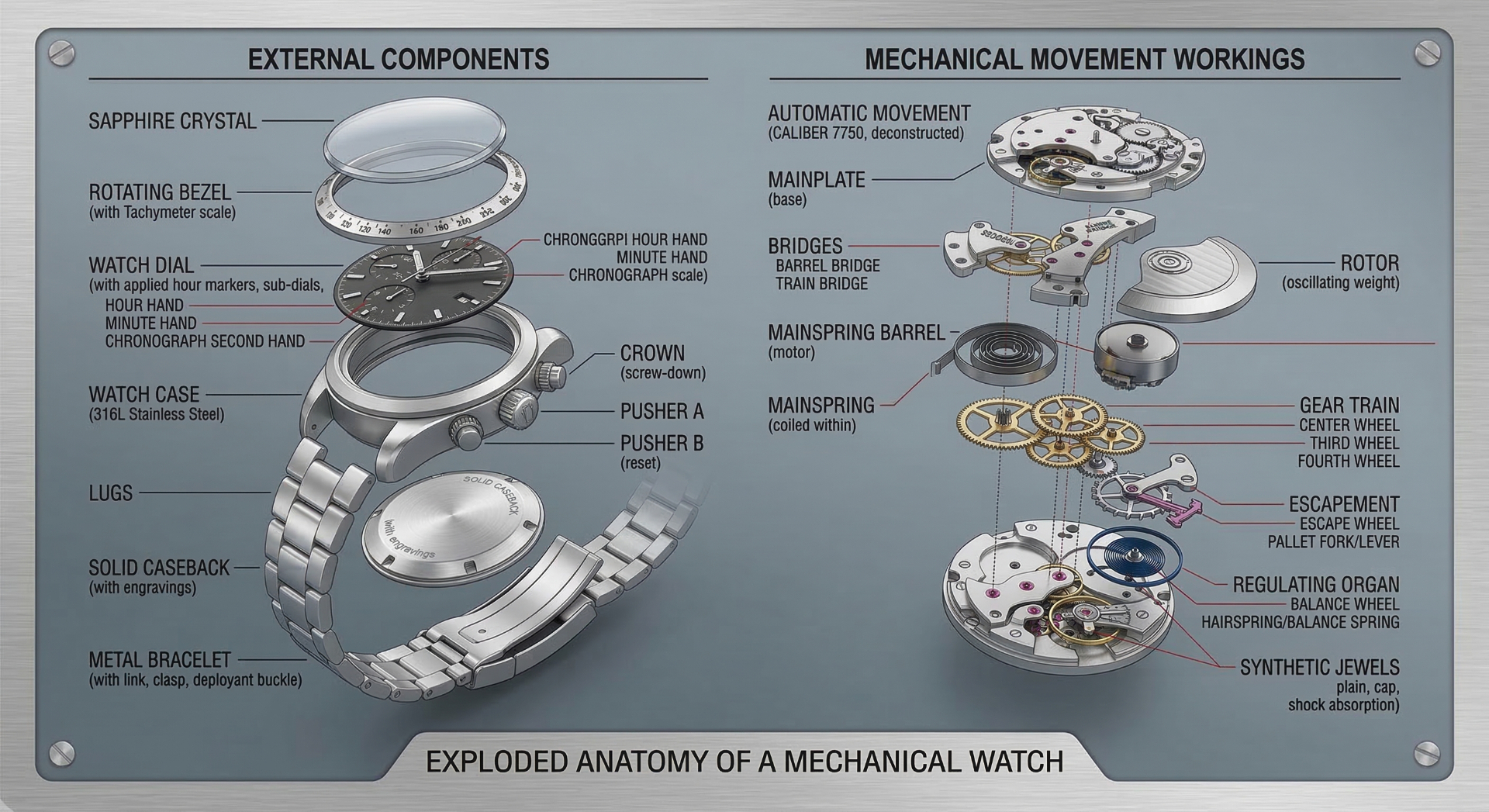
Basic chronograph components: #
1. Pushers (buttons on case side):
- Top pusher (2 o'clock): Start/stop chronograph
- Bottom pusher (4 o'clock): Reset chronograph to zero
2. Hands:
- Central chronograph seconds hand: Large sweeping hand (starts/stops when timing)
- Subdial hands: Small hands in subdials showing elapsed minutes, hours
3. Subdials (small circles on main dial):
- 30-minute counter: Tracks elapsed minutes (0-30)
- 12-hour counter: Tracks elapsed hours (0-12)
- Running seconds: Shows movement is running (not part of chronograph—just timekeeping)
4. Internal mechanism:
- Clutch: Engages/disengages chronograph from main movement
- Column wheel or cam: Controls start/stop/reset functions (column wheel = traditional, cam = modern/cheaper)
- Chronograph gear train: Separate gears driving chronograph hands
How to Use a Chronograph #
Timing something: #
- Press top pusher once: Chronograph starts (central seconds hand begins sweeping)
- Wait: Let time elapse (hand continues moving)
- Press top pusher again: Chronograph stops (hand freezes, showing elapsed time)
- Read subdials: Check elapsed minutes (30-min counter), hours (12-hr counter)
- Press bottom pusher: Reset to zero (all chronograph hands return to 12 o'clock)
Example: Timing 10K run #
- Start: Press top pusher as you begin running
- Run: Central seconds hand sweeps, minute counter advances
- Finish: Press top pusher when crossing finish line
- Result: Read time—maybe 45 minutes, 23 seconds
- Reset: Press bottom pusher to zero everything for next use
Chronograph Complications (Variations) #
Basic chronograph:
- Central seconds, 30-minute counter, 12-hour counter
- Most common configuration
Flyback chronograph: #
- Press pusher — hands fly back to zero and immediately start timing again
- Used in aviation (time multiple events consecutively without stopping)
- More complex/expensive ($500-1,000 premium vs. basic)
Split-seconds (rattrapante) chronograph #
- TWO central seconds hands (one overlays other)
- Time two simultaneous events with different end times
- Example: Time two runners—first hand stops for runner #1, second continues for runner #2
- Extremely complex (watchmaking's most difficult complication)
- Found in $20,000-100,000+ watches
Monopusher chronograph #
- Single pusher controls start/stop/reset (all three functions via one button)
- Press once: Start
- Press again: Stop
- Press third time: Reset
- Vintage aesthetic (1930s-1950s chronographs used monopusher)
Chronograph Movements: Mechanical vs. Meca-Quartz #
Mechanical chronograph #
- Automatic or hand-wound movement
- Spring-driven (no battery)
- Column wheel or cam-driven chronograph mechanism
- Smooth sweeping chronograph hand (8 beats/second typical)
Common movements: #
- Valjoux 7750: Swiss workhorse ($300-500 wholesale, found in $2,000-5,000 watches)
- Seiko 6S28: Japanese alternative ($150-250 wholesale, found in $800-1,500 watches)
- Sellita SW510: Swiss, based on Valjoux 7750 ($350-600 wholesale)
Price: Mechanical chronographs typically $1,500-3,000 entry (microbrand tier), $3,000-10,000 Swiss tier
Meca-quartz chronograph #
- Battery-powered timekeeping (quartz)
- Mechanical chronograph module (spring-driven stopwatch mechanism)
- Best of both: Quartz accuracy for time, mechanical smoothness for chronograph
Seiko VK63/VK64 #
Most popular meca-quartz ($30-50 wholesale, found in $300-600 watches)
- Smooth chronograph hand (not stepping like pure quartz)
- Mechanical "click" when pressing pushers (satisfying tactile feedback)
Advantages: #
- Affordable ($300-600 watches can have chronograph vs. $1,500+ mechanical)
- Accurate timekeeping (quartz for time = ±15 sec/month vs. mechanical ±20 sec/day)
- Smooth chronograph sweep (mechanical module = sweeping hand vs. stepping quartz)
- Low maintenance (battery every 2-3 years vs. mechanical service every 5-7 years)
Disadvantages: #
- Less prestige (not fully mechanical—some purists dismiss)
- Battery required (not self-winding like automatic)
Best use: #
Budget chronographs (Brew Metric $525, Dan Henry 1962 $270)—excellent stopwatch function without $2,000 mechanical cost
Tachymeter Scale (Chronograph's Best Friend) #
What it is: #
Numbers printed on bezel or dial edge (usually starting at 500, ending at 60)
What it does: #
Converts elapsed time into speed (units per hour)
How to use: #
Example: Calculate car speed #
- Note mile marker on highway
- Start chronograph when passing marker
- Stop chronograph when passing next mile marker (1 mile traveled)
- Read tachymeter where chronograph hand stopped
- Number shown = miles per hour
If chronograph stopped at 12 o'clock (60 seconds): Tachymeter reads 60 = 60 MPH
If chronograph stopped at 40 seconds: Tachymeter reads 90 = 90 MPH
Math: #
Tachymeter calculates 3,600 seconds (1 hour) ÷ elapsed seconds = units per hour
Other uses: #
- Production rate (how many widgets manufactured per hour?)
- Heartbeat (count 30 beats, use tachymeter to calculate beats per minute)
Limitation: #
Only works for times under 60 seconds (most tachymeters start at 500, end at 60)
Famous Chronographs #
Omega Speedmaster Professional ("Moonwatch"): #
- NASA-certified (only watch qualified for spacewalks)
- Manual-wound Omega 1861 movement
- Hesalite crystal (plastic—doesn't shatter in zero gravity)
- Tachymeter bezel
- Price: $6,000-7,000
- Chronograph? YES. Chronometer? NO (not COSC certified)
Rolex Daytona: #
- Racing chronograph (named after Daytona International Speedway)
- Automatic Rolex 4130 movement (in-house)
- Ceramic bezel, COSC chronometer certified
- Price: $30,000-40,000+ (waitlists, gray market markups)
- Chronograph? YES. Chronometer? YES (both)
Breitling Navitimer: #
- Aviation chronograph (slide rule bezel for flight calculations)
- Automatic Breitling B01 movement
- COSC chronometer certified
- Price: $8,000-12,000
- Chronograph? YES. Chronometer? YES (both)
TAG Heuer Carrera: #
- Racing heritage (1960s motorsport chronograph)
- Various movements (ETA/Sellita-based, some in-house)
- Price: $3,000-6,000
- Chronograph? YES. Chronometer? Usually NO (most not COSC certified)
PART 2: CHRONOMETER IN DEPTH #
What Chronometer Means (Literally) #
Etymology: #
- Chrono = Greek for "time"
- Meter = Greek for "measure"
Chronometer = "time measurer"
COSC Certification: The Gold Standard #
COSC = Contrôle Officiel Suisse des Chronomètres
- English: "Official Swiss Chronometer Testing Institute"
- Swiss non-profit founded 1973
- Independent testing agency (not affiliated with watch brands)
What COSC does: #
Tests watch movements for accuracy across multiple positions, temperatures, conditions. Issues certificate if movement meets standards.
COSC Testing Procedure #
Duration: 15 days continuous testing
Conditions: #
- 5 positions: Dial up, dial down, crown up, crown left, crown right (gravity affects accuracy differently in each position)
- 3 temperatures: 8°C (46°F), 23°C (73°F), 38°C (100°F) (temperature affects metal expansion, lubrication viscosity)
Measurements: #
- Daily rate deviation in each position
- Mean daily rate (average across all positions)
- Greatest variation (largest difference between positions)
- Rate variation across temperature changes
Passing criteria: #
- Mean daily rate: -4 to +6 seconds per day (watch can lose up to 4 seconds or gain up to 6 seconds daily)
- Mean variation: Maximum 2 seconds per day difference across positions
- Greatest variation: Maximum 5 seconds difference between any two positions
- Rate variation: Maximum 0.6 seconds per °C temperature change
If movement passes: COSC issues certificate, movement gets "chronometer" designation
If movement fails: Watchmaker adjusts movement, resubmits (no limit on attempts)
What COSC Certification Guarantees #
- Accuracy: -4/+6 seconds per day (very good for mechanical watch)
- Consistency: Performs similarly in different positions (doesn't gain time dial-up, lose time crown-down)
- Temperature stability: Accuracy doesn't degrade in cold/heat (important for daily wear—body temperature, weather changes)
- Quality control: Manufacturer cared enough to submit for testing (signal of overall quality standards)
What COSC Doesn't Guarantee #
- After-casing accuracy: COSC tests movements before being put in cases. Once cased, accuracy can change (case pressure, magnetic fields, daily wear affects accuracy)
- Long-term accuracy: Certificate valid at testing moment. Years later, lubrication degrades, parts wear—accuracy drifts. Service every 5-7 years maintains accuracy.
- Better movement than non-certified: Many non-COSC movements keep time just as well (Grand Seiko famously doesn't COSC-certify but exceeds COSC standards). COSC = proof, not necessarily superiority.
COSC vs. Non-COSC: Real-World Accuracy #
| Standard | Accuracy |
|---|---|
| COSC chronometer: | -4/+6 seconds per day |
| Quality non-COSC automatic: | -10/+20 seconds per day (typical Seiko NH35, Miyota 9015) |
| Grand Seiko (non-COSC): | -3/+5 seconds per day or better (exceeds COSC without certification) |
| Quartz watch (any brand): | ±15 seconds per MONTH (10-20X more accurate than COSC mechanical) |
Perspective: #
- COSC chronometer losing 4 sec/day = 2 minutes/month = 24 minutes/year
- Quality non-COSC losing 15 sec/day = 7.5 minutes/month = 90 minutes/year
Difference: ~60 minutes per year (1 hour total drift difference between COSC vs. quality non-COSC)
Does it matter? For most people, no. You reset your watch periodically anyway (after not wearing a few days, after traveling, when changing date). The extra accuracy rarely impacts daily life.
When it matters: Professionals needing precision (pilots, sailors navigating by chronometer in pre-GPS era), watch enthusiasts valuing certification prestige, collectors wanting guaranteed accuracy.
Alternative Chronometer Certifications #
METAS (Master Chronometer): #
- Omega's proprietary certification (2014+)
- Stricter than COSC: 0/+5 seconds per day (vs. COSC -4/+6)
- Tests fully cased watch (vs. COSC testing movement only)
- Tests magnetism resistance (15,000 gauss—huge for everyday electronics exposure)
- Tests water resistance, power reserve
- Found on: Modern Omega (Seamaster, Speedmaster, Constellation)
Patek Philippe Seal: #
- Patek's in-house certification (replacing COSC)
- Stricter accuracy: -3/+2 seconds per day
- Tests entire watch (movement, case, finishing, functionality)
- Found on: All Patek Philippe watches (2009+)
Rolex Superlative Chronometer: #
- Rolex internal certification (after COSC)
- Stricter accuracy: -2/+2 seconds per day (after casing)
- Double certification: COSC first (movement), then Rolex tests cased watch
- Found on: All modern Rolex
Grand Seiko standard: #
- Not COSC certified (Grand Seiko chooses not to submit)
- Accuracy: -3/+5 seconds per day (better than COSC)
- Internal testing (rigorous Japanese quality control)
- Proves COSC isn't only accuracy standard
Famous Chronometers (Non-Chronograph) #
Rolex Submariner: #
- Dive watch (rotating bezel, 300m WR, no stopwatch)
- COSC + Rolex Superlative Chronometer (-2/+2 sec/day)
- Price: $9,100-10,000+
- Chronograph? NO. Chronometer? YES
Omega Seamaster (modern): #
- Dive watch (rotating bezel, 300m WR, no stopwatch)
- COSC + METAS Master Chronometer (0/+5 sec/day, 15,000 gauss)
- Price: $5,200-6,500
- Chronograph? NO. Chronometer? YES
Grand Seiko SBGM221: #
- GMT watch (24-hour hand, rotating bezel)
- Non-COSC but exceeds COSC accuracy (-3/+5 sec/day)
- Price: $4,500-5,500
- Chronograph? NO. Chronometer? Not certified but chronometer-level accuracy
Tudor Black Bay 58: #
- Dive watch (rotating bezel, 200m WR)
- COSC chronometer certified
- Price: $3,700-4,000
- Chronograph? NO. Chronometer? YES
CHRONOGRAPH + CHRONOMETER: BEST OF BOTH WORLDS #
Watches That Are Both #
Breitling Navitimer B01: #
- Chronograph (stopwatch, slide rule bezel)
- COSC chronometer certified
- In-house Breitling B01 movement
- Price: $8,900-11,000
- Why both matters: Stopwatch precision guaranteed by accuracy certification
Omega Speedmaster Racing Co-Axial: #
- Chronograph (stopwatch, column wheel)
- COSC + METAS chronometer (dual certification)
- Price: $6,000-8,000
- Why both matters: Chronograph for timing, chronometer for daily timekeeping accuracy
Rolex Daytona: #
- Chronograph (racing stopwatch)
- COSC + Rolex Superlative Chronometer
- In-house 4130 movement
- Price: $30,000-40,000+
- Why both matters: Racing precision (chronograph) + guaranteed accuracy (chronometer)
Zenith Chronomaster: #
- Chronograph (El Primero movement—36,000 vph, 1/10th second precision)
- COSC chronometer certified (some models)
- Price: $7,000-12,000
- Why both matters: Highest-frequency chronograph + certified accuracy
Why Brands Certify Chronographs as Chronometers #
- Marketing: "Chronometer-certified chronograph" sounds prestigious (double certification = double quality signal)
- Timekeeping accuracy: Chronograph mechanism can affect base movement accuracy. COSC certification proves complications didn't compromise timekeeping.
- Prestige positioning: Separates $8,000 Breitling from $800 chronograph (certification justifies premium)
- Historical tradition: Chronographs originally precision instruments (aviation, racing, military). Chronometer certification maintains that precision tradition.
PRICING IMPLICATIONS #
How Much Does Each Add to Cost? #
Chronograph complication: #
- Mechanical chronograph: +$500-1,500 vs. time-only (same brand/quality)
- Meca-quartz chronograph: +$100-300 vs. time-only
- Why expensive: Complex mechanism (50-100+ additional parts), more assembly labor, testing
Chronometer certification: #
- COSC certification: +$200-400 vs. non-certified (same movement, same watch)
- Why expensive: Testing fee (~$100 per movement), regulation labor (adjusting movement to pass), marketing prestige
Both together: #
- Chronometer-certified chronograph: +$700-2,000 vs. simple time-only watch
Value Proposition: Which Adds More? #
Chronograph adds functionality: #
- Tangible feature (you can USE stopwatch)
- Daily utility (timing runs, cooking, meetings, whatever)
- Aesthetic impact (subdials, pushers, visual complexity)
- Resale appeal (chronographs often easier to sell—more desirable complication)
Chronometer adds assurance: #
- Intangible quality (invisible, can't see/touch accuracy)
- Peace of mind (know watch keeps accurate time)
- Prestige (certification on dial = quality signal)
- Limited resale impact (collectors care, regular buyers often don't notice)
For most buyers: Chronograph adds more perceived value (you can see it, use it, show it off)
For enthusiasts: Chronometer adds more actual value (accuracy guarantee, quality assurance, horological respect)
WHICH MATTERS MORE FOR YOU? #
Choose Chronograph If... #
- ✅ You actually time things: Run, cook, work out, track tasks—stopwatch gets used
- ✅ You love mechanical complexity: Watching chronograph mechanism engage/disengage satisfies
- ✅ Aesthetics matter: Subdials, pushers, visual interest appeal to you
- ✅ Budget allows: Mechanical chronograph starts $1,500 (microbrands), $3,000+ Swiss
- ✅ Meca-quartz acceptable: Budget $300-600, Seiko VK63/64 excellent affordable option
Choose Chronometer If... #
- Accuracy obsession: Want guaranteed precise timekeeping
- Quality assurance matters: Certification = peace of mind
- Prestige appeals: "Chronometer" on dial = status symbol
- Simple watch preference: Don't need stopwatch, just want excellent time-only watch
- Rolex/Omega buyer: Most modern Rolex/Omega = chronometer certified (comes with territory)
Skip Both If... #
- Budget under $500: Quality non-COSC, non-chronograph watches excellent value (Seiko, Orient, microbrands)
- Quartz preference: Quartz 10-20X more accurate than COSC chronometer, no certification needed
- Functionality irrelevant: Don't time things, don't care about accuracy guarantees—simple watch sufficient
- Maintenance aversion: Chronographs more complex = more expensive service ($400-800 vs. $200-400 time-only)
COMMON MISCONCEPTIONS #
"Chronometer is the fancy word for chronograph" FALSE. Completely different: Chronometer = accuracy certification. Chronograph = stopwatch complication.
"COSC chronometer = best accuracy possible" FALSE. COSC good but not ultimate: Grand Seiko exceeds COSC without certification. Rolex Superlative Chronometer stricter (-2/+2 vs. -4/+6). Quartz watches 10-20X more accurate than COSC mechanical.
"Chronograph watches keep better time" FALSE. Chronograph = stopwatch function. Doesn't affect base timekeeping accuracy unless chronometer certified.
"All Rolex are chronometers" MOSTLY TRUE. All modern Rolex (2000+) are COSC + Superlative Chronometer certified. Vintage Rolex not always certified.
"All chronographs are expensive" FALSE. Meca-quartz chronographs excellent $300-600 (Brew Metric, Dan Henry). Mechanical chronographs expensive ($1,500+), but quartz/meca-quartz affordable.
"You need chronometer certification for accurate watch" FALSE. Many non-certified watches keep excellent time. COSC = guarantee, not requirement for accuracy.
EXAMPLES AT EVERY PRICE POINT #
Budget Chronographs ($300-600) #
Brew Metric ($525)
- Meca-quartz VK64
- Integrated bracelet, 36mm
- Chronograph? YES. Chronometer? NO
- Great value: Stopwatch function, retro aesthetic, American microbrand
Dan Henry 1962 ($270)
- Meca-quartz VK63
- Racing panda dial, 38mm
- Chronograph? YES. Chronometer? NO
- Budget champion: Affordable stopwatch, vintage racing style
Mid-Tier Chronographs ($1,500-3,000) #
Baltic Bicompax ($1,695)
- Mechanical Sellita SW510
- Vintage bicompax layout, 39mm
- Chronograph? YES. Chronometer? NO
- French elegance: Mechanical chronograph, 1940s aesthetic, excellent finishing
Hamilton Intra-Matic Chronograph ($2,295)
- Mechanical H-31 (Valjoux 7753-based)
- Panda dial, 40mm
- Chronograph? YES. Chronometer? NO
- Swiss value: Mechanical chrono, Hamilton heritage, affordable Swiss
Chronometer-Certified (Non-Chronograph) ($1,000-4,000) #
Tudor Black Bay 58 ($3,700)
- COSC chronometer
- Dive watch, 39mm, 200m WR
- Chronograph? NO. Chronometer? YES
- Rolex sibling: Certified accuracy, excellent value vs. Rolex Submariner
Omega Aqua Terra ($6,000)
- COSC + METAS Master Chronometer
- Dress-sport, 41mm, 150m WR
- Chronograph? NO. Chronometer? YES
- Dual certified: COSC + METAS, 15,000 gauss anti-magnetic
Chronometer-Certified Chronographs ($7,000-12,000) #
Breitling Navitimer B01 ($8,900)
- COSC chronometer, mechanical B01 chronograph
- Slide rule bezel, 43mm
- Chronograph? YES. Chronometer? YES
- Aviation icon: Both stopwatch precision + timekeeping accuracy
Omega Speedmaster Racing Co-Axial ($6,500)
- COSC + METAS chronometer, mechanical chronograph
- Column wheel, 44mm
- Chronograph? YES. Chronometer? YES
- Modern Speedmaster: Certified accuracy (unlike original Moonwatch)
Ultra-Luxury ($30,000+) #
Rolex Daytona ($30,000-40,000+)
- COSC + Superlative Chronometer, in-house 4130 chronograph
- Ceramic bezel, 40mm
- Chronograph? YES. Chronometer? YES
- Ultimate: Racing chronograph with double certification, Rolex prestige
FINAL VERDICT: WHICH MATTERS MORE? #
For Watch Enthusiasts #
Chronometer certification matters because:
- Guarantees horological quality
- Proves movement excellence
- Adds prestige, collecting appeal
- Signals manufacturer quality standards
Recommended: Seek COSC or equivalent certification when buying luxury ($3,000+)
For Regular Watch Buyers #
Chronograph matters more because:
- Tangible function you can use
- Visible feature (subdials, pushers = aesthetic interest)
- Practical utility (time runs, cooking, workouts)
- Resale appeal (chronographs more desirable)
Recommended: If choosing one, buy chronograph over chronometer certification
For Budget Buyers #
Neither matters because:
- Quality non-certified watches keep good time
- Meca-quartz chronographs affordable ($300-600)
- Mechanical chronographs expensive ($1,500+)
- COSC certification adds cost without daily-life benefit
Recommended: Buy excellent non-certified, non-chronograph watch (Seiko, Orient, microbrands $300-800)
THE SUMMARY #
Chronograph = Stopwatch complication (function you use—pushers, subdials, timing capability)
Chronometer = Accuracy certification (invisible quality—movement tested, guaranteed accurate)
A watch can be:
- Chronograph only (stopwatch, not certified)
- Chronometer only (certified, no stopwatch)
- Both (certified stopwatch)
- Neither (simple watch)
Confusion stems from: Similar spelling, both start "chrono," both relate to time
Remember: Chronograph = stopwatch. Chronometer = accurate.
When shopping, ask:
- Do I need stopwatch? (Yes → seek chronograph)
- Do I care about accuracy certification? (Yes → seek chronometer)
- Both? (Seek chronometer-certified chronograph—expensive but ultimate)
- Neither? (Buy excellent time-only watch, save money)
The confusion ends here. You now know the difference.
Find Your Perfect Watch
Browse our curated collection of indie and microbrand timepieces.
📚 Related Reading
Handpicked articles from the same topic