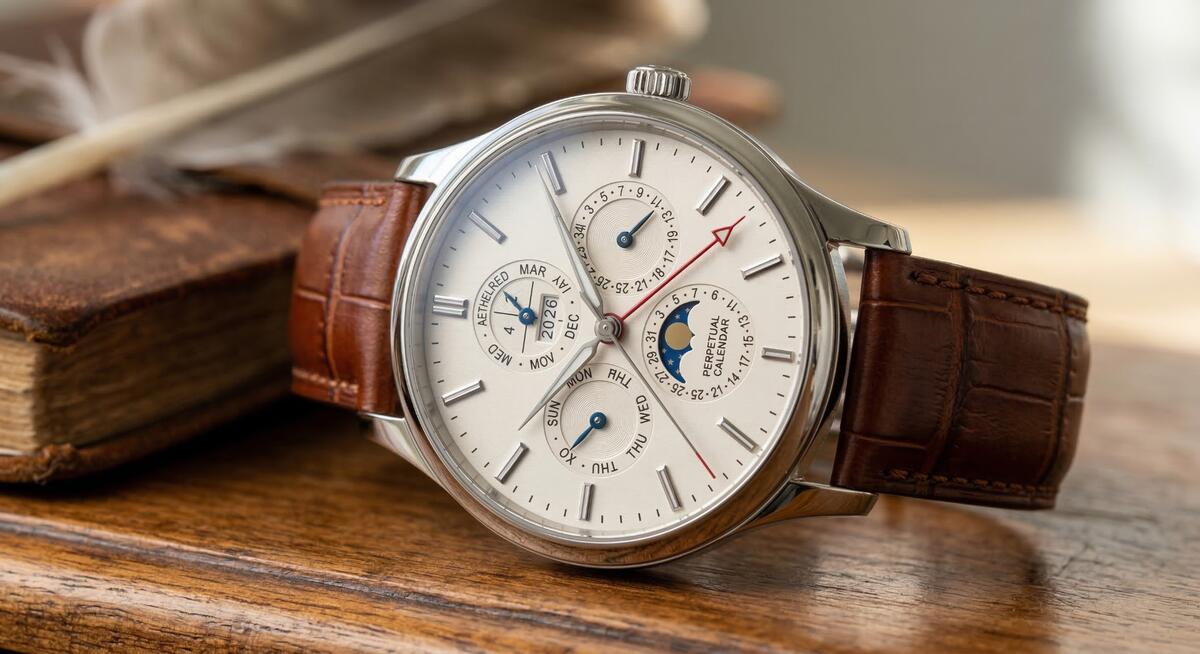
Watch Complications: The Comprehensive Guide
From simple date windows to million-dollar minute repeaters — understanding every function watches can perform.
Steven Thompson
Independent Watchmaker · 10 Years Experience
Reviewed by Indie Watches
Editorially reviewed for accuracy
⚡ Key Takeaways
- ✓✅ Simple complications (date, day-date, GMT, chronograph — useful daily functions)
- ✓✅ Calendar complications (annual calendar, perpetual calendar, complete calendar — tracking months, leap years, moon phases)
- ✓✅ Astronomical complications (moon phase, equation of time, sunrise/sunset times — connecting watches to celestial mechanics)
- ✓✅ Mechanical showpieces (tourbillon, minute repeater, carousel — horological artistry with minimal practical utility)
- ✓✅ Grand complications (watches combining 3+ complex functions — ultimate watchmaking achievement)
📑 Table of Contents
Your friend just bought a watch with "perpetual calendar, moon phase, and power reserve indicator." They're beaming with pride.
📚 Explore our full watches guide →
You nod politely while thinking: What do any of those words mean? And why did they just spend $15,000 on a watch that still just tells time?
Welcome to the world of watch complications.
Complications are additional functions beyond basic timekeeping. Simple complications like date displays add $50–200 to manufacturing cost. Complex complications like perpetual calendars add $5,000–20,000. The most complex — minute repeaters, tourbillons, perpetual calendars combined — can push watches into $100,000–1,000,000+ territory.
Yet most buyers have no idea what these complications do, how they work, or whether they're worth the premium.
Ask ten watch buyers "What's a perpetual calendar?" and nine will shrug. Ask "What's a tourbillon?" and all ten will guess wrong (no, it's not a fancy name for automatic winding). The confusion is universal.
This guide eliminates that confusion permanently.
We'll explore every major complication in modern watchmaking: what it does, how it works, why it exists, real-world utility, pricing impact, and whether it's worth paying for. From basic date windows ($50 premium) to grand complications ($500,000+ watches combining multiple complex functions).
By the end, you'll understand:
- ✅ Simple complications (date, day-date, GMT, chronograph — useful daily functions)
- ✅ Calendar complications (annual calendar, perpetual calendar, complete calendar — tracking months, leap years, moon phases)
- ✅ Astronomical complications (moon phase, equation of time, sunrise/sunset times — connecting watches to celestial mechanics)
- ✅ Mechanical showpieces (tourbillon, minute repeater, carousel — horological artistry with minimal practical utility)
- ✅ Grand complications (watches combining 3+ complex functions — ultimate watchmaking achievement)
- ✅ Practical value (which complications you'll actually use vs. prestige-only features)
- ✅ Price implications (what each complication adds to cost, whether worth it)
Whether you're buying first luxury watch, evaluating complications, or just curious why some watches cost more than houses — this guide explains everything.
Let's explore the mechanical functions that separate $500 watches from $500,000 icons.
WHAT ARE COMPLICATIONS? #
The Definition #
Complication: Any function a watch performs beyond displaying hours, minutes, and seconds.
Basic watch (no complications): #
- Hours hand (tells hour)
- Minutes hand (tells minutes)
- Seconds hand (tells seconds)
- That's it. Just time.
Watch with complications: #
- Hours, minutes, seconds (basic timekeeping)
- PLUS: Date display (complication #1)
- PLUS: GMT hand showing second timezone (complication #2)
- PLUS: Power reserve indicator (complication #3)
- Total: Three complications beyond basic time
Why Complications Exist #
Historical necessity: Before smartphones, watches were only portable information sources. Need to know date? Your watch should show it. Traveling? Need second timezone. Timing something? Need stopwatch (chronograph).
Modern reality: Smartphones display date, timezone, stopwatch, moon phase, calendar — everything watches do, instantly, accurately, free.
So why do complications still matter?
- Mechanical artistry: Creating complex functions with tiny gears, springs, levers = horological achievement
- Convenience: Glance at wrist vs. pulling out phone (small advantage, but real)
- Status signaling: Perpetual calendar = "I appreciate fine watchmaking" (prestige, not utility)
- Collection building: Complications create variety (date watch, GMT watch, chronograph, moon phase — different tools, different aesthetics)
Honest truth: Most complications offer minimal practical advantage over smartphones. But mechanical execution — building tiny machines performing complex calculations — remains impressive.
Complication Categories (By Complexity) #
Simple complications ($50–500 premium): Date, day-date, power reserve indicator, small seconds, GMT/dual time, chronograph
Intermediate complications ($1,000–5,000 premium): Annual calendar, complete calendar, moon phase, world time
Complex complications ($5,000–50,000+ premium): Perpetual calendar, tourbillon, minute repeater, equation of time
Grand complications ($100,000–1,000,000+): Watches combining 3+ complex complications (perpetual calendar + minute repeater + tourbillon = grand complication)
PART 1: SIMPLE COMPLICATIONS #
Date Display #
What it does: Shows current date (1–31)
How it works:
- Date wheel (disc with numbers 1–31 printed)
- Wheel advances once per 24 hours (midnight)
- Visible through window in dial (typically 3 o'clock or 6 o'clock position)
Variants:
- Date window: Number visible through aperture (most common)
- Pointer date: Hand points to date around dial periphery (less common, dressier)
- Big date: Oversized date display using two separate discs (units and tens) — found on A. Lange & Söhne, Glashütte Original
User Interaction:
- Setting: Pull crown to first position, rotate to advance date
- Quick-set: Most modern watches allow date jumping forward without advancing full 24 hours
- Warning: Never adjust date between 8 PM – 4 AM (date mechanism engaged — forcing adjustment can damage gears)
Advantages:
- ✅ Useful daily (know date without phone)
- ✅ Minimal complexity (simple mechanism, reliable)
- ✅ Affordable ($50–200 added cost)
Disadvantages:
- ❌ Manual adjustment needed (31-day months ending, watch stopped, etc.)
- ❌ Breaks dial symmetry (date window disrupts clean dial aesthetic — some prefer no date)
- ❌ Requires periodic correction (every short month — February, April, June, September, November)
Found On: 80% of watches $500+ (almost universal in sports/dive watches, common in dress watches)
Examples:
- Rolex Submariner Date ($10,000): Date window at 3 o'clock, Cyclops magnifier
- Omega Seamaster 300M ($5,200): Date at 6 o'clock
- Tudor Black Bay 58 ($3,700): No date (purist version)
- Seiko SKX007 ($300): Date at 3 o'clock
Price Impact: +$50–200 vs. no-date version (same watch)
Should You Buy?
- Yes if: You check date frequently, don't mind dial asymmetry
- No if: You prefer clean dials, always have phone nearby, hate date windows aesthetically
Day-Date Display #
What it does: Shows day of week (Monday–Sunday) AND date (1–31)
How it works:
- Date wheel (1–31, same as date-only)
- Day wheel (separate disc with day names — sometimes abbreviated MON/TUE, sometimes full MONDAY/TUESDAY)
- Both advance at midnight
Variants:
- Day-date windows: Two separate windows showing day and date
- Pointer day, window date: Hand points to day, window shows date (Rolex Day-Date style)
- Language options: Day wheels often bilingual (English/Spanish common, English/French, English/German)
User interaction:
- Set day AND date when watch stops (if unworn 40+ hours, both reset)
- Quick-set both independently (modern watches)
Advantages:
- ✅ Extra information (day + date)
- ✅ Useful for people who lose track of weekdays
- ✅ Prestigious (Rolex Day-Date = "President" watch — status symbol)
Disadvantages:
- ❌ More dial clutter (two windows vs. one)
- ❌ More manual adjustment (both day and date need setting)
- ❌ Slightly more complex mechanism (more parts = more service cost)
Found on: Premium watches typically (Rolex Day-Date, Omega, Grand Seiko)
Famous example: Rolex Day-Date
- President bracelet (semi-circular links)
- Day at 12 o'clock (arc window), date at 3 o'clock
- Only available precious metals (gold, platinum — never steel)
- Price: $35,000–60,000+
- Worn by presidents, CEOs, executives (hence "President" nickname)
Price impact: +$100–300 vs. date-only (marginal complexity increase)
Should you buy?
- Yes if: You value day information, like Rolex Day-Date aesthetic
- No if: Day display unnecessary (you know what day it is), prefer simpler dials
Power Reserve Indicator #
What it does: Shows how much power (energy) remains in mainspring — how long until watch stops if not worn/wound
How it works:
- Mainspring unwinds as watch runs (stored energy depletes)
- Gear connected to barrel arbor (mainspring housing) rotates as spring unwinds
- Indicator hand connected to this gear shows remaining power (like fuel gauge)
Display formats:
- Arc indicator: Semicircular scale on dial (40, 50, 60, 70 hours marked), hand shows position
- Linear indicator: Straight line scale
- Digital window: Number showing hours remaining (rare)
Typical power reserves:
- Budget automatics (Seiko NH35, Miyota 8215): 38–42 hours
- Quality automatics (Sellita SW200, ETA 2824): 38–42 hours
- Extended reserve (modified movements): 60–80 hours (Tudor, Seiko, Tissot)
- Long reserve (specialized movements): 100–192 hours (Panerai, A. Lange & Söhne)
- Ultra-long (JLC, Vacheron): 7–14 days (168–336 hours)
Advantages:
- ✅ Practical utility (know when to wind watch before it stops)
- ✅ Encourages wearing/winding (prevents stopping mid-wear)
- ✅ Interesting mechanical feature (visible complication, aesthetic interest)
Disadvantages:
- ❌ Limited utility (most people wear watches daily — power never depletes)
- ❌ Dial clutter (adds subdial or indicator, disrupts clean aesthetic)
- ❌ No utility on quartz (battery-powered = no mainspring to indicate)
Found on: Higher-end mechanical watches (Panerai, Glashütte Original, A. Lange & Söhne common)
Examples:
- Panerai Luminor 8 Days ($8,000+): 8-day (192-hour) power reserve indicator at 12 o'clock
- Glashütte Original Senator ($10,000+): Up-down indicator showing reserve
- Hamilton Jazzmaster ($1,000): Budget option with power reserve indicator
Price impact: +$200–500 (requires additional mechanism, dial work)
Should you buy?
- Yes if: You rotate multiple watches (need to know which needs winding), appreciate visible complication
- No if: You wear same watch daily (never stops anyway), prefer clean dials
Small Seconds (Subsidiary Seconds) #
What it does: Displays seconds on small subdial instead of central seconds hand
How it works:
- Seconds hand driven by fourth wheel in movement
- Positioned off-center (usually 6 o'clock, sometimes 9 o'clock)
- Runs continuously (not start/stop like chronograph subdials)
Why it exists:
- Historical: Early wristwatches used pocket watch movements — seconds at 6 o'clock standard placement
- Aesthetic: Creates classic vintage look, dress watch elegance
- Dial balance: Symmetrical layouts possible (small seconds at 6, logo at 12)
Advantages:
- ✅ Clean central dial (no central seconds hand)
- ✅ Vintage/dressy aesthetic (elegant, refined)
- ✅ Dial symmetry possible (balanced design)
- ✅ Shows movement running (if small seconds stops, movement stopped)
Disadvantages:
- ❌ Less precise time reading (seconds harder to read off-center)
- ❌ Not everyone's aesthetic (some prefer central seconds)
Found on: Dress watches, vintage-inspired watches, minimalist designs
Examples:
- Nomos Tangente ($2,200): Small seconds at 6 o'clock, Bauhaus minimalism
- Stowa Marine ($1,200): Classic German marine chronometer, small seconds
- Baltic Hermétique ($1,395): Vintage-inspired, small seconds at 6
Price impact: Neutral (not more expensive than central seconds — just different hand placement)
Should you buy?
- Yes if: You love vintage aesthetic, dress watch focus, Bauhaus minimalism
- No if: You need precise seconds reading (prefer central seconds)
PART 2: TIME-RELATED COMPLICATIONS #
GMT / Dual Time #
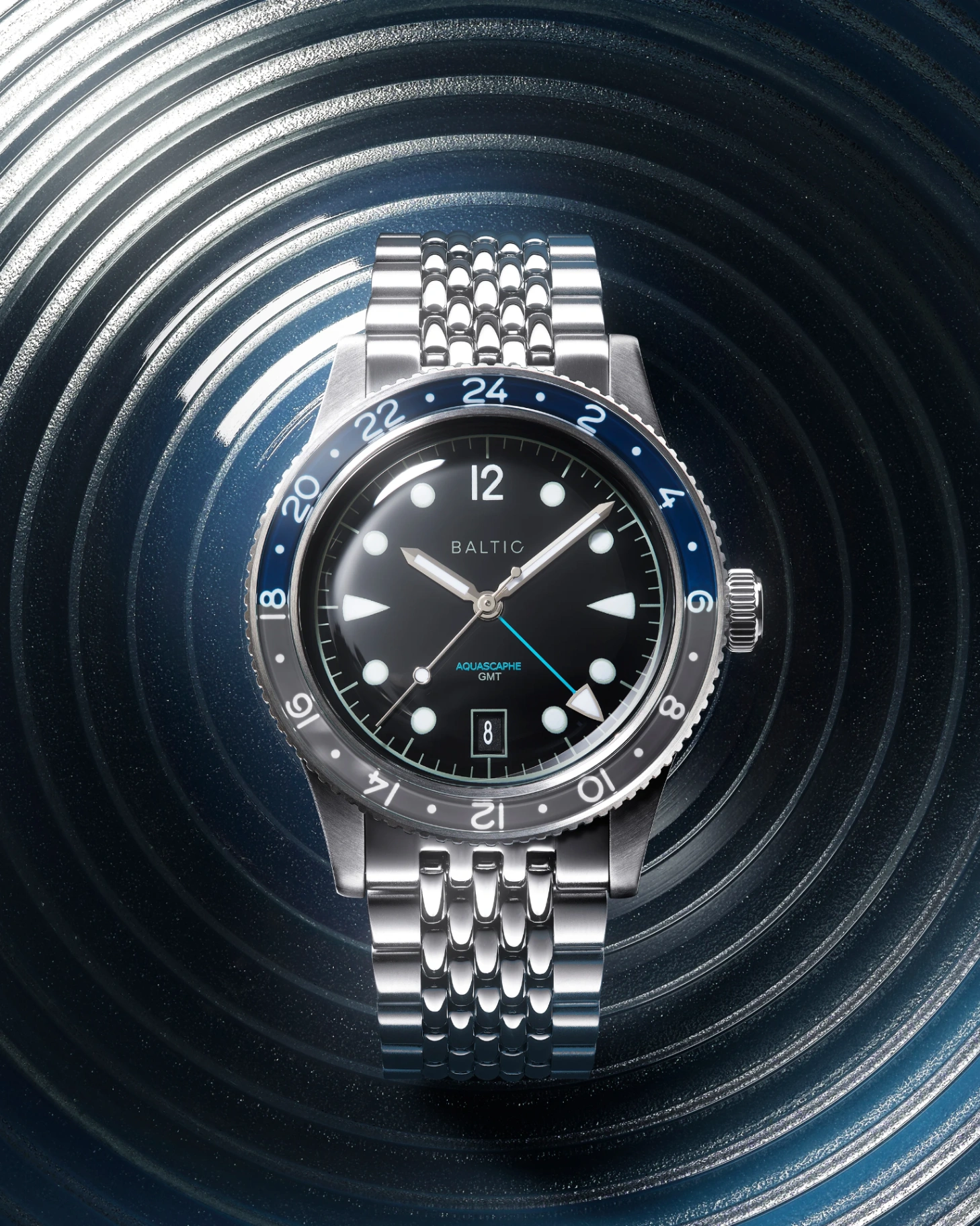
What it does: Displays second timezone simultaneously with local time
How it works:
- GMT hand: Extra hand rotating once per 24 hours (vs. hour hand's 12 hours)
- 24-hour scale: Numbers 1–24 on bezel or dial periphery
- Reading: GMT hand points to 24-hour scale, showing second timezone
Two types of GMT:
1. "True" GMT (independently adjustable local hour):
- Hour hand jumps in 1-hour increments (quick-set local time)
- GMT hand continues tracking reference timezone
- Changing timezones: Jump hour hand forward/backward, GMT hand unchanged
- Found in: Rolex GMT-Master II, Tudor Black Bay GMT, Grand Seiko GMT
- Movements: Rolex 3285, Seiko 9S GMT, Sellita SW330-2
2. "Caller" GMT (GMT hand jumps):
- GMT hand jumps in 1-hour increments
- Hour hand remains fixed to movement
- Less practical for frequent travelers (requires resetting minutes when changing zones)
- Found in: Many affordable GMTs
- Movements: ETA 2893-2, Miyota 9075
Use case:
- Travelers: Track home time + local time (in London, GMT shows New York time)
- Remote workers: Track office timezone + local time
- Sailors/pilots: Track UTC (universal time) + local
Advantages:
- ✅ Extremely practical for travelers (no phone checking for home time)
- ✅ Professional utility (aviation, maritime use UTC reference)
- ✅ Visual appeal (24-hour hand, rotating bezel adds dial interest)
- ✅ Relatively affordable (Seiko, microbrands offer sub-$1,000 GMTs)
Disadvantages:
- ❌ Complexity premium ($300–800 more than time-only)
- ❌ Caller GMT less useful (true GMT better but more expensive)
- ❌ Only useful if you actually travel/work across timezones
Famous GMTs:
- Rolex GMT-Master II ("Pepsi" blue/red bezel, $10,000+): True GMT, iconic
- Tudor Black Bay GMT ($4,000): True GMT, affordable Rolex alternative
- Grand Seiko SBGM221 ($4,500): True GMT, zaratsu polishing, Japanese excellence
- Christopher Ward C63 Sealander GMT ($1,195): True GMT, integrated bracelet, budget option
Price impact: +$300–800 vs. time-only (GMT movements more complex)
Should you buy?
- Yes if: You travel internationally, work remote across timezones, appreciate complication utility
- No if: You never leave your timezone, smartphone works fine for checking other times
World Time #
What it does: Displays time in ALL 24 major timezones simultaneously
How it works:
- City ring: Outer ring with 24 cities (each representing timezone — New York, London, Tokyo, etc.)
- 24-hour ring: Inner ring with 24-hour scale
- Mechanism: Rotating city ring OR 24-hour ring advances, showing time in each city
- Changing reference timezone: Rotate bezel or pusher advances city ring
Reading:
- Find your city on ring (e.g., "New York")
- Read corresponding 24-hour time (e.g., "14" = 2 PM)
- Check any other city instantly (rotate eyes to "Tokyo," read its 24-hour time)
Advantages:
- ✅ ALL timezones at once (vs. GMT showing only 2)
- ✅ Ultimate traveler complication (instant timezone info)
- ✅ Impressive mechanical execution (complex mechanism)
- ✅ Aesthetic richness (city names, colored dial sections, visual complexity)
Disadvantages:
- ❌ Expensive ($3,000–15,000+ typically)
- ❌ Complex to read (requires learning system)
- ❌ Overkill for most (GMT handles 95% of timezone needs)
- ❌ Dial clutter (lots of text, numbers, scales)
Famous examples:
- Patek Philippe World Time Ref. 5230 ($30,000+): Guilloché center, enamel map, ultimate luxury
- Vacheron Constantin Overseas World Time ($40,000+): Integrated bracelet, instant timezone change via pushers
- Montblanc Heritage Spirit Orbis Terrarum ($4,500): Affordable world time, day/night indicator
Price impact: +$2,000–10,000 vs. simple watch (extremely complex mechanism)
Should you buy?
- Yes if: You travel globally constantly, appreciate complicated watches, have budget
- No if: GMT sufficient (99% of people), prefer simpler watches, budget-conscious
Chronograph #
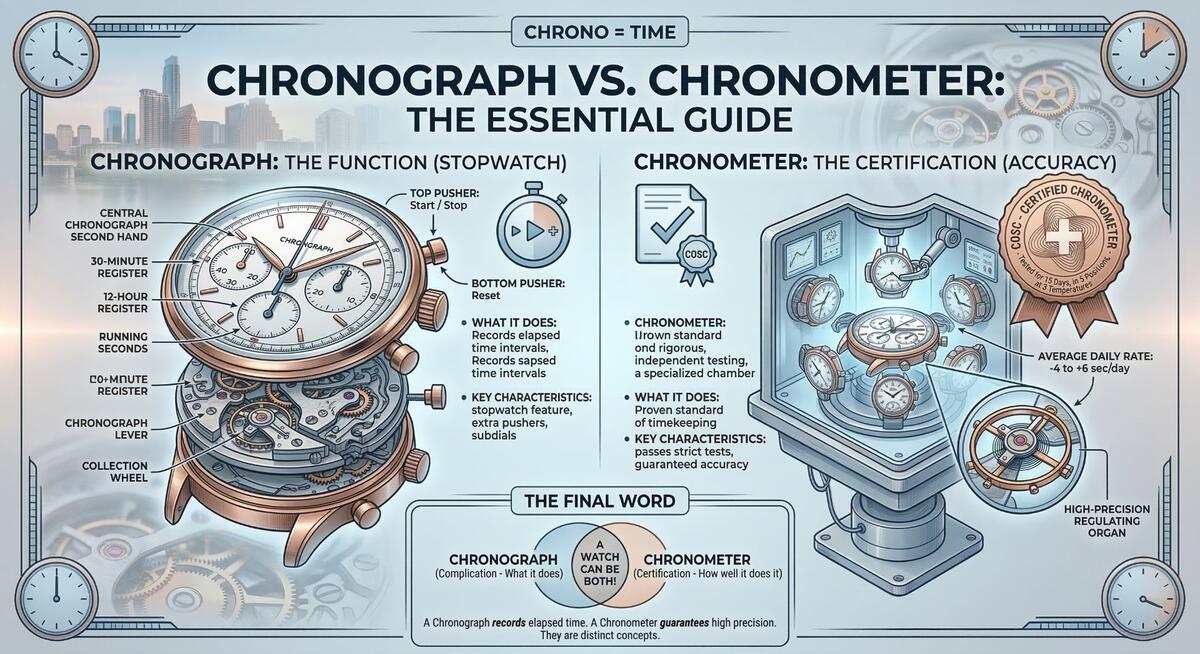
What it does: Stopwatch function — measures elapsed time
Note: This was covered extensively in the "Chronograph vs. Chronometer" article. Brief summary here:
How it works:
- Pushers start/stop/reset central chronograph seconds hand
- Subdials track elapsed minutes (30-minute counter), hours (12-hour counter)
- Separate gear train engages/disengages from main timekeeping
Types:
- Standard: Two pushers (start/stop, reset)
- Flyback: Single pusher resets and restarts instantly
- Meca-quartz: Battery timekeeping + mechanical chronograph (Seiko VK63/64)
Advantages:
- ✅ Practical utility (time runs, cooking, workouts, meetings)
- ✅ Mechanical interest (visible complication, subdials, pushers)
- ✅ Tachymeter compatibility (calculate speed from elapsed time)
Disadvantages:
- ❌ Expensive mechanical ($1,500+ entry, $3,000+ Swiss)
- ❌ More service cost ($400–800 vs. $200–400 time-only)
- ❌ Dial complexity (subdials, scales, busy appearance)
Budget option: Meca-quartz chronographs $300–600 (Brew Metric, Dan Henry)
Price impact: +$500–1,500 mechanical, +$100–300 meca-quartz
PART 3: CALENDAR COMPLICATIONS #
Complete Calendar (Triple Calendar) #
What it does: Displays date (1–31), day (Monday–Sunday), AND month (January–December)
How it works:
- Date wheel (1–31)
- Day wheel (7 days)
- Month wheel (12 months)
- All advance automatically (day/date at midnight, month at end of each month)
Manual adjustment:
- Short months (February, April, June, September, November): Month advances to next month, but date shows 31 — must manually advance to 1
- February ending: Manually advance from 28 (or 29 leap years) to 1
- Requires user correction 5 times per year (every short month)
Advantages:
- ✅ Comprehensive date information (day, date, month all visible)
- ✅ More affordable than annual/perpetual calendars (simpler mechanism)
- ✅ Vintage charm (1940s–1950s popular complication)
Disadvantages:
- ❌ Requires periodic adjustment (5 times yearly for short months)
- ❌ Not "smart" (doesn't know month lengths)
- ❌ Dial clutter (three separate indications = busy dial)
Found on: Vintage-inspired watches, mid-tier Swiss watches
Examples:
- Universal Genève Tri-Compax (vintage 1940s): Triple calendar + chronograph + moon phase
- Longines Master Collection ($2,200): Modern complete calendar, moon phase
- Frederique Constant Classics ($1,500): Complete calendar, affordable Swiss
Price impact: +$500–1,500 vs. simple date (three calendar mechanisms)
Should you buy?
- Yes if: You want comprehensive calendar without perpetual calendar cost, love vintage aesthetics
- No if: Manual adjustment annoying, prefer annual/perpetual calendar automation
Annual Calendar #
What it does: Automatically adjusts for short months (30 days) and long months (31 days) — only requires manual correction once per year (end of February)
How it works:
- Mechanical "memory" of 30-day vs. 31-day months
- Gears programmed to advance correctly for Jan (31), Feb (?), Mar (31), Apr (30), May (31), Jun (30), Jul (31), Aug (31), Sep (30), Oct (31), Nov (30), Dec (31)
- Still treats February as 30 days (doesn't account for 28/29) — requires manual advance March 1st each year
User interaction:
- Set date/day/month when watch stops (if power reserve depletes)
- Manually advance February 28/29 → March 1 (once per year)
- Otherwise: Automatic for 11 months
Invented: Patek Philippe, 1996 (relatively recent complication — simplified perpetual calendar)
Advantages:
- ✅ Almost hands-off (only 1 correction yearly vs. 5 for complete calendar)
- ✅ More affordable than perpetual calendar ($3,000–8,000 vs. $15,000–50,000)
- ✅ Practical luxury complication (useful, impressive, attainable)
Disadvantages:
- ❌ Still requires annual adjustment (February transition)
- ❌ Expensive vs. simple date ($2,000–5,000 premium)
- ❌ Complexity (more parts = higher service cost)
Famous examples:
- Patek Philippe Annual Calendar 5205 ($45,000+): Creator of complication, ultimate execution
- Glashütte Original Senator Excellence ($14,000): German precision annual calendar
- Montblanc Heritage Spirit ($4,500): Affordable annual calendar entry
Price impact: +$2,000–5,000 vs. simple watch (complex calendar mechanism)
Should you buy?
- Yes if: You want near-perpetual automation without perpetual cost, appreciate complications
- No if: Annual February adjustment still annoying, budget under $5,000, prefer simpler watches
Perpetual Calendar #
What it does: Automatically adjusts for ALL month lengths (30, 31 days) AND leap years — never needs date adjustment until year 2100 (when leap year cycle breaks — complex astronomical reason)
How it works:
- Mechanical "brain" programmed with:
- 12 months (January–December)
- Varying month lengths (28/29, 30, 31 days)
- 4-year leap year cycle (every 4th year, February has 29 days)
- Gear train with 4-year cycle cam (rotates once every 4 years)
- Automatically advances correctly: Jan 31 → Feb 1, Feb 28 → Mar 1 (non-leap), Feb 29 → Mar 1 (leap year), Apr 30 → May 1, etc.
Displays:
- Date (1–31)
- Day (Monday–Sunday)
- Month (January–December)
- Often: Leap year indicator (1, 2, 3, 4 cycle showing year in leap cycle)
- Often: Moon phase (perpetual calendars frequently include moon phase complication)
User interaction:
- If watch keeps running: NEVER touch date/calendar (automatic for 76+ years until 2100)
- If watch stops: Must reset ENTIRE calendar (date, day, month, leap year) — tedious, requires careful manual or watchmaker service
- Warning: NEVER adjust perpetual calendar between 8 PM – 4 AM (mechanism engaged — forcing adjustment = expensive damage)
Why 2100 breaks:
- Leap year rule: Every 4 years = leap year (2020, 2024, 2028, etc.)
- Exception: Century years (1900, 2000, 2100) NOT leap years... UNLESS divisible by 400
- 2000 was leap year (divisible by 400)
- 2100 NOT leap year (not divisible by 400)
- Most perpetual calendars programmed for simple 4-year cycle — don't account for 400-year exception
- Solution: Year 2100, manually advance Feb 28 → Mar 1 (skipping Feb 29)
- Some ultra-expensive perpetual calendars (Patek Philippe) programmed for 400-year cycle — accurate until year 2400
Advantages:
- ✅ Ultimate calendar complication (set once, runs forever — practically speaking)
- ✅ Mechanical masterpiece (hundreds of parts working harmoniously)
- ✅ Horological prestige (perpetual calendar = serious watch)
- ✅ Practical for collectors (rotating multiple watches — perpetual keeps accurate date even if unworn weeks)
Disadvantages:
- ❌ Extremely expensive ($15,000–50,000 entry, $50,000–500,000+ typical)
- ❌ If watch stops: Tedious reset (all calendar functions must be manually set)
- ❌ Service expensive ($1,500–3,000+ vs. $300–500 simple movement)
- ❌ Fragile (perpetual calendar mechanisms delicate — shock, magnetic fields, improper adjustment = damage)
Famous perpetual calendars:
- Patek Philippe Perpetual Calendar 5320 ($60,000–80,000): Classic Patek elegance, moon phase, leap year
- Audemars Piguet Royal Oak Perpetual Calendar ($80,000–120,000): Integrated bracelet, ultra-thin
- A. Lange & Söhne Langematik Perpetual ($80,000+): German precision, outsize date
- IWC Portugieser Perpetual Calendar ($35,000–50,000): Accessible perpetual (relatively), 7-day power reserve
- Jaeger-LeCoultre Master Perpetual ($25,000–40,000): Entry perpetual, excellent value
Price impact: +$15,000–50,000 vs. simple watch (hundreds of additional parts, extreme complexity)
Should you buy?
- Yes if: You're serious collector, have budget, rotate multiple watches, appreciate ultimate complication
- No if: Budget under $20,000, you wear same watch daily (simple date sufficient), don't want service cost/fragility
Moon Phase #
What it does: Displays current phase of moon (new moon, waxing crescent, first quarter, waxing gibbous, full moon, waning gibbous, last quarter, waning crescent)
How it works:
- Disc underneath dial with two moon images painted
- Disc rotates slowly (completes one rotation every 29.5 days — lunar month)
- Aperture in dial reveals current moon phase
- Mechanism: Gear train reduces rotation so disc advances correctly
- 59-tooth wheel common: Advances one tooth every 24 hours, 59 teeth = 29.5 days (29.5 × 2 moons = 59)
Accuracy:
- Budget moon phase: 59-tooth wheel = loses 1 day accuracy every 2.5 years (requires manual adjustment)
- Precision moon phase: 135-tooth, 122-tooth wheels = loses 1 day accuracy every 100–1,000 years
- Ultra-precision: Astronomical moon phase (A. Lange & Söhne) = accurate 1,058 years
User interaction:
- Set moon phase by checking current actual moon phase (online, lunar calendar)
- Advance moon disc until watch matches reality
- Adjust when accuracy drifts (every 2–3 years for 59-tooth wheels)
Advantages:
- ✅ Beautiful aesthetic (moon disc often hand-painted, gold leaf, artistic)
- ✅ Romantic complication (connects watch to cosmos)
- ✅ Historical significance (sailors used moon phases for navigation)
- ✅ Affordable complication ($300–1,500 premium vs. more complex complications)
Disadvantages:
- ❌ Zero practical utility (smartphone shows moon phase instantly)
- ❌ Requires periodic adjustment (budget moon phases lose accuracy)
- ❌ Dial space (moon phase aperture takes real estate)
Found on: Dress watches, vintage-inspired watches, romantic/elegant timepieces
Examples:
- Jaeger-LeCoultre Master Ultra Thin Moon ($12,000): Elegant moon phase, ultra-thin
- Longines Master Collection Moon Phase ($2,600): Affordable Swiss moon phase
- Frederique Constant Slimline Moon Phase ($1,000): Budget moon phase entry
- A. Lange & Söhne Lange 1 Moon Phase ($40,000+): Precision astronomical moon, outsize date
Price impact: +$300–1,500 vs. simple watch (relatively affordable complication)
Should you buy?
- Yes if: You love romantic complications, appreciate dial artistry, want conversation piece
- No if: You want only practical complications (moon phase purely aesthetic)
PART 4: MECHANICAL SHOWPIECES #
Tourbillon #
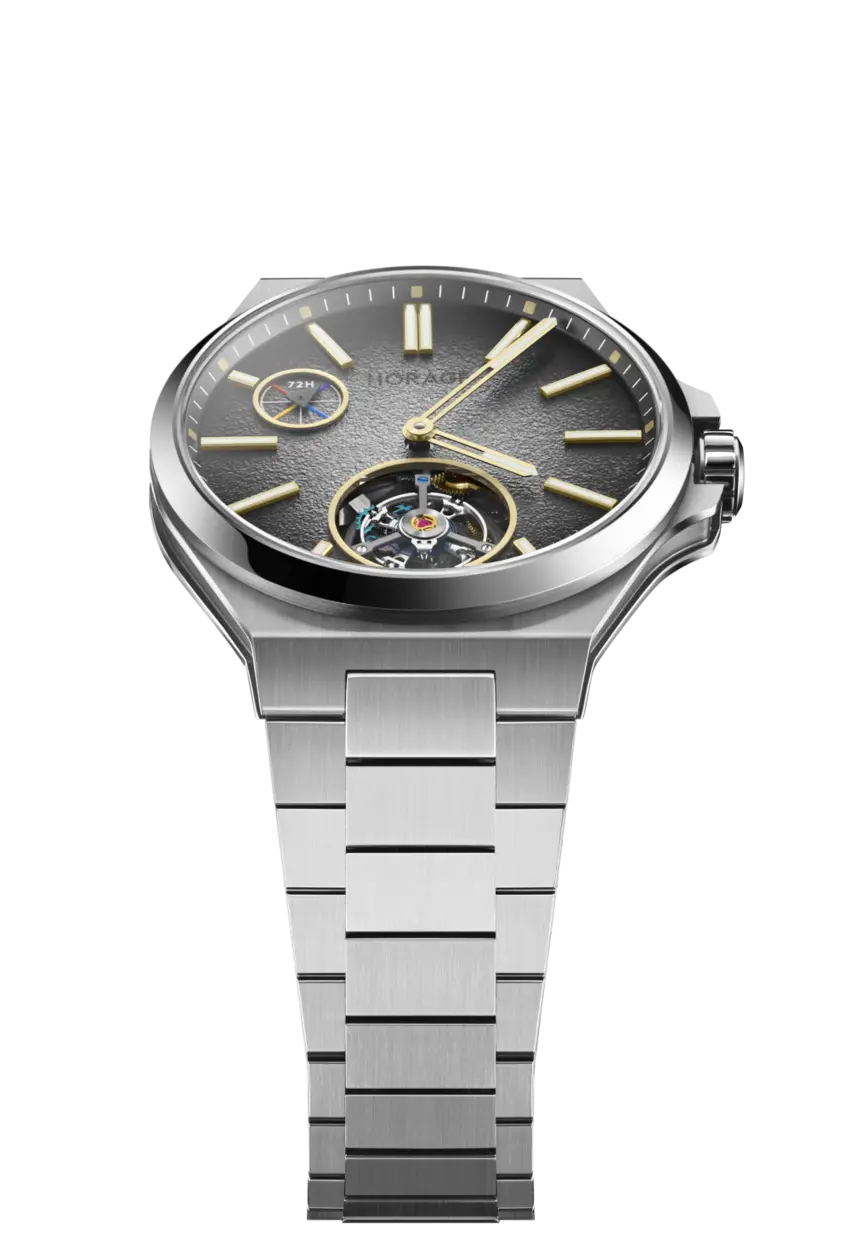
What it does: Rotates escapement (balance wheel, lever, escape wheel) in cage to average out positional errors caused by gravity
Why it exists:
- Problem: Pocket watches hung vertically (gravity affected balance wheel consistently — always pulling down)
- Solution: Abraham-Louis Breguet invented tourbillon (1795) — rotate entire escapement, gravity affects all positions equally, errors average out
- Modern irrelevance: Wristwatches worn in constantly changing positions (arm movement = natural averaging). Tourbillon offers ZERO accuracy improvement in wristwatches.
How it works:
- Escapement mounted in rotating cage
- Cage rotates once per minute (or 30 seconds, 4 minutes — varies by design)
- Entire escapement (balance, hairspring, lever, escape wheel) rotates together
- Visible through dial opening (tourbillon almost always displayed — it's showpiece)
Why watchmakers still make them:
- Prestige: Tourbillon = ultimate watchmaking skill (extremely difficult to manufacture, regulate)
- Aesthetics: Mesmerizing to watch (rotating cage, visible escapement)
- Collectors: Tourbillon ownership = serious watch enthusiast signal
- Marketing: "Tourbillon" justifies $20,000–200,000+ pricing
Advantages:
- ✅ Mechanical artistry (incredible craftsmanship)
- ✅ Visual spectacle (hypnotic movement, conversation piece)
- ✅ Collectibility (tourbillon watches hold value, prestigious)
Disadvantages:
- ❌ Zero practical advantage (wristwatches don't benefit from tourbillon — it's mechanical jewelry)
- ❌ Extremely expensive ($15,000–200,000+ typical, can reach $1,000,000+)
- ❌ Fragile (exposed escapement vulnerable to shock, magnetic fields)
- ❌ Service expensive ($2,000–5,000+)
Famous tourbillons:
- Breguet Classique Tourbillon ($120,000+): Original tourbillon inventor's brand
- A. Lange & Söhne Pour le Mérite Tourbillon ($150,000+): German precision, chain fusée
- TAG Heuer Carrera Tourbillon ($15,000–25,000): "Affordable" tourbillon (relatively)
- Richard Mille Tourbillon ($500,000–2,000,000): Ultra-light, skeletonized, sports tourbillon
Price impact: +$15,000–150,000 vs. simple watch (pure prestige pricing)
Should you buy?
- Yes if: You're wealthy collector, appreciate mechanical artistry, want ultimate prestige complication
- No if: You want accuracy (quartz 100X more accurate), value practicality, budget under $20,000
Minute Repeater #
What it does: Chimes the current time audibly on demand — hours, quarter-hours, minutes
How it works:
- Slide or pusher activates mechanism
- Hammers strike gongs (metal wires coiled inside case)
- Chiming sequence:
- Hours: Low tone (one chime per hour — 3 chimes = 3 o'clock)
- Quarter-hours: Double tone (high-low pair per quarter — two pairs = 30 minutes past)
- Minutes: High tone (one chime per minute past last quarter — four chimes = 4 minutes)
- Example: 3:49 = 3 low chimes (hours) + 3 double chimes (45 minutes in quarters) + 4 high chimes (4 additional minutes) = 3:49
Why it exists:
- Historical: Pre-electric lighting — tell time in darkness via sound
- Modern: Pure mechanical showpiece (smartphones have flashlights — repeaters obsolete practically)
Why so expensive:
- Extreme complexity (300+ additional parts vs. simple watch)
- Acoustic engineering (gongs must sound beautiful — hours of hand-tuning per watch)
- Hand-assembly required (minute repeaters can't be mass-produced — master watchmaker work)
- Rarity (few watchmakers capable of making repeaters — Patek Philippe, Vacheron Constantin, Audemars Piguet, Jaeger-LeCoultre)
Advantages:
- ✅ Ultimate horological complication (most difficult watchmaking achievement)
- ✅ Musical beauty (well-tuned repeater sounds like tiny bell concert)
- ✅ Extreme collectibility (minute repeaters = holy grail for collectors)
Disadvantages:
- ❌ Zero practical utility (you can just look at dial)
- ❌ Insanely expensive ($200,000–1,000,000+ typical)
- ❌ Fragile (complex striking mechanism prone to damage)
- ❌ Service extremely expensive ($5,000–15,000+)
Famous minute repeaters:
- Patek Philippe 5374 ($300,000+): Classic minute repeater, enamel dial
- Audemars Piguet Royal Oak Concept Minute Repeater ($500,000+): Titanium, transparent, modern
- Jaeger-LeCoultre Master Grande Tradition Répétition Minutes ($200,000+): Accessible repeater (relatively)
Price impact: +$200,000–800,000 vs. simple watch (rarest, most expensive complication)
Should you buy?
- Yes if: You're ultra-wealthy collector, appreciate ultimate watchmaking, want rarest complication
- No if: Budget under $200,000, value practicality, want watches you'll actually use
Equation of Time #
What it does: Shows difference between solar time (actual sun position) and mean time (standardized 24-hour clock)
Why it exists:
- Earth's elliptical orbit + axial tilt = sun doesn't cross meridian at exactly same time daily
- Solar noon (sun highest in sky) can be up to 16 minutes early or late vs. 12:00 PM clock time
- Equation of time tracks this difference
How it works:
- Hand on subdial shows +/- minutes difference
- Example: February 12, equation of time shows +14 minutes = solar noon occurs at 12:14 PM clock time
User interaction:
- Read difference, add/subtract from displayed time to get true solar time
- Reset when changing locations (equation of time specific to longitude)
Advantages:
- ✅ Astronomical complication (connects watch to solar mechanics)
- ✅ Extreme rarity (very few watchmakers produce)
- ✅ Intellectual complication (for astronomy enthusiasts)
Disadvantages:
- ❌ Zero practical utility (nobody needs solar time vs. mean time)
- ❌ Extremely expensive ($50,000–200,000+)
- ❌ Complex to understand (most people don't grasp what it does)
Famous examples:
- Audemars Piguet Royal Oak Equation of Time ($100,000+)
- Jaeger-LeCoultre Master Grande Tradition ($80,000+)
Should you buy?
- Yes if: You're astronomy enthusiast, ultra-wealthy collector, want ultra-rare complication
- No if: 99.9% of people (most esoteric complication in watchmaking)
PART 5: GRAND COMPLICATIONS #
What Defines a Grand Complication #
Traditional definition: Watch combining 3+ major complications from different categories:
- Chronograph (timing)
- Perpetual calendar (calendar)
- Minute repeater (chiming)
Other combinations qualifying as grand complication:
- Perpetual calendar + tourbillon + chronograph
- Minute repeater + moon phase + equation of time + perpetual calendar
Why "grand":
- Extreme complexity (500–1,000+ parts)
- Multiple master watchmakers required (calendars specialist, repeater specialist, etc.)
- Years to produce single watch (hand-assembly, regulation, testing)
- Ultimate watchmaking achievement
Famous Grand Complications #
1. Patek Philippe Grandmaster Chime Ref. 6300
- Complications: 20 total (minute repeater, perpetual calendar, moonphase, chronograph, second timezone, alarm, etc.)
- Price: $2,500,000+ retail, $31,000,000 auction (most expensive watch ever sold)
- Production: Few per year (extreme rarity)
2. Vacheron Constantin Les Cabinotiers Grand Complication Phoenix
- Complications: 15 (tourbillon, perpetual calendar, minute repeater, etc.)
- Price: $1,000,000+
- Unique: One-of-one commission (client worked with Vacheron to design)
3. Audemars Piguet Royal Oak Grande Complication
- Complications: Perpetual calendar, minute repeater, chronograph
- Price: $700,000+
- Uniqueness: Integrated bracelet grand complication (extremely difficult)
4. Jaeger-LeCoultre Hybris Mechanica Grande Sonnerie
- Complications: Grande sonnerie (chimes hours + quarters automatically), minute repeater, perpetual calendar, tourbillon
- Price: $2,500,000+
- Extreme: Most complex chiming watch (grande sonnerie = chimes every 15 minutes automatically)
Who Buys Grand Complications? #
Ultra-high-net-worth collectors:
- $100M+ net worth typical
- Own 50–200+ watches
- View as art investment (grand complications appreciate)
- Never worn (kept in safe, appreciated as mechanical art)
Museums:
- Patek Philippe Museum, Audemars Piguet Museum
- Preserve watchmaking history
Should regular buyers consider?
No. Grand complications are mechanical art for ultra-wealthy, not practical watches.
PRACTICAL BUYING GUIDE #
Which Complications Actually Matter #
High utility (worth paying for):
- ✅ Date: Daily reference, practical, minimal cost (+$50–200)
- ✅ GMT/Dual Time: If you travel internationally or work across timezones (+$300–800)
- ✅ Chronograph: If you actually time things (running, cooking, etc.) (+$500–1,500 mechanical, +$100–300 meca-quartz)
Medium utility (nice to have, not essential):
- Power reserve indicator: Useful if rotating multiple watches (+$200–500)
- Day-date: Convenient if you lose track of weekdays (+$100–300)
- Annual calendar: Practical if you want near-perpetual automation (+$2,000–5,000)
Low utility (prestige > practicality):
- ❌ Moon phase: Beautiful, zero practical use (+$300–1,500)
- ❌ Perpetual calendar: Ultimate calendar, but expensive and fragile (+$15,000–50,000)
- ❌ Tourbillon: Visual spectacle, zero accuracy advantage (+$15,000–150,000)
- ❌ Minute repeater: Acoustic artistry, obsolete practically (+$200,000–800,000)
- ❌ Equation of time: Astronomical curiosity, nobody needs (+$50,000–200,000)
Budget-Based Recommendations #
Under $500:
- Simple date or no complications (Seiko, Orient, budget microbrands)
- Meca-quartz chronograph if you need stopwatch (Dan Henry, Brew)
$500–1,500:
- Date + rotating bezel (dive watches — practical countdown bezel)
- Meca-quartz chronograph (Brew Metric $525)
- Simple GMT (Seiko, microbrands)
$1,500–4,000:
- COSC chronometer + GMT (Tudor, Omega)
- Chronograph + date (TAG Heuer, Breitling entry)
- Moon phase + date (Longines, JLC)
$4,000–10,000:
- COSC chronometer + GMT (Tudor, Omega)
- Chronograph + date (TAG Heuer, Breitling entry)
- Moon phase + date (Longines, JLC)
$10,000–30,000:
- Annual calendar (Glashütte Original, Montblanc)
- Chronometer chronograph (Breitling Navitimer, Omega Speedmaster Racing)
- GMT + chronograph (Rolex Daytona, Breitling)
$30,000–100,000:
- Perpetual calendar (IWC, Jaeger-LeCoultre entry)
- Tourbillon (TAG Heuer, Zenith)
$100,000+:
- Grand complications (Patek Philippe, Vacheron Constantin, Audemars Piguet)
- Minute repeaters
- Ultra-complex perpetual calendars
Final Recommendations #
For Most Buyers #
Buy:
- Date complication ($50–200 premium — useful daily)
- GMT if you travel ($300–800 premium — practical for international work/travel)
- Chronograph if you time things ($500–1,500 mechanical OR $100–300 meca-quartz — functional utility)
Skip:
- Tourbillon (zero practical advantage, pure prestige)
- Minute repeater (obsolete, insanely expensive)
- Perpetual calendar unless you're serious collector ($15,000+ for automation you'll rarely appreciate)
For Watch Enthusiasts #
Buy:
- Annual calendar (near-perpetual automation, $3,000–8,000 — sweet spot of complexity and practicality)
- Moon phase (romantic, beautiful, affordable complication $300–1,500)
- Power reserve indicator (useful for rotated collection $200–500)
Consider:
- Perpetual calendar if budget allows ($15,000+ — ultimate calendar complication)
- Tourbillon if you appreciate mechanical artistry ($15,000+ — visual spectacle)
For Wealthy Collectors #
Buy:
- Perpetual calendar (essential complication for serious collection)
- Tourbillon (mechanical artistry, prestige)
- Minute repeater (if budget allows $200,000+ — rarest, most difficult complication)
- Grand complication (ultimate goal for collectors with $500,000+ budgets)
CONCLUSION #
Complications range from practical ($50 date) to pure prestige ($1,000,000 grand complications).
The honest truth: Smartphones do everything watches do — better, faster, cheaper. Complications exist because mechanical execution impresses, not because utility justifies cost.
Smart buying strategy:
- Identify actually useful complications (date, GMT if you travel, chronograph if you time things)
- Pay for those ($50–1,500 total premium — reasonable)
- Appreciate others from afar (tourbillon, perpetual calendar, minute repeater beautiful but unnecessary for 99% of buyers)
Buy complications you'll use. Admire complications you won't.
❓ Frequently Asked Questions
Q:Who Buys Grand Complications?
Ultra-high-net-worth collectors:
Find Your Perfect Watch
Browse our curated collection of indie and microbrand timepieces.
📚 Related Reading
Handpicked articles from the same topic