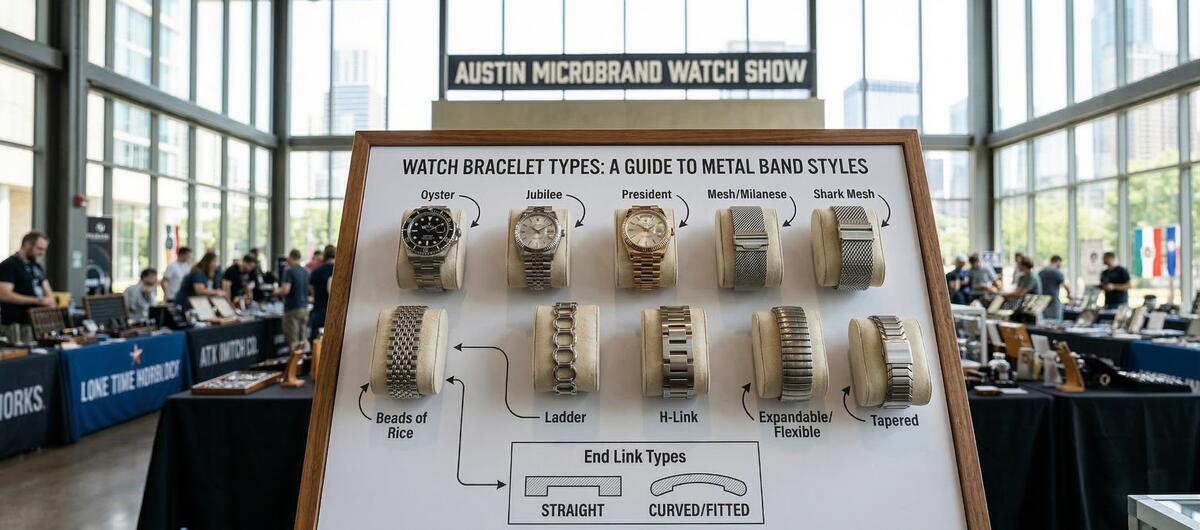
Watch Bracelet Types: The Complete Guide to Popular Styles
From Oyster to President—understanding the metal bracelets that define iconic watches. Same Rolex Datejust on Oyster bracelet? Sporty, robust, tool watch energy. Same Datejust on Jubilee? Dressy, elegant, sophisticated. Same watch, completely different personalities—all because of metal links.
Steven Thompson
Independent Watchmaker · 10 Years Experience
Reviewed by Indie Watches
Editorially reviewed for accuracy
⚡ Key Takeaways
- ✓✅ Oyster vs. Jubilee (the eternal three-link vs. five-link debate)
- ✓✅ President bracelet mystique (why semi-circular links cost 3X more)
- ✓✅ Beads of Rice vintage charm (when rounded links make sense)
- ✓✅ Milanese mesh versatility (infinitely adjustable luxury)
- ✓✅ Engineer bracelet ruggedness (screwed links for serious tool watches)
📑 Table of Contents
From Oyster to President—understanding the metal bracelets that define iconic watches
📚 Explore our full watch straps guide →
Walk into any watch forum asking "Which bracelet should I get?" and you'll drown in opinions. Oyster purists insist "three-link only—everything else is compromise." Jubilee devotees counter "five-link comfort can't be beat." President bracelet owners simply smile, knowing they've achieved peak elegance.
The truth: Bracelet choice matters as much as the watch itself.
Same Rolex Datejust on Oyster bracelet? Sporty, robust, tool watch energy. Same Datejust on Jubilee? Dressy, elegant, sophisticated. Same watch, completely different personalities—all because of metal links.
Yet most buyers focus entirely on case, dial, movement—ignoring the bracelet touching their wrist 16 hours daily. That's backwards. Your bracelet defines wearing experience more than any other component.
This guide fixes that knowledge gap.
We'll explore the most popular bracelet styles in modern watchmaking: their histories, characteristics, which watches wear them, construction quality indicators, comfort factors, pricing implications, and how each transforms a watch's personality.
By the end, you'll understand:
- ✅ Oyster vs. Jubilee (the eternal three-link vs. five-link debate)
- ✅ President bracelet mystique (why semi-circular links cost 3X more)
- ✅ Beads of Rice vintage charm (when rounded links make sense)
- ✅ Milanese mesh versatility (infinitely adjustable luxury)
- ✅ Engineer bracelet ruggedness (screwed links for serious tool watches)
- ✅ H-link elegance (dress watch sophistication)
- ✅ Integrated bracelet revolution (Royal Oak to Tissot PRX—seamless case-to-bracelet flow)
- ✅ Quality indicators (how to spot solid vs. hollow links, excellent vs. mediocre finishing)
Whether you're buying first luxury watch, upgrading microbrand bracelet, or just curious why Rolex charges $1,500 for President bracelet—this guide explains everything.
Let's explore the metal links that separate $500 watches from $50,000 icons. #
THE FUNDAMENTALS: WHAT MAKES BRACELETS DIFFERENT #
Why Bracelet Matters More Than You Think #
Consider two identical scenarios:
- Scenario A: $5,000 Omega Seamaster with hollow-link bracelet (rattles, feels cheap, stretches over time)
- Scenario B: $500 microbrand with solid-link bracelet (substantial feel, zero rattle, decades of durability)
Which delivers better wearing experience? Scenario B—despite costing 10X less.
The bracelet determines:
- Comfort (weight distribution, articulation, skin contact)
- Perceived value (substantial vs. cheap feel)
- Durability (solid links last decades; hollow links stretch, dent, rattle)
- Aesthetics (sporty vs. dressy vs. elegant vs. vintage)
- Resale value (watches sell better on quality bracelets)
Smart buying strategy: $500 watch + $150 excellent bracelet = better ownership experience than $5,000 watch with $50 cost-cutting bracelet.
Construction Quality: The Hidden Variable #
Before diving into styles, understand quality tiers:
Hollow links: #
- Stamped sheet metal, hollow interior
- Lightweight (feels insubstantial)
- Rattles, jingles when shaken
- Dents easily (thin walls)
- Found on: Budget watches under $300
- Red flag on watches over $500
Folded links: #
- Single piece folded over, welded/pinned
- Stronger than hollow, cheaper than solid
- Acceptable in $400-800 watches
- More substantial than hollow, less than solid
Solid links: #
- Machined or forged solid metal throughout
- Substantial heft, premium feel
- No rattling, excellent durability
- Expected standard in $800+ watches, mandatory $1,500+
OYSTER BRACELET - The Three-Link Sports Standard #
What It Is #
Design: Three-link construction—flat center link flanked by curved outer links
Origin: Rolex, 1930s-1940s (evolved alongside Oyster case)
Iconic on: Rolex Submariner, GMT-Master, Explorer, Sea-Dweller, Daytona
Also found on: Countless microbrands, homages, sports watches (most copied bracelet design in watchmaking)
Characteristics #
Visual appearance: #
- Robust, sporty aesthetic
- Masculine presence (broader links than Jubilee)
- Brushed center link, polished outer links typical (mixed finishing)
Link structure: #
- Large, flat center links (easy to clean, less crevices than Jubilee)
- Curved outer links (ergonomic wrist wrap)
- Three-link = simpler geometry (less complex than five-link Jubilee)
Articulation: #
- Moderate flexibility (less than Jubilee, more than solid integrated)
- Comfortable wrist conforming
Quality test: #
Pick up watch, shake gently. Hear jingling/rattling? Hollow or folded links. Silence? Solid links.
History & Evolution #
- 1930s-1950s: Early Rolex Oyster bracelets basic riveted construction (links held by pins)
- 1960s: Evolution to modern three-link geometry (broader center link, refined proportions)
- 1970s-1980s: Introduction of solid links (replacing hollow links), Easylink extension system
- 2000s: Glidelock clasp (Submariner, Sea-Dweller—tool-less micro-adjustments)
- Today: Modern Oyster bracelets represent peak evolution—solid links, ceramic inserts in clasps (prevent scratching), Glidelock/Easylink extensions, perfect finishing
Quality Indicators #
Budget Oyster-style ($50-150): #
- Hollow links (rattle, feel cheap)
- Sharp edges (uncomfortable, snag clothing)
- Poor finishing (machining marks visible, uneven brushing)
- Stamped clasps (thin metal, flex when pressed)
Mid-tier Oyster-style ($150-400): #
- Folded or thin solid links
- Acceptable finishing (some beveling, consistent brushing)
- Deployant clasps (better than fold-over)
- Found on: Microbrands $500-1,000
Premium Oyster-style ($400-1,000): #
- Solid links throughout
- Excellent finishing (sharp bevels, mirror polishing, uniform brushing)
- Push-button deployant with safety
- Micro-adjustments (5-8 positions)
- Found on: Premium microbrands, mid-tier Swiss (Tudor, Longines)
Rolex Oyster ($1,500-2,500 if purchased separately): #
- Solid links, ceramic-lined clasp
- Glidelock (10mm+ tool-less adjustment) or Easylink (5mm quick-adjust)
- Perfect finishing (Zaratsu-level polishing, crisp bevels)
- Zero rattling, stretch, or wear after decades
Pros & Cons #
Pros: #
- ✅ Sporty versatility: Works dive watches to casual dress (versatile aesthetic)
- ✅ Easy cleaning: Flat links, fewer crevices (vs. Jubilee complexity)
- ✅ Robust appearance: Masculine, tool watch appropriate
- ✅ Widely serviceable: Every watchmaker familiar with three-link construction
- ✅ Affordable alternatives: Many microbrands offer excellent Oyster-style bracelets $150-300
Cons: #
- ❌ Less dressy than Jubilee/President: Too sporty for formal black-tie occasions
- ❌ Less comfortable than Jubilee: Three-link less flexible than five-link (Jubilee drapes better)
- ❌ Scratches visible: Polished outer links show desk diving damage easily
- ❌ Generic appearance: Most common bracelet style (lacks uniqueness)
When to Choose Oyster #
Perfect for: #
- Dive watches (Submariner-style, appropriate aesthetic)
- GMT watches (sporty tool watch category)
- Sports watches generally (Daytona, Speedmaster alternatives)
- Casual daily wear (jeans to business casual)
- Active lifestyles (durable, water-resistant, robust)
Skip for: #
- Formal dress watches (too sporty—use President, H-link, or leather)
- Vintage aesthetics (Oyster distinctly modern—use Beads of Rice)
Price Expectations #
Aftermarket Oyster-style bracelets: #
- Budget: $50-100 (hollow links, acceptable for beater watches)
JUBILEE BRACELET - The Five-Link Dressy Alternative #
What It Is #
Design: Five-link construction—smaller, rounded links creating refined appearance
Origin: Rolex, 1945 (created specifically for Datejust launch)
Iconic on: Rolex Datejust, GMT-Master II (newer versions), Lady-Datejust
Also found on: Grand Seiko, microbrands, dress-sport watches
Characteristics #
Visual appearance: #
- Dressy-sporty aesthetic (more elegant than Oyster)
- Intricate link pattern (five small links vs. three large)
- Classic 1940s-1960s elegance (vintage charm)
Link structure: #
- Center link flanked by pairs of smaller outer links
- Rounded, polished links (vs. Oyster flat center)
- More complex geometry (harder to manufacture than Oyster)
Articulation: #
- Highly flexible (five links = more articulation points)
- Drapes beautifully over wrist (conforms better than Oyster)
- Most comfortable bracelet for daily wear (many wearers prefer over Oyster)
History & Evolution #
1945: Introduced alongside Datejust (Rolex's first automatic with date)
1950s-1970s: Became signature Datejust bracelet (elegant tool watch aesthetic)
1980s-1990s: Expanded to GMT-Master II, other Rolex models
2000s: Continued refinement (solid links, hidden clasp, Easylink extension)
Today: Available on Datejust, GMT-Master II (polarizing—some prefer Oyster on GMT)
Quality Indicators #
Budget Jubilee-style ($60-200): #
- Hollow links (significant rattling due to complexity)
- Many crevices trap dirt (five-link = harder to clean)
- Sharp edges on link transitions
- Found on: Budget watches, cheap homages
Mid-tier Jubilee-style ($200-500): #
- Folded or thin solid links
- Acceptable finishing (some polishing, beveling)
- Deployant clasps
- Found on: Quality microbrands, mid-tier Japanese (Grand Seiko alternatives)
Premium Jubilee-style ($500-1,200): #
- Solid links, excellent finishing
- Mixed finishing (brushed centers, polished outers)
- Push-button deployant with safety
- Micro-adjustments
- Found on: Grand Seiko, premium microbrands
Rolex Jubilee ($1,800-3,000 if purchased separately): #
- Solid links, hidden clasp (Crownclasp—integrated, invisible from top)
- Easylink 5mm extension
- Perfect finishing (mirror polishing, precise beveling)
- Zero stretch after decades
Pros & Cons #
Pros: #
- ✅ Dressy elegance: More refined than Oyster (works business formal to casual)
- ✅ Superior comfort: Five-link articulation = best wrist draping (most comfortable daily wear)
- ✅ Classic aesthetic: 1940s heritage (timeless, vintage charm)
- ✅ Versatility: Dress-sport sweet spot (not too sporty, not too formal)
Cons: #
- ❌ Harder to clean: Five links = more crevices (dirt, lint, skin oils trapped)
- ❌ Less sporty than Oyster: Some find too dressy for dive watches
- ❌ Expensive quality versions: Premium Jubilee costs more than equivalent Oyster (complexity)
- ❌ Polished links scratch easily: Shows desk diving damage (constant polishing needed)
When to Choose Jubilee #
Perfect for: #
- Dress-sport watches (Datejust, dress GMTs)
- Daily office wear (business professional to business casual)
- People prioritizing comfort (best wrist draping)
- Vintage-inspired watches (1940s-1960s aesthetic)
Skip for: #
- Pure dive watches (too dressy for Submariner aesthetic—though personal preference)
- Ultra-casual/rugged wear (Oyster more appropriate)
Oyster vs. Jubilee: The Eternal Debate #
Same watch, different bracelet—personality transformation:
Rolex Datejust on Oyster: #
- Sporty, robust, tool watch
- Casual Friday, weekend wear
- Masculine, understated
Rolex Datejust on Jubilee: #
- Elegant, dressy, sophisticated
- Business meetings, formal dinners
- Refined, classic
Both correct. Different vibes.
Comfort: Jubilee wins (better wrist draping, more articulation)
Durability/cleaning: Oyster wins (simpler, easier maintenance)
Versatility: Oyster (works casual to dressy; Jubilee less casual)
Aesthetics: Personal preference (sporty vs. elegant)
Price Expectations #
| Aftermarket Jubilee-style: | |
|---|---|
| Budget: | $60-150 (hollow links, poor finishing) |
| Mid-tier: | $200-400 (Strapcode solid links—excellent value) |
| Premium: | $500-1,000 (Grand Seiko OEM, premium microbrands) |
| Rolex OEM: | $1,800-3,000 (includes clasp, perfect finishing) |
PRESIDENT BRACELET - The Semi-Circular Luxury #
What It Is #
Design: Three-piece semi-circular links creating seamless, flowing aesthetic
Origin: Rolex, 1956 (introduced with Day-Date "President" watch)
Iconic on: Rolex Day-Date exclusively (never offered on other Rolex models)
Also found on: Some microbrands attempting homage (rare—difficult/expensive to manufacture)
Characteristics #
Visual appearance: #
- Ultimate luxury aesthetic (most elegant metal bracelet)
- Semi-circular links (D-shaped cross-section)
- Seamless flow (links nest together with minimal gaps)
- Available in: Yellow gold, white gold, rose gold, platinum (never steel—Day-Date exclusive)
Link structure: #
- Three links per row (similar to Oyster count but different shape)
- Semi-circular profile (round outer surface, flat inner surface against wrist)
- Extremely comfortable (round surface distributes weight evenly)
Articulation: #
- Very flexible (semi-circular links allow smooth articulation)
- Drapes beautifully (conforms to wrist naturally)
- Heavier than Oyster/Jubilee (solid precious metal construction)
History & Evolution #
- 1956: Introduced with Day-Date (Rolex's first watch displaying day and date)
- 1960s-1970s: Became synonymous with power, success (US Presidents wore Day-Date—hence "President" nickname)
- 1980s-2000s: Continued exclusive to Day-Date (maintaining prestige)
- Today: Still Day-Date exclusive (Rolex maintains tradition—President bracelet = Day-Date only)
Why President Costs 3X More #
Manufacturing complexity: #
- Oyster/Jubilee: Flat or slightly curved links (easier machining, stamping)
- President: Semi-circular links requiring:
Material cost: #
- President only available in precious metals (gold, platinum)
- Never steel (maintains exclusivity)
- Heavier than Oyster/Jubilee (more metal = higher material cost)
Result: President bracelet alone costs $3,000-8,000 (depending on metal—yellow gold cheapest, platinum most expensive)
Quality Indicators #
Real President bracelet (Rolex OEM only):
- Solid precious metal links (no hollow, no plating)
- Seamless articulation (links nest perfectly, zero wobble)
- Hidden Crownclasp (deployant hidden under links—invisible from top)
- Perfect finishing (mirror polishing on precious metal)
- Extreme weight (solid gold/platinum substantial)
"President-style" bracelets (microbrands, homages): #
- Typically steel (not precious metal—loses prestige)
- Approximated semi-circular shape (never matches Rolex precision)
- Standard clasps (not hidden Crownclasp)
- Acceptable as "President-inspired" but not true President experience
Pros & Cons #
Pros: #
- ✅ Ultimate elegance: Most refined metal bracelet (peak dress watch sophistication)
- ✅ Exceptional comfort: Semi-circular links distribute weight evenly (no pressure points)
- ✅ Prestige: Day-Date exclusive (wearing President = automatic status signal)
- ✅ Timeless aesthetic: Elegant in 1956, elegant today (no design trends)
Cons: #
- ❌ Extreme cost: $3,000-8,000 bracelet alone (most expensive mass-produced bracelet)
- ❌ Precious metal only: Never steel (limits accessibility)
- ❌ Too dressy for sports watches: Only appropriate dress/formal watches
- ❌ Heavy: Solid gold/platinum substantial weight (fatiguing for some)
- ❌ Scratches show prominently: Polished precious metal = constant polishing needed
When to Choose President #
Perfect for:
- Dress watches exclusively (Day-Date, dress watch alternatives)
- Formal occasions (black-tie, business formal, executive settings)
- People wanting maximum elegance (aesthetics priority over practicality)
- Precious metal watch owners (yellow/white/rose gold, platinum)
Never for: #
- Sports watches (too formal for dive, GMT, chronograph)
- Casual wear (overkill for jeans and t-shirt)
- Active lifestyles (too delicate, too valuable for rough wear)
Price Expectations #
Rolex President bracelet OEM: #
- Yellow gold: $3,000-4,500
- White gold: $4,000-5,500
- Rose gold: $4,000-5,500
- Platinum: $6,000-8,000+
President-style aftermarket (steel): #
- $200-500 (approximates aesthetic, not true President experience)
BEADS OF RICE (BOR) - The Vintage Favorite #
What It Is #
- Design: Links shaped like rice grains—rounded, cylindrical, classic 1950s-1960s aesthetic
- Origin: 1940s-1960s (common on vintage dive watches, dress watches)
- Iconic on: Vintage Omega Seamaster, vintage Rolex, vintage chronographs
- Modern use: Vintage reissues, retro-inspired microbrands (Baltic, Serica, etc.)
Characteristics #
Visual appearance: #
- Distinctive rice-grain-shaped links (rounded, organic)
- Vintage 1950s-1960s charm (nostalgic aesthetic)
- Often three-link configuration (large center rice grains, smaller outer)
Link structure: #
- Cylindrical links (vs. flat Oyster or five-link Jubilee)
- Hollow links common (vintage manufacturing—lighter, cheaper)
- Modern versions: Solid or folded (improved durability)
Articulation: #
- Very flexible (cylindrical shape articulates smoothly)
- Comfortable wrist draping (rounded links gentle on skin)
- Lighter than modern bracelets (especially vintage hollow versions)
History & Evolution #
1940s-1960s: Peak popularity (standard bracelet style on many watches)
Why so common: Easier manufacturing (cylindrical stamping simpler than complex Oyster/Jubilee machining)
1970s-1980s: Declined in popularity (Oyster/Jubilee modern styles replaced vintage BOR)
2010s-present: Revival via vintage reissues (Baltic, Serica, Dan Henry use modern BOR)
Quality Indicators #
Vintage BOR (original 1950s-1960s): #
- Almost always hollow links (lightweight, flex when pressed)
- Patina (aged, scratched, character)
- Stretch common (hollow links stretch over decades—gap between links increases)
- Value: Varies ($50-300 depending on condition, brand)
Modern BOR (Baltic, Serica, microbrands): #
- Solid or folded links (improved durability vs. vintage)
- Better finishing (modern machining precision)
- Less authentic patina (new, clean—lacks vintage soul)
- Price: $40-200 aftermarket; $100-400 OEM with watch
Pros & Cons #
Pros: #
- ✅ Vintage aesthetic: Perfect for retro-inspired watches (1950s-1960s vibe)
- ✅ Comfortable: Rounded links gentle on skin (no sharp edges)
- ✅ Flexible: Cylindrical shape articulates smoothly (good wrist draping)
- ✅ Affordable: Modern BOR bracelets cheap (simpler construction than Oyster/Jubilee)
- ✅ Lightweight: Especially vintage hollow versions (comfortable all-day wear)
Cons: #
- ❌ Less robust than modern bracelets: Hollow links dent, scratch, stretch
- ❌ Vintage-only aesthetic: Doesn't suit modern sports watches (works retro only)
- ❌ Limited availability: Few brands offer modern BOR (niche market)
- ❌ Stretching issues: Vintage BOR notorious for link stretching (gaps increase, loose fit)
When to Choose BOR #
Perfect for: #
- Vintage reissues (Baltic Aquascaphe, Serica 5303, Dan Henry 1964)
- Retro dive watches (1950s-1960s Seamaster aesthetic)
- People who love vintage charm (patina, history, nostalgia)
- Lightweight comfort preference (hollow BOR ultra-light)
Skip for: #
- Modern sports watches (aesthetically mismatched)
- Durability priority (BOR less robust than Oyster/Jubilee)
- People who hate stretch/wear (vintage BOR stretches over time)
Price Expectations #
Vintage BOR (original 1950s-1960s): #
- Fair condition: $50-150
- Excellent condition: $150-300
- Rare brands (Rolex, Omega): $300-800
Modern BOR (new production): #
- Generic aftermarket: $40-100
- Quality brands (Uncle Seiko, Strapcode): $100-200
- OEM with watch (Baltic, Serica): Included, value $150-300
MILANESE MESH - The Infinitely Adjustable Luxury #
What It Is #
Design: Woven metal mesh—thousands of tiny interlocking loops creating fabric-like bracelet
Origin: Milan, Italy, 1960s (hence "Milanese")
Iconic on: Vintage chronographs, 1960s-1970s dress watches, modern minimalist watches
Modern use: Daniel Wellington popularized (2010s minimalist trend), now widespread
Characteristics #
Visual appearance: #
- Woven metal texture (distinctive, recognizable)
- Flexible, fabric-like quality (drapes like cloth)
- Sleek, minimal aesthetic (pairs well with dress/minimalist watches)
Adjustment: #
- Infinitely adjustable (huge advantage over traditional bracelets)
- No holes, no links to remove—slides to ANY wrist size
- Magnetic or friction clasp (holds position via magnet or clasp pressure)
Texture: #
- Smooth (quality mesh) vs. coarse (cheap mesh)
- Can catch arm hair (some meshes worse than others)
- Can snag clothing (delicate fabrics)
Quality Indicators #
Budget mesh ($15-50): #
- Loose weave (large gaps between wires)
- Thin, flimsy metal (flexes excessively, loses shape)
- Sharp edges (scratches skin, catches hair)
- Friction clasp (slides unintentionally, unreliable)
- Stretches over time (weave loosens, loses tension)
Mid-tier mesh ($80-200): #
- Tighter weave (smaller gaps, more substantial)
- Better finishing (smooth edges, comfortable)
- Magnetic clasp (reliable hold, adjustable)
- Found on: Quality microbrands, mid-tier dress watches
Premium mesh ($300-600): #
- Extremely tight weave (looks nearly solid from distance)
- Heavy, substantial feel (quality metal throughout)
- Magnetic clasp with safety (prevents accidental release)
- Perfect finishing (no sharp edges, no hair-catching)
- Found on: Luxury dress watches, premium microbrands
Pros & Cons #
Pros: #
- ✅ Infinitely adjustable: Slide to ANY wrist size (no tools, no link removal)
- ✅ Comfortable size changes: Wrist swells/contracts with temperature—mesh adjusts instantly
- ✅ Elegant appearance: Distinctive texture, dress watch sophistication
- ✅ Lightweight: Woven construction lighter than solid link bracelets
- ✅ Vintage 1960s-1970s charm: Authentic period aesthetic
Cons: #
- ❌ Catches arm hair: Woven loops grab hair (painful for hairy-armed wearers)
- ❌ Snags clothing: Delicate fabrics (dress shirts, sweaters) can catch in mesh
- ❌ Stretches over time: Budget mesh loses tension (cheap weave loosens, bracelet sags)
- ❌ Difficult to clean: Dirt, lint, skin oils trapped in weave (hard to remove)
- ❌ Not sporty: Too dressy for dive watches, sports watches (dress/casual only)
When to Choose Mesh #
Perfect for:
- Dress watches (minimalist, elegant aesthetic)
- People with fluctuating wrist size (temperature, water retention—mesh adjusts)
- Vintage 1960s-1970s aesthetic lovers
- Convenience seekers (infinite adjustment = grab-and-go)
Skip for:
- Hairy arms (mesh catches hair painfully)
- Sports watches (aesthetically mismatched)
- People who hate snagging (mesh catches clothing, delicate fabrics)
- Budget buyers (quality mesh expensive—cheap mesh terrible)
Price Expectations #
Aftermarket mesh:
- Budget: $15-40 (stretches quickly, poor quality)
- Mid-tier: $80-150 (acceptable for occasional wear)
- Premium: $200-400 (Staib, high-end manufacturers—excellent quality)
Warning: Budget mesh NOT worth saving money. Stretches within months, catches hair, feels cheap. Spend $80+ minimum or skip mesh entirely.
ENGINEER BRACELET - The Screwed-Link Tool Watch #
What It Is #
Design: H-link style with visible screws securing each link
Origin: 1960s-1970s tool watches, vintage Seiko divers
Iconic on: Seiko SKX, vintage dive watches, tool watches
Modern use: Vintage-inspired dive watches, tool watch reissues
Characteristics #
Visual appearance:
- Industrial aesthetic (visible screw heads)
- Rugged, utilitarian vibe (tool watch appropriate)
Link Structure #
- H-shaped links (side view looks like "H")
- Each link secured by screws (vs. pins in traditional bracelets)
- Requires screwdriver for resizing (each link individually removed via screws)
Durability #
- Extremely robust (screwed links very secure)
- Less prone to stretch (screws hold tighter than pins)
- Difficult to break (tool-watch-grade construction)
Quality Indicators #
Budget Engineer ($50-150): #
- Thin links (flex when pressed)
- Machine screws (Phillips head, industrial look)
- Acceptable finishing (basic brushing)
Premium Engineer ($200-500): #
- Thick, solid links (substantial, no flex)
- Recessed screws (flush with surface, smooth)
- Excellent finishing (perfect brushing, beveled edges)
- Found on: Premium Seiko, quality microbrands
Pros & Cons #
Pros: #
- ✅ Tool watch aesthetic: Industrial, rugged, appropriate for serious dive/field watches
- ✅ Extremely durable: Screwed links very secure (minimal stretch/wear)
- ✅ Distinctive appearance: Visible screws create unique look
Cons: #
- ❌ Resizing tedious: Each link requires screwdriver (vs. quick-release pins)
- ❌ Screws can loosen: Over time, vibration loosens screws (periodic tightening needed)
- ❌ Too industrial for dress: Only appropriate tool watches (never dress/formal)
When to Choose Engineer #
Perfect for: #
- Vintage dive watches (Seiko SKX aesthetic)
- Tool watch enthusiasts (appreciate industrial aesthetic)
- People who rarely resize (don't mind screw hassle)
Skip for: #
- Dress watches (too industrial)
- People who frequently resize (screw removal tedious)
H-LINK BRACELET - The Dress Watch Elegance #
What It Is #
Design: Links shaped like "H" when viewed from side—elegant, refined, dressy
Origin: Vintage dress watches, luxury watches (Patek Philippe, Vacheron Constantin)
Iconic on: Rolex Day-Date (President bracelet = semi-circular H-link), luxury dress watches
Modern use: Premium dress watches, luxury sports watches
Characteristics #
Visual appearance: #
- Sophisticated, dressy aesthetic (more formal than Oyster)
- Clean lines (geometric, architectural)
- Often polished (high shine, mirror surface)
Link structure: #
- H-shaped cross-section (two vertical bars connected by horizontal bar)
- Heavier than Oyster (more metal per link)
- Less sporty (formal, executive aesthetic)
Articulation: #
- Moderate flexibility (less than Jubilee, comparable to Oyster)
- Comfortable (H-shape distributes weight evenly)
Pros & Cons #
Pros: #
- ✅ Dress watch elegance: More refined than Oyster/Jubilee
- ✅ Substantial feel: Heavier, premium presence
- ✅ Timeless aesthetic: Classic design (won't date)
Cons: #
- ❌ Too dressy for sports watches: Inappropriate dive/field/chronograph
- ❌ Expensive: Complex machining = higher cost
- ❌ Scratches visible: Polished surfaces show damage easily
When to Choose H-Link #
Perfect for: #
- Dress watches (formal, business, executive contexts)
- People wanting refined elegance (step above Oyster)
Skip for: #
- Sports watches (aesthetically mismatched)
- Casual daily wear (too formal)
INTEGRATED BRACELET - The Seamless Modern Aesthetic #
What It Is #
Design: Bracelet flows seamlessly from case—no gap between case and first link
Origin #
Audemars Piguet Royal Oak (1972), Patek Philippe Nautilus (1976)
Iconic on #
Royal Oak, Nautilus, Vacheron Constantin Overseas, Zenith Defy
Affordable alternatives #
Tissot PRX ($725), Christopher Ward C63 Sealander ($1,195)
Characteristics #
Visual appearance: #
- Sleek, unified design (case and bracelet one cohesive piece)
- Modern, architectural aesthetic (geometric, intentional)
- Premium look (typically $3,000+ watches—microbrands bringing to $700-1,200)
Link structure: #
- First link flows from case (tapered, custom-shaped)
- Integrated = can't swap bracelets easily (bracelet IS the watch design)
- Often complex machining (expensive to manufacture)
Quality Indicators #
Budget integrated ($100-300 watches): #
- Hollow links (despite integrated aesthetic, cheap construction)
- Poor finishing (machining marks, rough edges)
Mid-tier integrated ($700-1,500): #
- Solid links, good finishing
- Found on: Tissot PRX, Christopher Ward C63, premium microbrands
- Excellent value (Royal Oak aesthetic at 1/30th price)
Luxury integrated ($3,000-80,000): #
- Perfect finishing (Zaratsu polishing, beveling, mirror surfaces)
- Found on: Royal Oak, Nautilus, Vacheron Overseas
- Bracelet alone costs $2,000-10,000 to replace
Pros & Cons #
Pros: #
- ✅ Sleek, modern aesthetic: Unified design (very contemporary)
- ✅ Premium appearance: Typically associated with luxury watches
- ✅ Microbrands democratized: Tissot PRX, Christopher Ward bring integrated to $700-1,200
Cons: #
- ❌ Limited strap versatility: Bracelet IS the design—can't easily swap to leather/NATO
- ❌ Expensive to replace: Proprietary bracelet = expensive replacement if damaged
- ❌ Not everyone's aesthetic: Integrated looks polarizing (love or hate)
When to Choose Integrated #
Perfect for: #
- Modern sports-luxury aesthetic lovers (Royal Oak fans)
- People wanting one-bracelet watch (don't swap straps)
- Microbrands offering affordable integrated (Tissot PRX incredible value)
Skip for: #
- Strap swappers (integrated limits versatility)
- Vintage aesthetic preference (integrated distinctly modern)
BRACELET BUYING GUIDE #
How to Choose for Your Watch #
- Dive watches: Oyster (sporty, robust) or Engineer (industrial tool watch)
- GMT/Travel watches: Oyster (versatile) or Jubilee (dress-sport)
- Dress watches: President (ultimate elegance), H-link (refined), Jubilee (classic)
- Vintage reissues: Beads of Rice (period-correct), mesh (1960s-1970s charm)
- Modern sports-luxury: Integrated (Royal Oak aesthetic)
- Minimalist dress: Mesh (sleek, elegant)
Quality Checklist (Before Buying) #
- ✅ Shake test: No rattling = solid links (rattling = hollow/poor quality)
- ✅ Flex test: Press bracelet laterally—minimal flex = quality (excessive flex = thin/weak)
- ✅ Finishing inspection: Sharp bevels, consistent brushing, mirror polishing (vs. rough edges, uneven surfaces)
- ✅ Clasp quality: Push-button deployant with safety (vs. cheap fold-over, thin stamped metal)
- ✅ Micro-adjustments: 5-8 positions ideal (vs. fixed or no adjustment)
- ✅ Weight: Substantial feel = solid links (too light = hollow or thin)
Aftermarket Bracelet Recommendations #
Best value aftermarket bracelets: #
Oyster-style: #
- Strapcode Super Oyster ($150-250): Solid links, excellent finishing, micro-adjustments
- Uncle Seiko Z199 ($160-220): Vintage-style Oyster, perfect for retro watches
Jubilee-style: #
- Strapcode Jubilee ($180-280): Solid links, great finishing, comfortable
Beads of Rice: #
- Uncle Seiko BOR ($100-180): Modern solid links, vintage aesthetic
Mesh: #
- Staib Milanese ($200-400): German quality, tight weave, magnetic clasp
Engineer: #
- Strapcode Engineer II ($150-250): Solid links, screwed construction
When to Buy OEM vs. Aftermarket #
Buy OEM bracelet if: #
- Watch came on leather/NATO, you want bracelet (ensures perfect fit)
- Resale value matters (OEM maintains value better)
- You can afford it (OEM often 2-3X aftermarket cost but perfect integration)
Buy aftermarket if: #
- OEM unavailable or too expensive
- You want to experiment (try Jubilee on Oyster watch, etc.)
- Budget-conscious (aftermarket delivers 80% quality for 40% price)
FINAL THOUGHTS: BRACELET TRANSFORMS THE WATCH #
The same $1,000 watch on different bracelets:
- On Oyster: Sporty, robust, tool watch—wear to gym, casual Friday, weekend hiking
- On Jubilee: Elegant, refined, dress-sport—wear to office, business dinners, dressy casual
- On President: Formal, luxurious, executive—wear to black-tie, formal events (if gold watch)
- On Mesh: Sleek, minimalist, contemporary—wear to creative office, modern aesthetic contexts
- On Beads of Rice: Vintage, nostalgic, retro—wear when embracing 1960s aesthetic
Different bracelets = different watches. Same case, movement, dial—completely different personality.
Smart strategy: #
- Buy watch on bracelet you'll wear 70% of time
- Add one aftermarket alternative (swap for variety—Oyster + Jubilee, for example)
- Budget $150-250 for quality aftermarket (Strapcode, Uncle Seiko—worth investment)
- Avoid cheap hollow-link bracelets (save up, buy quality or stick with leather/NATO)
The bracelet matters. It's touching your wrist 16 hours daily. It defines comfort, perceived value, aesthetics, durability. Don't ignore it. Choose wisely.
Find Your Perfect Watch
Browse our curated collection of indie and microbrand timepieces.
📚 Related Reading
Handpicked articles from the same topic