Formex Watches Review: Swiss Tool Watches with Shock-Absorbing Secret Weapon
When a Swiss independent builds watches to survive motorcycle crashes and mountain climbing—then prices them under $3,000. Formex builds some of the most shock-resistant, practically indestructible Swiss watches with proprietary suspension and case hardening technologies.
Steven Thompson
Independent Watchmaker · 10 Years Experience
Reviewed by Indie Watches
Editorially reviewed for accuracy
⚡ Key Takeaways
- ✓Founded: 1999 (young by Swiss standards—most luxury brands founded 1800s-1950s)
- ✓Location: Bienne, Switzerland (watchmaking capital—same city as Rolex, Omega, Breitling, Swatch Group)
- ✓Founders: Raphaël Granito, Paolo Planes (engineers, not traditional watchmakers—important distinction)
- ✓Original vision: Build Swiss tool watches for extreme sports enthusiasts who actually abuse watches (climbers, motorcyclists, skiers, divers)
- ✓Key insight: Luxury watch industry focused on elegance, heritage, prestige. Nobody focused on genuine durability—shock resistance, scratch resistance, real-world abuse survival.
📑 Table of Contents
When a Swiss independent builds watches to survive motorcycle crashes and mountain climbing—then prices them under $3,000.
📚 Explore our full watches guide →
Ask random watch enthusiasts "Name a Swiss independent brand" and you'll hear: Oris, Sinn, maybe Christopher Ward (UK, but close enough).
Formex never makes the list.
Zero celebrity ambassadors. No Formula 1 sponsorships. No Instagram influencer partnerships. Formex operates in the shadows of Swiss watchmaking—making technically advanced tool watches while everyone else chases hype.
Yet Formex builds some of the most shock-resistant, practically indestructible Swiss watches under $3,000.
Hold any luxury watch. Tap it against a table. Feel that slight anxiety? That's normal—mechanical watches are fragile. Drop a Rolex from waist height onto concrete and you might crack the crystal, shock the balance wheel, stop the movement. Mechanical watches evolved for gentlemen's wrists, not extreme environments.
Formex rejected that fragility.
Founded 1999 in Bienne, Switzerland (watchmaking capital—neighbors with Rolex, Omega, Breitling), Formex asked: "What if we built watches that could survive real abuse?" Not marketing abuse (50m water resistance called "dive watch"). Real abuse—motorcycle accidents, rock climbing falls, extreme sports impacts.
The answer: proprietary suspension system.
Formex doesn't rigidly mount movements to cases like every other watch brand. Instead, movements float on shock-absorbing suspension—like car suspension protecting passengers from road impacts. Drop Formex watch from height, suspension absorbs shock before reaching movement. Smash into rock face climbing, suspension dissipates impact.
Add proprietary case hardening (scratch resistance 5X standard stainless steel) and you have Swiss tool watches engineered for genuine abuse.
Price? $1,800-3,500 typically. Less than entry Omega. Less than Sinn. Less than Tudor. For Swiss-made watches with technologies unavailable elsewhere at any price.
This review explores why Formex deserves recognition, how their suspension system actually works, which models offer best value, and whether technical innovations justify choosing unknown Swiss independent over established brands.
Spoiler: For tool watch buyers who actually use watches hard—Formex is exceptional value hiding in plain sight.
The Brand: Swiss Independents with Extreme Sports DNA #
Origins: Not Your Grandfather's Swiss Watch Company #
- Founded: 1999 (young by Swiss standards—most luxury brands founded 1800s-1950s)
- Location: Bienne, Switzerland (watchmaking capital—same city as Rolex, Omega, Breitling, Swatch Group)
- Founders: Raphaël Granito, Paolo Planes (engineers, not traditional watchmakers—important distinction)
- Original vision: Build Swiss tool watches for extreme sports enthusiasts who actually abuse watches (climbers, motorcyclists, skiers, divers)
- Key insight: Luxury watch industry focused on elegance, heritage, prestige. Nobody focused on genuine durability—shock resistance, scratch resistance, real-world abuse survival.
- Formex's solution: Engineer watches like sports equipment—prioritize function over tradition, technology over heritage.
What "Formex" Means #
- Etymology: Latin "forma" (form/shape) + "excellence"
- Philosophy: Excellence through purposeful form—every design decision serves function, zero decoration for decoration's sake
- Marketing tagline: "Swiss Made, Built to Last"
- Reality: Unlike typical Swiss "built to last" marketing (vague longevity claims), Formex offers specific technical solutions—suspension system, case hardening, modular construction.
Production Philosophy #
Annual output: ~5,000-8,000 watches (estimated—private company, doesn't publish numbers)
Manufacturing: Swiss assembly, Swiss quality control, Swiss movement regulation
Movements: Sellita (Swiss ETA-equivalent) and modified Sellita calibers—NOT in-house
Case manufacturing: Switzerland (proprietary hardening process requires Swiss facility)
Target customer: "Professional Tool Watch User"—people who actually need watches to survive abuse (climbers, divers, motorcyclists, military/tactical professionals)
Design philosophy: German-inspired functionality (despite being Swiss)—clean lines, high contrast, legibility priority
The Secret: Dual Technology Platform #
Technology #1: Suspension System #
The problem:
Mechanical watches fragile. Balance wheel oscillates 28,800 times per hour (4 Hz). Single shock can disrupt oscillation, damage pivots, stop movement. Traditional watches rigidly mount movement to case—100% of impact transmitted directly to movement.
Industry standard solution:
Shock protection systems (Incabloc, KIF)—spring-loaded jewel bearings absorb minor shocks. Works for daily bumps (hand wrist against door frame). Fails for major impacts (dropping watch, sports collisions).
Formex's solution:
Don't just protect pivots—isolate ENTIRE MOVEMENT from case using suspension system.
How Formex Suspension Works
Traditional watch construction:
- Movement fits into case
- Movement holder (metal ring) clamps movement rigidly to case
- Impact on case = 100% transmitted to movement
- Shock protectors (Incabloc) only protect balance wheel pivots
Formex suspension construction:
- Movement mounted in floating holder
- Holder suspended on elastomer (rubber-like polymer) dampers
- Dampers absorb impacts before reaching movement
- Movement "floats" inside case—decoupled from external shocks
Analogy:
- Traditional watch = laptop in hard case (case rigid, laptop feels every bump)
- Formex suspension = laptop in foam-padded case (foam absorbs impact, laptop protected)
Technical specs (Formex claims):
- Absorbs shocks up to 5,000 G (gravitational force units)
- Standard shock protectors: ~1,000 G maximum
- 5X improvement in shock resistance
Real-world meaning:
Drop traditional watch from 1 meter onto concrete = potential damage.
Drop Formex from 1 meter = suspension absorbs impact, movement unaffected.
Does Suspension Actually Work?
Testing evidence:
- Formex conducts drop tests (videos available showing watches dropped from height, still running)
- Independent reviewers report wearing Formex during motorcycle crashes, rock climbing, extreme sports—no movement damage
- Anecdotal: Formex owners frequently abuse watches intentionally (drop tests, impact tests) without failure
Limitations:
- Crystal can still crack (suspension protects movement, not crystal—sapphire remains fragile)
- Case can still dent (suspension protects movement, not case exterior)
- NOT waterproof against suspension failure (if elastomer dampers degrade, suspension compromised)
Honest assessment:
Suspension works as advertised for movement protection. Doesn't make watch indestructible—makes movement damage extremely unlikely under normal abuse.
Technology #2: Case Hardening #
The problem:
Stainless steel scratches easily. 316L stainless (watch industry standard) = ~200 Vickers hardness. Wears against desk, picks up hairline scratches, loses polish quickly.
Industry solutions:
- PVD coating (black coating—~1,500-2,500 Vickers but wears through to steel underneath)
- Ceramic cases (extremely hard but brittle—shatters if dropped)
- DLC coating (diamond-like carbon—extremely hard but expensive, still coating)
Formex's solution: Proprietary hardening process called "CVD treatment" (chemical vapor deposition—similar to DLC but different application/bonding)
How Formex hardening works
- Steel case manufactured normally
- Case placed in CVD chamber
- Carbon atoms bonded to steel surface at molecular level (not coating—actual surface transformation)
- Surface hardness increases 5-10X vs. untreated steel
- Hardness: ~1,200-1,500 Vickers (vs. standard steel 200 Vickers)
Advantages vs. coating
- Bonded at molecular level (won't wear through to steel—no two-tone effect from coating wear)
- Maintains steel appearance (silver/gray—not black like PVD)
- Can be polished (if deep scratch occurs, can re-polish unlike coatings)
Real-world results:
- Formex cases resist desk diving scratches (hairline scratches typical watches accumulate)
- Not immune (can still scratch if deliberately abraded—keys, sandpaper, concrete)
- Much better than untreated steel, better than most PVD, close to ceramic (but less brittle)
The Watches: Key Model Lines #
Formex Reef Series (Dive Watches) #
- Price range: $1,800-3,200
- Case sizes: 39mm, 42mm, 43mm (various models)
- Water resistance: 300m (30 ATM—genuine dive watch rating)
- Movement: Sellita SW200-1 automatic (Swiss, 28,800 bph, 38-hour power reserve)
- Bezel: Unidirectional rotating, 120-click (ceramic insert on higher models, hardened steel on base models)
Signature features
- Formex suspension system (all Reef models)
- CVD case hardening
- High-contrast dial (white indices on black, extreme legibility)
- Drilled lugs (tool-free strap changes)
Dial variants
- Black dial (most common, highest contrast)
- Blue dial (sunburst, dressy dive watch)
- White dial (rare, highest visibility)
Bracelet
- Three-link oyster-style (brushed + polished)
- Solid links throughout
- Push-button clasp with micro-adjustments (6 positions)
- Quick-release (tool-free removal)
Why it's special
- Genuine 300m dive rating (serious diving capability)
- Suspension system rare in dive watches (most brands don't bother—assumes water protects from shocks)
- Case hardening practical (dive watches hit rocks, coral, boat decks—scratch resistance valuable)
- Tool-free strap changes (drilled lugs + quick-release bracelet = swap straps in 10 seconds)
- Swiss made under $2,500 (comparable Oris, Sinn $2,500-4,000)
Weaknesses
- Sellita SW200 ubiquitous (same movement as $500 microbrands—no exclusivity)
- Design conservative (clean but not distinctive—looks like generic dive watch)
- Brand unknown (wear to impress others = nobody knows Formex)
Comparison
- Oris Aquis ($2,200-3,500): Better finishing, brand recognition, no suspension system
- Sinn 104 ($1,400-2,000): German tool watch alternative, competing technology (tegiment hardening), similar philosophy
- Christopher Ward C60 Trident Pro ($1,000-1,300): Budget alternative, lacks suspension/hardening, inferior finishing
Who should buy Reef
- Divers who abuse watches (suspension protects from boat impacts, drops)
- Tool watch collectors wanting Swiss alternative to Sinn
- People who swap straps frequently (tool-free changes addictive)
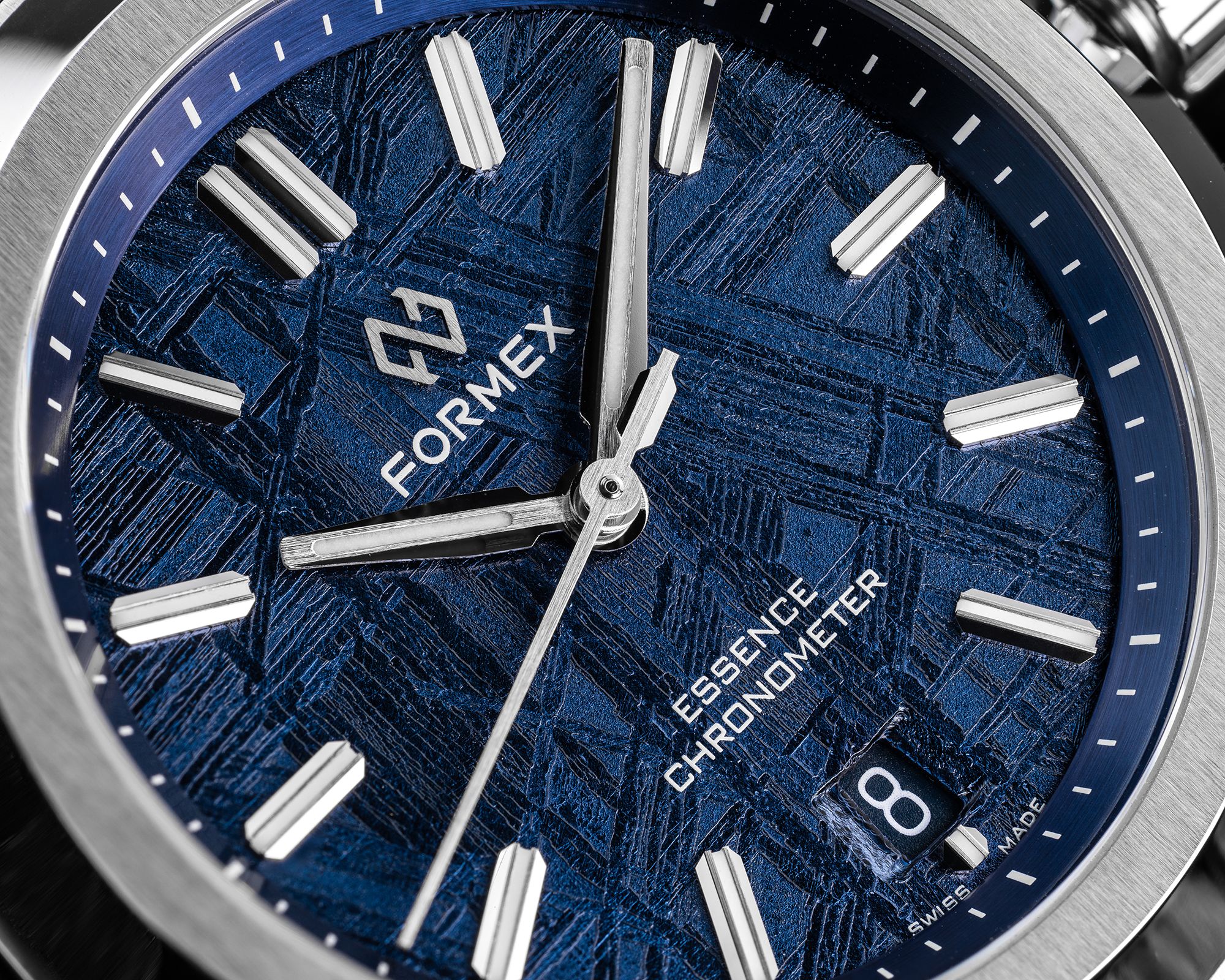
Formex Essence Series (Dress-Sports Hybrid) #
Price range: $1,800-3,000
Case sizes: 39mm, 41mm, 43mm
Water resistance: 100m (10 ATM—splash/rain resistant)
Movement: Sellita SW200-1 or Sellita SW300-1 (some chronograph models use SW500)
Signature features
- Formex suspension system
- CVD case hardening
- Integrated bracelet design (bracelet flows from case—no gaps)
- Slimmer profile than Reef (dress-sports positioning)
Dial variants
- Silver/white dial (classic dress watch)
- Black dial (versatile)
- Blue dial (sunburst, elegant)
- Skeleton dial (some limited editions—visible movement)
Bracelet
- Five-link or seven-link (depending on model)
- Integrated design (Royal Oak / Nautilus aesthetic at accessible pricing)
- Mixed finishing (polished centers, brushed edges)
- Quick-release
Why it's special
- Integrated bracelet under $3,000 (Royal Oak style at 1/10 price)
- Suspension system in dress watch unusual (most brands reserve for sports watches)
- Versatile (dress up for office, dress down for weekend)
- Thinner than Reef (more wearable daily)
Weaknesses
- Integrated bracelet limits versatility (hard to swap straps—defeats Formex's tool-free change advantage)
- Less distinctive than Royal Oak/Nautilus (inspired by luxury icons but doesn't match their presence)
- 100m WR only (fine for daily wear, not serious diving/water sports)
Comparison
- Tissot PRX ($725-975): Budget integrated bracelet, lacks suspension/hardening, inferior finishing
- Christopher Ward C63 Sealander ($1,195): Cheaper integrated option, lacks Formex technologies
- Audemars Piguet Royal Oak ($30,000+): Luxury inspiration, 10X price, superior finishing/prestige
Who should buy Essence
- Integrated bracelet lovers on budget (Royal Oak aesthetic, $2,500 not $30,000)
- Office professionals wanting technical watch (dress appearance, tool watch durability)
- People who rarely swap straps (integrated design accepts this)
Formex Field Series (Military/Tool Watches) #
Price range: $1,600-2,800
Case sizes: 39mm, 41mm
Water resistance: 100m
Movement: Sellita SW200-1
Signature features
- Formex suspension system
- CVD case hardening
- High-contrast dials (military-inspired markings)
- Drilled lugs + quick-release
- Field watch aesthetic (large Arabic numerals, railroad track chapter ring)
Dial variants
- Black dial, white indices (highest contrast)
- Cream/beige dial (vintage military aesthetic)
- Green dial (limited editions)
Why it's special
- Field watch category underserved (few Swiss field watches exist)
- Military durability with Swiss precision (suspension + hardening = genuine military-grade toughness)
- Legibility extreme (large numerals, high contrast)
- Strap versatility (drilled lugs + quick-release = NATO straps in 10 seconds)
Weaknesses
- Field watch niche appeal (not everyone wants military aesthetic)
- 100m WR only (field watches traditionally higher WR for wilderness use)
Comparison
- Hamilton Khaki Field ($500-800): Classic field watch, lacks suspension/hardening, budget alternative
- Sinn 556 ($1,200-1,600): German field/tool watch, competing technologies, similar philosophy
- IWC Mark XVIII ($4,500+): Luxury field watch, superior finishing/brand, 3X price
Who should buy Field
- Military/tactical professionals (suspension survives combat abuse)
- Hikers/outdoors enthusiasts (hardening resists wilderness scratches)
- NATO strap collectors (quick-release makes strap swapping effortless)
Finishing Quality: Mid-Tier Swiss Standard #
Case Finishing #
Polished surfaces:
- Mirror quality: 7/10 (good Swiss finishing—not Zaratsu/Sallaz level, but clean mirrors)
- Consistency: 8/10 (machine polishing consistent, minimal variance piece-to-piece)
Brushed surfaces:
- Grain uniformity: 8/10 (clean parallel lines, well-executed)
- Directionality: 8/10 (brushing follows case contours appropriately)
Mixed finishing:
- Transitions: 7/10 (clean separation polished/brushed but not knife-edge precision)
CVD hardening:
- Scratch resistance: 9/10 (demonstrably superior to standard steel)
- Appearance: 8/10 (maintains steel look well—slight gray tint vs. untreated steel)
Overall case finishing: 7.5/10 (good mid-tier Swiss quality—exceeds microbrands, below Grand Seiko/luxury Swiss)
Dial Finishing #
Printing:
- Sharpness: 8/10 (clean, crisp text/markers)
- Alignment: 8/10 (proper centering, minimal defects)
Lume:
- Application: 8/10 (even coverage, clean edges)
- Brightness: 8/10 (strong glow, lasts 4-6 hours)
- Color: Swiss Super-LumiNova (green/blue standard)
Indices:
- Applied vs. printed: Mix (higher models applied indices, base models printed—both well-executed)
- Finishing: 7/10 (polished facets on applied indices clean but not exceptional)
Overall dial finishing: 7.5/10 (clean, functional, professional—not artistic like Grand Seiko but perfectly adequate)
Bracelet Finishing #
Polished sections:
- 7/10 (good mirrors—hairline scratches appear over time but acceptable)
Brushed sections:
- 8/10 (consistent grain, quality execution)
Solid vs. hollow:
- Solid links throughout (no rattle, substantial feel)
Clasp:
- Push-button: 8/10 (secure, easy operation)
- Micro-adjustments: 8/10 (6 positions—adequate for most wrists)
- Finishing: 7/10 (functional, clean—not exceptional)
Quick-release system:
- Function: 10/10 (works perfectly—push button, bracelet/strap releases instantly)
- Durability: 9/10 (reports of thousands of strap changes without failure)
Overall bracelet: 8/10 (excellent functionality, good finishing—quick-release is standout feature)
Movement Finishing #
Visible through caseback:
- Sellita base: 6/10 (industrial Swiss movement—functional, not decorated)
- Formex modifications: 6/10 (minimal decoration added—custom rotor, basic perlage, that's it)
- Regulation: 7/10 (Formex regulates movements better than stock—typically -5/+10 sec/day vs. -12/+12 stock)
Honest assessment: Movement finishing is Formex weakness (like Minase). Formex focuses on case technology (suspension, hardening) not movement decoration. If you want exhibition caseback beauty, buy Grand Seiko or luxury Swiss.
Why this matters: Formex is engineering company making watches, not traditional watchmaker. DNA = technical innovation (suspension, hardening) not decorative arts (movement finishing). Different priorities.
Value Proposition: Swiss Technology at Microbrand Pricing #
What You're Paying For #
Formex Reef ($2,200 typical):
- Sellita SW200-1 movement: ~$200-300 wholesale
- Case (raw material + machining + CVD hardening): ~$300-500
- Suspension system (R&D amortized, production cost): ~$100-200
- Bracelet (solid links, quick-release): ~$200-300
- Swiss assembly, QC, regulation: ~$200-300
- Brand operations, distribution, warranty: ~$400-600
Total attributable cost: ~$1,400-2,200 (retail $2,200 = fair to low margin)
Comparison: Oris Aquis ($2,400):
- Sellita SW200-1 movement: ~$200-300
- Case (standard polishing): ~$300-400
- Bracelet: ~$200-300
- Brand equity (Oris established name): ~$500-800
- Distribution, marketing: ~$400-600
Total attributable cost: ~$1,600-2,400 (retail $2,400 = similar margin)
The Value Equation #
Formex strengths:
- Proprietary suspension system (unique technology unavailable elsewhere)
- CVD case hardening (scratch resistance 5X standard steel)
- Quick-release strap system (tool-free changes—massively convenient)
- Swiss made under $2,500 (genuine Swiss quality at accessible pricing)
- Genuine tool watch durability (engineered for abuse, not just marketed)
Formex weaknesses:
- Brand unknown (zero recognition outside watch enthusiast circles)
- Movement finishing basic (Sellita base, minimal decoration)
- Design conservative (clean but generic—lacks distinctive identity)
- Resale value uncertain (limited secondary market, unknown brand = discounts)
- Service network small (fewer watchmakers familiar with suspension system)
Formex vs. Competitors #
When Formex wins:
- Shock resistance (suspension system unmatched under $5,000)
- Scratch resistance (CVD hardening superior to most competitors)
- Strap versatility (quick-release best implementation available)
- Swiss quality under $2,500 (genuine Swiss vs. microbrand quality)
When competitors win:
- Brand recognition (Oris, Omega, Tudor all vastly more known)
- Movement finishing (Grand Seiko, luxury Swiss better decorated)
Comparisons: Formex vs. Tool Watch Competitors #
Formex vs. Sinn (German Tool Watch King) #
Similarities:
- Engineering-focused (function over heritage)
- Proprietary technologies (Formex suspension vs. Sinn tegiment hardening, Ar dehumidifying)
- Tool watch philosophy (built for real use, not showpieces)
- Under-the-radar brands (minimal marketing, enthusiast-focused)
Differences:
- Formex: Swiss made, suspension focus, quick-release strap system
- Sinn: German made, multiple technologies (tegiment, Ar, magnetic protection), pilot watch heritage
Price comparison:
- Formex Reef: $1,800-2,500
- Sinn 104: $1,400-2,000 (cheaper)
- Sinn U1: $2,400-2,800 (similar)
When to choose Formex:
- Prefer Swiss over German
- Want suspension system (Sinn doesn't have equivalent)
- Love quick-release straps (Sinn uses traditional spring bars)
When to choose Sinn:
- Want pilot watch aesthetic (Sinn's heritage)
- Need multiple technologies (tegiment + Ar + magnetic protection all together)
- Prefer Sinn's brand reputation (more established than Formex)
Verdict: Competitors, not substitutes. Both excellent tool watch choices—preference depends on specific technology priorities and aesthetic taste.
Formex vs. Oris (Swiss Independent Leader) #
Similarities:
- Swiss independents (not conglomerate-owned)
- Mid-tier pricing ($2,000-4,000 range)
- Dive watches focus (Oris Aquis vs. Formex Reef)
Differences:
- Formex: Engineering focus, proprietary suspension/hardening, unknown brand
- Oris: Brand heritage (120+ years), better finishing, global recognition, no unique technologies
Price comparison:
- Formex Reef: $2,200
- Oris Aquis: $2,400-3,500 (overlapping but higher average)
When to choose Formex:
- Want proprietary technologies (suspension, hardening—Oris lacks)
- Prefer quick-release system (Oris uses standard bracelets)
- Budget under $2,500 (Formex slightly cheaper average)
When to choose Oris:
- Want brand recognition (Oris far more known)
- Prefer better finishing (Oris slight edge in dial/case finishing)
- Value resale (Oris holds value better—established secondary market)
Verdict: Formex = technology play. Oris = safe Swiss independent. Choose based on technology priority vs. brand comfort.
Formex vs. Christopher Ward (UK Direct-to-Consumer) #
Similarities:
- Under-the-radar brands (minimal marketing)
- Direct-to-consumer focus (online sales, cut middlemen)
- Value proposition (quality exceeding price point)
Differences:
- Formex: Swiss made, proprietary suspension/hardening, higher pricing
- Christopher Ward: UK designed/Swiss made, no proprietary tech, aggressive pricing
Price comparison:
- Formex Reef: $2,200
- Christopher Ward C60 Trident Pro: $1,000-1,300 (much cheaper)
When to choose Formex:
- Want Swiss brand (Formex fully Swiss vs. CW hybrid)
- Need suspension system (CW lacks shock protection technology)
- Prefer CVD hardening (CW standard stainless)
When to choose Christopher Ward:
- Budget under $1,500 (CW 40-50% cheaper)
- Want better case finishing (CW light-play case finishing excellent for price)
- Prefer distinctive design (CW twin-flag logo, unique case shapes)
Verdict: Different tiers. CW = budget tool watch excellence. Formex = mid-tier Swiss with proprietary tech. Not direct competitors—different budget levels.
Formex vs. Tudor (Rolex's Little Brother) #
Similarities:
- Swiss tool watches (dive watches, field watches)
- In-house movements (Tudor MT5602 vs. Formex Sellita—wait, Formex uses Sellita, so NOT similar here)
Differences:
- Formex: Unknown independent, suspension technology, $1,800-3,200 pricing
- Tudor: Rolex-owned, brand prestige, in-house movements, $3,000-5,000 pricing
Price comparison:
- Formex Reef: $2,200
- Tudor Black Bay 58: $3,700 (60% more expensive)
When to choose Formex:
- Budget under $2,500 (Tudor starts $3,000+)
- Want suspension technology (Tudor lacks)
- Prefer quick-release system (Tudor traditional bracelets)
When to choose Tudor:
- Want brand recognition (Tudor vastly more known—Rolex association)
- Prefer in-house movement (Tudor MT5602 superior to Sellita)
- Value resale (Tudor holds value excellently—Rolex ecosystem)
Verdict: Different leagues. Tudor = accessible luxury with Rolex DNA. Formex = technical tool watch for users, not collectors. Choose based on use case (abuse watches = Formex; collection building = Tudor).
Who Should Buy Formex? #
Perfect Buyer Profile #
- Tool watch users: You actually abuse watches (climbing, diving, motorcycling, military/tactical work)
- Technology enthusiasts: Proprietary suspension/hardening systems appeal more than brand heritage
- Strap swappers: Quick-release system makes you swap straps daily (NATO, rubber, leather)
- Swiss quality seekers: Want genuine Swiss made under $2,500 (vs. microbrand quality)
- Anti-hype buyers: You avoid trendy brands deliberately (Formex obscurity = feature, not bug)
- Pragmatists: Value function over form (suspension works even if nobody knows brand)
- Sinn/tool watch collectors: Appreciate engineering-focused independents
- People who drop things: You're clumsy, accident-prone—suspension protects your investment
Wrong Buyer Profile #
- Brand prestige seekers: Nobody recognizes Formex (wear to impress = buy Omega, Tudor)
- Movement enthusiasts: Sellita SW200 doesn't excite (buy Grand Seiko for movement finishing)
- Design-first buyers: Formex conservative aesthetics (buy Omega, Tudor for distinctive designs)
- Investment focus: Formex depreciates—buy Rolex, Omega for value retention
- Luxury experience seekers: Formex packaging basic, boutique experience minimal (buy luxury Swiss for retail experience)
- Budget under $1,500: Formex entry $1,800 (buy Christopher Ward, microbrands—better value at entry pricing)
Buying Formex: Practical Guide #
Where to Buy #
Official Formex retailers:
- Switzerland: Formex boutique (Bienne), select authorized dealers
- USA: Limited authorized dealers (specialty watch retailers)
- Europe: Authorized dealers (Germany, UK, France—limited distribution)
- Online: Formex official website (direct sales with warranty)
- Chrono24 (listings appear regularly)
- WatchExchange (Reddit—occasional listings)
IndieWatches.store:
- Check availability: indiewatches.store/marketplace
Recommendation: Buy from authorized dealer or Formex direct (warranty, authenticity). Gray market acceptable if 20%+ discount (limited Formex secondary market means patient sellers discount heavily).
Pricing Guide #
New retail (USD approximate):
- Reef dive watches: $1,800-3,200
- Essence dress-sports: $1,800-3,000
- Field watches: $1,600-2,800
- Limited editions: $2,500-4,000
Secondary market (used):
- Expect 30-50% discount vs. new (unknown brand = steep discounts)
- Reef: $1,200-2,000
- Essence: $1,200-1,800
- Field: $1,000-1,600
Value opportunity: Secondary Formex exceptional value (technology + Swiss quality at microbrand pricing after depreciation).
What to Inspect Before Buying #
- Suspension function: Shake watch gently—should feel slight movement give (suspension working). If rigid = suspension may be seized/failed.
- Case hardening: Inspect under magnification—CVD hardened cases should show minimal scratching even on used examples. Heavy scratching = possibly refinished (hardening removed).
- Quick-release function: Test strap release—should operate smoothly, spring back positively.
- Movement accuracy: Request timing info (should be -5/+15 sec/day or better—Formex regulated)
- Papers/warranty: Formex warranty 2 years from authorized dealer—verify warranty card, documentation
Final Verdict: Legitimate Tool Watch Excellence in Obscurity #
What Formex Gets Right #
- Proprietary suspension system works (demonstrable shock protection superior to competition)
- CVD case hardening effective (scratch resistance 5X standard steel—real-world proven)
- Quick-release strap system best-in-class (10-second strap changes—massively convenient)
- Swiss quality under $2,500 (genuine Swiss manufacturing, regulation, QC)
- Tool watch authenticity (designed for abuse, engineered to survive—not just marketed as tough)
- Reasonable pricing ($1,800-3,200 = fair value for technology + Swiss quality)
- Strap compatibility (drilled lugs fit any 20mm/22mm strap—infinite customization)
What Formex Gets Wrong #
- Brand unknown (zero recognition outside enthusiast circles—wear for yourself only)
- Movement finishing basic (Sellita SW200 industrial—functional, not beautiful)
- Design conservative (clean but generic—lacks distinctive identity, recognizability)
- Resale value uncertain (limited secondary market, steep depreciation—30-50% vs. retail)
- Service network limited (fewer watchmakers familiar with suspension system—potential future concern)
- No in-house movements (Sellita dependence vs. Tudor/Grand Seiko proprietary calibers)
The Recommendation #
Buy Formex if:
- You abuse watches (climbing, diving, motorcycling, military—suspension protects investment)
- Technology matters more than brand (proprietary suspension/hardening appeal intellectually)
- You swap straps constantly (quick-release addictive—once used, can't go back)
- Want Swiss quality under $2,500 (genuine Swiss vs. microbrand compromise)
- Anti-hype mentality (buying unknown brands = statement against mainstream)
Skip Formex if:
- Brand recognition matters (nobody knows Formex—buy Omega, Tudor, Grand Seiko)
- Want investment watch (Formex depreciates—buy Rolex, Omega for value retention)
- Movement finishing priority (buy Grand Seiko for exhibition casebacks)
- Budget under $1,500 (buy Christopher Ward, microbrands—better value at entry pricing)
- Design distinctiveness priority (Formex generic—buy Omega, Tudor for recognizable aesthetics)
The Bottom Line #
Formex builds the most shock-resistant Swiss tool watches under $3,000. Period.
Is that enough to justify buying unknown Swiss independent over Omega/Tudor/Grand Seiko? For people who actually USE tool watches hard—absolutely. For collectors building prestigious lineups—probably not.
But if you're a climber who's destroyed three watches hitting rock faces, or a motorcyclist who has crashed twice with a watch on wrist, or a tactical professional who needs a watch surviving combat abuse—Formex suspension system is a genuine game-changer.
Sometimes the best tool isn't the famous one. Sometimes it's the obscure Swiss independent that engineers solutions nobody else bothered building.
Find Your Perfect Watch
Browse our curated collection of indie and microbrand timepieces.
📚 Related Reading
Handpicked articles from the same topic