What Is a GMT Watch? Complete Guide to Dual-Time Complications
Understanding the complication that lets you track multiple time zones from your wrist — from Pan Am pilots to modern global professionals.
Steven Thompson
Independent Watchmaker · 10 Years Experience
Reviewed by Indie Watches
Editorially reviewed for accuracy
⚡ Key Takeaways
- ✓Standard hour and minute hands show local time
- ✓An additional 24-hour hand (often distinctively colored) shows a second time zone
- ✓A 24-hour scale on the bezel or chapter ring provides reference
- ✓Some GMT watches allow independent adjustment of each time zone
📑 Table of Contents
What Is a GMT Watch? The Basic Definition #
A GMT watch is a watch that displays two or more time zones simultaneously on a single dial. The name "GMT" comes from Greenwich Mean Time — the time standard at the Prime Meridian (0° longitude) in Greenwich, England, used as the universal time reference for aviation and global coordination.
📚 Explore our full watches guide →
How It Works #
- Standard hour and minute hands show local time
- An additional 24-hour hand (often distinctively colored) shows a second time zone
- A 24-hour scale on the bezel or chapter ring provides reference
- Some GMT watches allow independent adjustment of each time zone
Visual Identification #
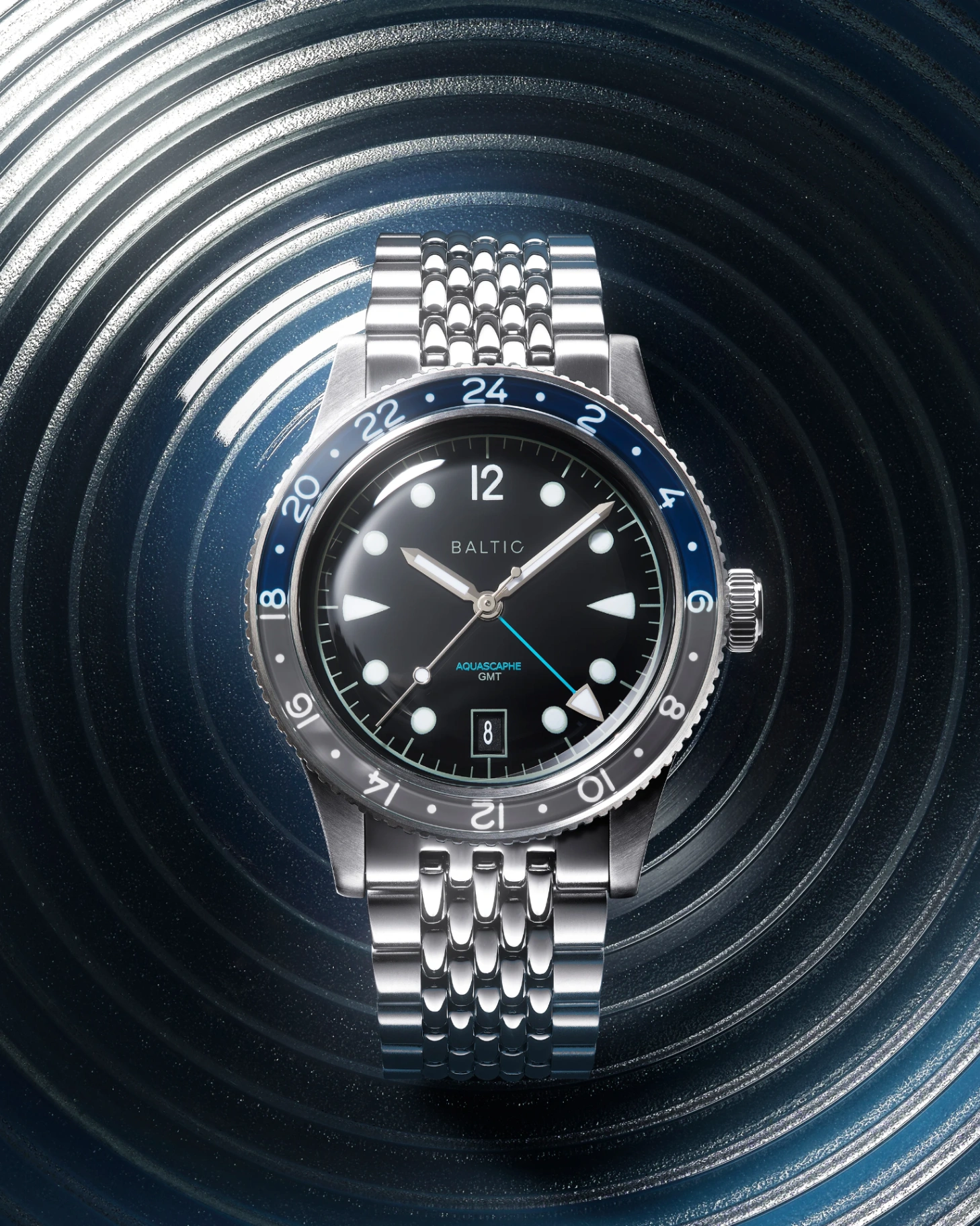
A GMT watch has an extra hand (typically arrow-shaped or triangle-tipped), 24-hour markings somewhere on the watch (bezel, dial, or both), and the extra hand completes one rotation every 24 hours (not 12 hours like a normal hour hand).
The Key Components #
The GMT hand is geared to complete exactly one rotation per 24 hours, moves continuously, and is often distinctively colored (red, orange, green) for visibility. The 24-hour scale provides reference numbers 1–24, usually on a rotating bezel or fixed chapter ring, and may be bi-color for day/night indication.
How GMT Watches Work: The Mechanics #
The 24-Hour GMT Hand #
The GMT hand points to the 24-hour scale on the bezel or dial. Look where the GMT hand points, read the indicated hour (1–24), and combine with the minute hand reading. This shows your reference time (home, UTC, etc.).
Example: Local time hands show 3:30 PM (you're in London). GMT hand points to 10 on the 24-hour scale. Second time zone is 10:30 AM (home in New York).
True GMT vs. Caller GMT: The Critical Distinction #
Not all GMT watches work the same way. Understanding the difference is crucial.
True GMT (Independently Adjustable Hour Hand) #
The GMT hand and hour hand can be set independently. The hour hand can "jump" in 1-hour increments without stopping the seconds. When traveling: the GMT hand stays set to home time, you pull the crown to the first position, and advance or retard the hour hand to the new local time. Seconds and GMT hand continue running uninterrupted.
Advantages: Quick, easy time zone changes during travel. Minimal disruption to timekeeping. Always maintain reference to home time. Better for frequent travelers.
Examples: Rolex GMT-Master II (since 1983), Grand Seiko GMT models, Tudor Black Bay GMT.
Caller GMT (Office GMT) #
The GMT hand and hour hand are linked together — both set simultaneously. To change time zones, you must rotate the bidirectional bezel. The standard hour/minute hands continue showing home time while you read the GMT hand position against the bezel for local time.
Advantages: Simpler mechanism (less expensive). Still functions as dual-time watch. Adequate for occasional travelers or office use.
Disadvantages: Less convenient for frequent travel. Bezel adjustment less intuitive than hour hand jumping.
The 24-Hour Bezel #
In true GMT watches, the bezel provides a third time zone capability: hour hand shows local time, GMT hand shows home/reference time, and the bezel can be rotated to show a third time zone.
Day/Night Indication: Many GMT bezels use bi-color design — one color for night hours (6 PM to 6 AM) and another for day hours (6 AM to 6 PM). Famous examples include the Rolex "Pepsi" (red and blue), "Batman" (blue and black), and "Coke" (red and black).
The History: From Pan Am Pilots to Global Icon #
The Problem: Jet Age Aviation (1950s) #
The 1950s saw rapid expansion of commercial jet aviation. Pan American World Airways flew international routes, and pilots crossed multiple time zones on single flights. They needed to track departure city time, destination city time, and UTC/GMT simultaneously. Standard watches only showed one time zone.
The Solution: Rolex GMT-Master (1954) #
Pan Am approached Rolex with specific requirements. The result was the Rolex GMT-Master, Reference 6542, featuring a 24-hour hand showing a second time zone, a rotating bezel with 24-hour scale, and the iconic "Pepsi" red and blue bezel. It became standard equipment for Pan Am pilots and established GMT watches in professional aviation.
Evolution and Expansion #
In the 1960s–1970s, multiple brands introduced GMT watches. In 1983, the Rolex GMT-Master II introduced the true GMT with independently adjustable hour hand — a major mechanical improvement that set the standard for modern GMT watches. Through the 1990s–2000s, GMT complications became common across all price points. Today, GMT watches feature ceramic bezels, improved movements, and remain relevant for travelers and global professionals.
Practical Uses: When GMT Watches Make Sense #
For Frequent Travelers #
The primary use case GMT was designed for. Set the GMT hand to home time (remains constant), adjust the hour hand when crossing time zones, and always know what time it is at home. Real-world scenarios include business travelers in Asia coordinating with US offices, tourists tracking home time, flight crew managing schedules, and digital nomads working remotely.
For Remote Workers and Global Teams #
Modern work creates GMT watch relevance. Use local time on hour/minute hands, the GMT hand to track a key time zone (boss, team lead, important market), and the bezel for a third zone if needed. One glance shows all three relevant times.
For Family Across Time Zones #
Always know the best time to call. Avoid accidentally calling at inappropriate hours. Maintain connection to loved ones' daily rhythms through time awareness.
For Market Traders and Financial Professionals #
Monitor multiple market opening and closing times across New York (EST), London (GMT), and Tokyo (JST). A GMT watch tracks multiple markets simultaneously.
How to Actually Use a GMT Watch #
Initial Setup (True GMT) #
- Set the time: Pull crown to outermost position and set hour/minute hands to current local time.
- Set the GMT hand: Pull crown to middle position (quickset hour). Rotate to move the hour hand in 1-hour jumps until the GMT hand points to your desired reference time zone.
- Set the date if applicable and verify all settings.
Time Zone Changes When Traveling #
- Determine the time zone offset.
- Pull crown to middle position and rotate the hour hand forward or backward to the new local time.
- If crossing midnight, the date adjusts automatically.
- The GMT hand remains unchanged, providing a constant reference point.
Reading Multiple Time Zones #
Primary (local time): Read hour and minute hands normally. Second time zone: Read where the GMT hand points on the 24-hour scale. Third time zone (using bezel): Calculate offset from GMT hand time zone, rotate bezel by that offset, and read GMT hand position against the rotated bezel.
Advanced: Tracking UTC #
Many professionals keep the GMT hand on UTC — the universal time standard used in aviation, science, and military. Set the GMT hand to UTC and calculate local time zones from that reference.
Popular GMT Watches Across Price Ranges #
Affordable ($500–$1,500) #
Various microbrands offer GMT complications (typically caller GMT) with quality materials at fair pricing. Seiko offers multiple GMT options with proven reliability. Citizen and Orient provide Eco-Drive GMT and other affordable Japanese GMT models.
Mid-Range ($1,500–$5,000) #
The Tudor Black Bay GMT offers a true GMT with independently adjustable hour hand, in-house movement (MT5652), and the iconic Pepsi bezel at a strong value proposition. Grand Seiko GMT models deliver exceptional quality in this range.
Luxury ($5,000–$15,000+) #
The Rolex GMT-Master II — the original and iconic GMT watch with true GMT, ceramic bezel options, and excellent resale value. Breitling offers SuperQuartz GMT and mechanical GMT options with aviation heritage. Jaeger-LeCoultre provides sophisticated GMT complications with exceptional movement finishing.
Ultra-Luxury ($15,000+) #
Patek Philippe combines GMT with grand complications and world time displays. Vacheron Constantin offers world time complications in haute horlogerie execution. A. Lange & Söhne delivers German precision in GMT complications with exceptional finishing.
GMT Alternatives and Related Complications #
World Time Watches #
Display time in multiple cities simultaneously (often 24–37 cities) using a rotating city ring and 24-hour ring. Advantages: See all major time zones at once without calculating offsets. Disadvantages: More complicated to read, usually more expensive, and busier dial design.
Dual Time / Second Time Zone #
A simpler two-time display, often using a sub-dial for the second time. Adequate if you only need to track one additional time zone and prefer a cleaner dial layout.
Digital Watches #
Electronic approach that displays multiple time zones easily with quick switching and world time databases — great for pure functionality at lower cost.
Common Misconceptions About GMT Watches #
"GMT Watches Are Only for Frequent Travelers" #
Reality: GMT is useful for anyone tracking multiple time zones — remote workers, families across oceans, market traders, anyone coordinating globally.
"All GMT Watches Work the Same" #
Reality: True GMT and caller GMT function very differently. True GMT offers independent hour hand adjustment; caller GMT uses linked hands with bezel adjustment. Verify which type before purchasing.
"GMT Hand Must Show GMT/UTC" #
Reality: The GMT hand can show any time zone — home time (most common for travelers), UTC (professionals, pilots), or any reference time zone you choose. "GMT" refers to the complication type, not a required time zone setting.
"You Need a GMT Bezel for GMT Function" #
Reality: Some GMT watches use fixed 24-hour scales instead of rotating bezels. Both work for GMT function, but a rotating bezel adds the capability to track a third time zone.
When NOT to Choose a GMT Watch #
GMT adds complexity without benefit if unused. Consider simpler options if you rarely travel, don't coordinate across time zones, have no family or work in different zones, or prefer cleaner dial designs. Better to have a quality simple watch than a poor GMT — choose quality over complication.
The Bottom Line: GMT Watches Offer Practical Global Connectivity #
GMT watches solve real problems for people tracking multiple time zones. The practical advantages are clear: track two (or three) time zones simultaneously, make quick adjustments when traveling, and handle all time zone needs with a single watch.
For the right person, GMT watches provide significant value. Frequent travelers benefit enormously from true GMT. Remote workers tracking team time zones find GMT practical. Families across oceans stay connected through time awareness.
GMT watches represent practical complications — they exist to solve real problems, not just showcase watchmaking prowess. If you regularly coordinate across time zones, GMT watches deliver tangible benefits that justify the additional complexity and cost. If you don't, simpler watches serve you better.
Find Your Perfect Watch
Browse our curated collection of indie and microbrand timepieces.
📚 Related Reading
Handpicked articles from the same topic