Watch Component Sourcing for Microbrands: Movements, Cases, Dials & Suppliers Guide
How to find reliable manufacturers, negotiate fair pricing, avoid common scams, and build quality watches — covering movements, cases, dials, crystals, bracelets, packaging, and assembly.
Steven Thompson
Independent Watchmaker · 10 Years Experience
Reviewed by Indie Watches
Editorially reviewed for accuracy
⚡ Key Takeaways
- ✓Movement supplier (the engine)
- ✓Case manufacturer (the body)
- ✓Dial producer (the face)
- ✓Crystal supplier (the window)
- ✓Hands, crowns, bracelets, packaging...
📑 Table of Contents
Watch Component Sourcing for Microbrands: Complete Guide to Movements, Cases, Dials & Suppliers
How to find reliable manufacturers, negotiate fair pricing, avoid common scams, and build quality watches without getting ripped off
📚 Explore our full watches guide →
You've designed your dream watch. Rendered it in CAD. Built mockups in Photoshop. Ready to make it real.
Now you need:
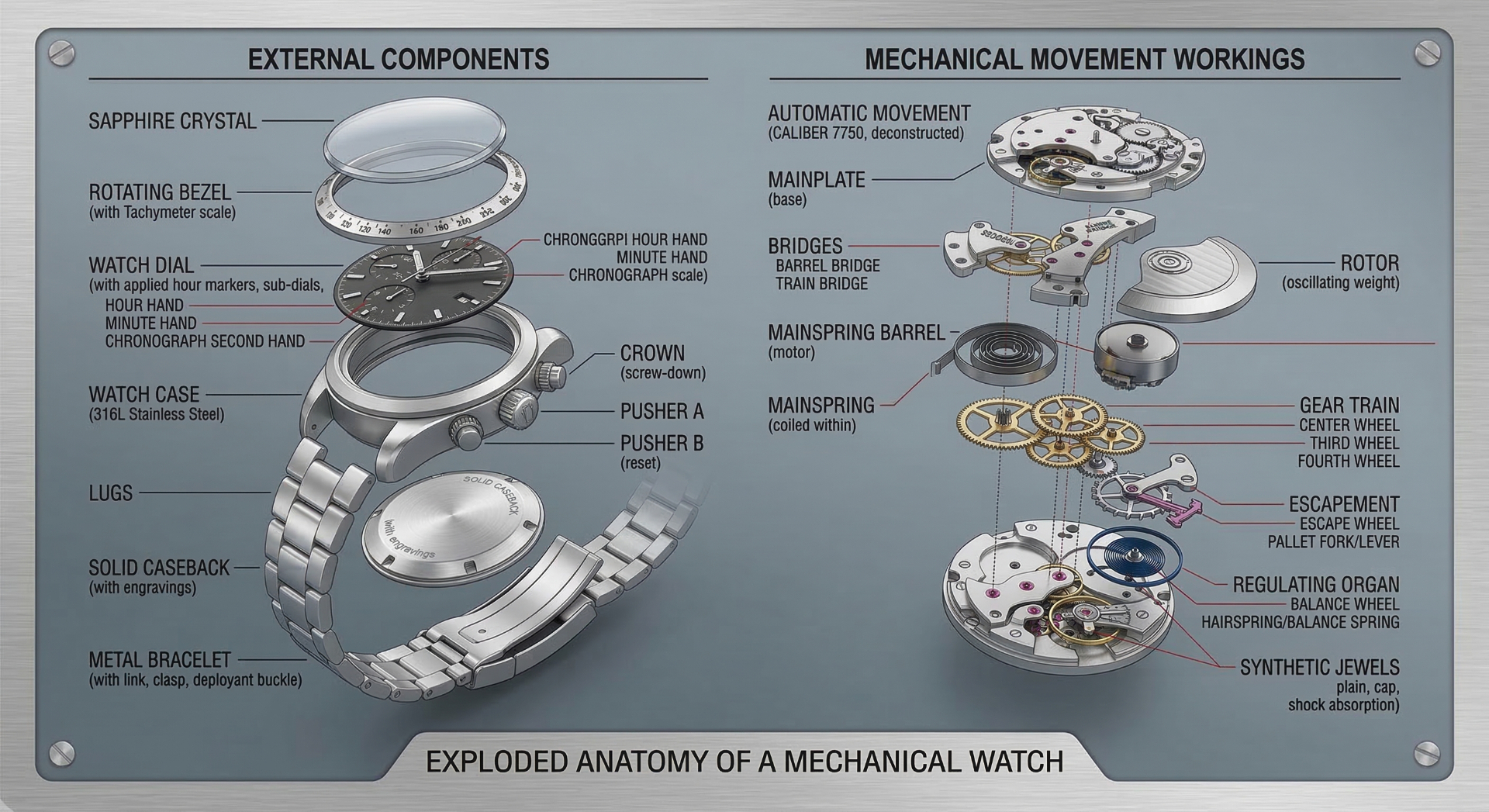
- Movement supplier (the engine)
- Case manufacturer (the body)
- Dial producer (the face)
- Crystal supplier (the window)
- Hands, crowns, bracelets, packaging...
The challenge: Finding trustworthy suppliers without industry connections. Navigating Alibaba's sea of manufacturers (which are legitimate? which are scammers?). Understanding MOQs (minimum order quantities), pricing structures, quality tiers. Avoiding deposit scams, bait-and-switch tactics, IP theft.
The stakes: $10,000-50,000+ initial investment. 6-12 months development. Your brand's reputation riding on quality. One bad supplier = destroyed Kickstarter, refund demands, permanent credibility damage.
This guide provides everything you need:
- ✅ Movement sourcing - Seiko NH35, Miyota 9015, Sellita SW200, Chinese alternatives (PT5000, DG2813), pricing, suppliers, MOQs
- ✅ Case manufacturing - China vs. Switzerland, finding factories, custom design, quality levels, realistic pricing ($15-150 per case)
- ✅ Dial production - Printing methods (pad printing, transfer, digital), custom designs, enamel options, suppliers, MOQs (100-500 units typical)
- ✅ Component sourcing - Crystals (mineral vs. sapphire), hands, crowns, gaskets, bracelets/straps, packaging
- ✅ Supplier verification - Due diligence process, avoiding scams, deposit protection, sample ordering, quality control
- ✅ Pricing expectations - Complete cost breakdown (movement + case + dial + assembly + shipping = total per watch)
- ✅ MOQ strategies - Negotiating minimums, mixing models, phased production
- ✅ Common scams - Bait-and-switch, deposit theft, IP theft, counterfeit components, ghost factories
Whether you're launching your first Kickstarter or scaling beyond prototypes—this playbook gives you the knowledge to source components confidently, negotiate fairly, and build quality watches without getting scammed.
Let's build your microbrand the right way.
Part 1: Movement Sourcing (The Heart of Your Watch) #
Understanding Movement Tiers #
Movements = 30-60% of your watch cost. Choose wisely.
Entry Level ($10-30 wholesale):
- Chinese quartz: Ronda clones, Seagull quartz
- Japanese quartz: Miyota GL20, VH31 meca-quartz
- Chinese mechanical: DG2813 (Seiko NH clone), ST1612 handwound
Mid Tier ($40-80 wholesale):
- Seiko NH35/NH36: Automatic, date, 41hr power reserve (industry standard)
- Seiko NH38: No-date version of NH35
- Seiko VK63: Meca-quartz chronograph
- Miyota 8215/8315: Automatic, date, 42hr power reserve
Upper Mid ($100-200 wholesale):
- Miyota 9015: High-beat automatic (28,800 vph), 42hr PR, slim (3.9mm)
- Seiko NH70/71: GMT function
- Sellita SW200-1: Swiss automatic (ETA 2824-2 clone), 38hr PR
- Sellita SW300: Swiss automatic (ETA 2892-A2 clone), 42hr PR
Premium ($250-500+ wholesale):
- ETA 2824-2: Swiss automatic, elaboré grade, 38hr PR
- ETA 2892-A2: Swiss automatic, slim (3.6mm), 42hr PR
- Soprod movements: Swiss independent (used by Oris, others)
- La Joux-Perret: Swiss automatic, various complications
In-House/Modified ($$$$):
- Custom module development (typically $50,000-200,000+ development)
- Not realistic for new microbrands (stick to established movements)
Seiko Movements (Most Popular Microbrand Choice) #
Why Seiko dominates microbrands:
- Reliable: Proven track record, easy servicing worldwide
- Affordable: NH35 = $40-50 wholesale (500+ units), $60-70 (100-300 units)
- Available: Multiple distributors, reasonable MOQs
- Hacking/Hand-winding: NH35/36 include both (DG2813 Chinese clone doesn't hack)
- Parts availability: Easy sourcing replacement parts
Key Seiko movements:
NH35A (no date) / NH36A (with date):
- Type: Automatic, 21 jewels, 24 jewels (NH36)
- Frequency: 21,600 vph (6 beats/second - slightly audible)
- Power reserve: 41 hours
- Accuracy: -20 to +40 seconds/day (unregulated), -10 to +20 (regulated)
- Features: Hacking seconds, hand-winding, date (NH36)
- Dimensions: 11.5mm height (thick - limits case design)
- Wholesale cost: $40-70 depending on quantity
- Used by: 90% of affordable microbrands (Baltic, Brew, VAER, Nodus, Zelos, etc.)
NH38A (no date, upgraded NH35):
- Same as NH35 but officially without date complication
- Slightly more expensive ($5-10 more)
- Cleaner dial (no date window)
NH70/NH71/NH72 (GMT/World Time):
- GMT hand complication
- Higher cost ($150-200 wholesale)
- Thicker (13mm+)
VK63 (Meca-Quartz Chronograph):
- Quartz base with mechanical chronograph
- Smooth sweeping chrono seconds hand
- $30-50 wholesale
- Popular for affordable chronographs
4R35/4R36 (Premium Seiko):
- Higher-grade version of NH35/36
- Better regulation (-15 to +25 seconds/day)
Where to buy Seiko movements:
Option 1: TMI (Time Module Inc.) - Official Seiko Distributor
- Website: tmi-watch.com
- Location: USA (New Jersey)
- MOQ: 50-100 units per movement type
- Pricing: NH35/36 = $60-70 (100 units), $50-60 (500+ units)
- Legitimacy: 100% genuine Seiko movements (no counterfeits)
- Lead time: 4-8 weeks typically
- Payment terms: Usually 50% deposit, 50% before shipping
- Pros: Reliable, genuine, USA-based support, consistent quality
- Cons: Higher pricing than direct China sourcing, MOQ requirements
Option 2: Chinese distributors (Alibaba/direct)
- Risk: Counterfeit movements common (fake Seiko stamping)
- Verification required: Ask for movement serial numbers, SII certification
- Pricing: $35-50 (appears cheaper but often counterfeits)
- Red flags: Prices significantly below TMI pricing, no certification, poor English communication
- Legitimate suppliers exist: But require extensive vetting
Option 3: Seiko Instruments Inc. (SII) - Direct
- For: Larger brands only (typically 1,000+ unit MOQ)
- Contact: Through official SII channels (Japan)
- Pricing: Best wholesale rates ($35-45 for NH35 at volume)
- Requirements: Business verification, large orders, established brand
- Not realistic for: First-time launches or small microbrands
Recommendation for new microbrands: Start with TMI (USA distributor). Pay slightly more for guarantee of genuine movements, reliable delivery, English-speaking support. Once proven demand (after successful Kickstarter), explore direct China sourcing or SII direct for cost savings.
Miyota Movements (Japanese Alternative) #
Why choose Miyota over Seiko:
- Thinner: 9015 = 3.9mm (vs NH35 11.5mm) - enables dress watch designs
- Smoother: 28,800 vph (vs NH35 21,600) - less audible ticking
- Hand-winding: Miyota 9015 bi-directional winding (easier to wind)
Key Miyota movements:
8215/8315 (Budget Automatic):
- Type: Automatic, 21 jewels
- Frequency: 21,600 vph
- Power reserve: 42 hours
- Features: Date (8315), no hacking or hand-winding
- Wholesale cost: $25-40
- Used by: Budget microbrands, Chinese watches
- Cons: No hacking (second hand doesn't stop when setting), no hand-winding (can only wind by wearing)
9015 (Premium Automatic):
- Type: Automatic, 24 jewels
- Frequency: 28,800 vph (high-beat)
- Power reserve: 42 hours
- Accuracy: -10 to +30 seconds/day
- Features: Date at 3 o'clock, hacking, bi-directional hand-winding
- Dimensions: 3.9mm height (very slim)
- Wholesale cost: $100-140 depending on quantity
- Used by: Christopher Ward, Brew, Baltic (some models), premium microbrands
- Pros: Thin, smooth, reliable, hand-winding
- Cons: More expensive than NH35, date at 3 only (limits dial design)
9039 (No-Date 9015):
- Same as 9015 but no date complication
- Cleaner dial aesthetic
- Slightly more expensive ($10-15 more than 9015)
- Popular for minimalist/dress watches
Cal. 9122 (Chronograph):
- Automatic chronograph
- 24-hour display, 30-minute counter
- Thick (7.9mm)
- $180-250 wholesale
- Used by: Premium chronograph microbrands
Where to buy Miyota movements:
Option 1: Miyota (Citizen Watch Co.) Direct
- MOQ: 100-300 units typically
- Pricing: 9015 = $120-140 (100 units), $100-120 (500+ units)
- Legitimacy: 100% genuine (official manufacturer)
- Contact: Through distributor inquiry form
- Best for: Established brands with proven demand
Option 2: Watch component suppliers (USA/Europe)
- Cas-Ker (cas-ker.com): USA watch parts supplier, smaller quantities
- Esslinger (esslinger.com): USA supplier, hobbyist-friendly
- Cousins UK (cousinsuk.com): UK supplier, international shipping
- Pricing: Higher per-unit ($150-180 for 9015) but lower MOQ (10-50 units)
- Best for: Prototypes, small batches, testing
Option 3: Alibaba/Chinese distributors
- Risk level: Moderate (fewer counterfeits than Seiko but still exist)
- Pricing: $80-110 (appears cheaper)
- Verification: Request Miyota certification, serial numbers
- Legitimate suppliers: Exist but require vetting
Sellita Movements (Swiss Made) #
Why Sellita:
- Swiss Made claim: Enables "Swiss Movement" marketing
- ETA clones: SW200-1 = ETA 2824-2 clone, SW300 = ETA 2892-A2 clone
- Quality: Comparable to ETA (some argue superior QC)
- Availability: Easier sourcing than ETA (Swatch Group restricts ETA sales to third parties)
Key Sellita movements:
SW200-1:
- Type: Automatic, 26 jewels
- Frequency: 28,800 vph
- Power reserve: 38 hours
- Features: Date, hacking, hand-winding
- Dimensions: 11.5mm height
- Wholesale cost: $150-220
- Used by: Christopher Ward, Baltic, microbrands claiming Swiss movements
- Grades: Standard, Elaboré (+better regulation), Top (+better still)
SW210-1:
- Hand-wound version of SW200
- 19 jewels
- 42-hour power reserve
- $120-180 wholesale
- Used by: anOrdain, dress watch microbrands
SW300:
- Thinner (3.35mm) alternative to SW200
- 25 jewels, 28,800 vph
- 42-hour power reserve
- $180-250 wholesale
- Used by: Premium microbrands wanting slim profile
Where to buy Sellita movements:
Option 1: Sellita AG Direct
- Location: Switzerland
- MOQ: 500-1,000 units typically
- Pricing: SW200-1 = $150-180 (volume)
- Requirements: Business verification, large orders
- Best for: Established microbrands with proven sales
Option 2: Authorized Sellita distributors:
- MOM Manufacturing (USA): Authorized distributor
- European suppliers: Various authorized dealers
- MOQ: 100-300 units
- Pricing: $180-220 (smaller quantities)
Option 3: Watch factories (indirect):
- Many Chinese watch factories stock Sellita movements
- Can include in assembly order
- Verify authenticity (counterfeit Sellitas exist)
- Pricing: $160-200 typically
Swiss Made regulations note:
- Using Sellita movement ≠ "Swiss Made" watch. Swiss Made requires specific criteria.
- You CAN say: "Swiss Movement" (if using Sellita/ETA)
- You CANNOT say: "Swiss Made" (unless meeting full criteria - typically impossible for microbrands)
Chinese Movements (Budget Alternative) #
Chinese movements improving rapidly 2020-2026.
PT5000 (Seagull/Peacock):
- Type: Seiko NH35 clone (very close copy)
- Features: Hacking, hand-winding, date, automatic
- Frequency: 21,600 vph
- Power reserve: 40 hours
- Wholesale cost: $15-30
- Quality: 70-80% of NH35 (acceptable for budget watches)
- Issues: Less consistent QC, harder servicing outside Asia, lower brand prestige
- Used by: Chinese microbrands, ultra-budget watches
DG2813:
- Type: Seiko 7s26 clone (older Seiko movement)
- Features: Automatic, date, NO hacking or hand-winding
- Wholesale cost: $8-15
- Quality: Budget tier (acceptable for sub-$100 watches)
- Issues: No hacking = frustrating time setting, no hand-winding
- Used by: AliExpress watches, ultra-budget brands
ST1612 (Seagull):
- Type: Hand-wound mechanical
- Features: No date, manual winding
- Frequency: 18,000 vph (slow beat)
- Wholesale cost: $12-20
- Quality: Good for the price (Seagull = established Chinese manufacturer)
- Used by: Budget hand-wound watches, vintage-style microbrands
Hangzhou 6460:
- Type: Chinese Miyota 9015 alternative
- Features: 28,800 vph, slim profile
- Wholesale cost: $35-60
- Quality: 60-70% of Miyota 9015 (not recommended - just pay for real Miyota)
When to use Chinese movements:
Good situations:
- Ultra-budget watches (sub-$150 retail)
- Testing designs before committing to expensive movements
- Markets where brand prestige less important (some Asian markets)
- High-volume production (cost savings significant)
Avoid if:
- Targeting enthusiast collectors - Will criticize Chinese movements
- Pricing above $200 retail (customers expect Seiko/Miyota minimum)
- Want long-term serviceability (harder finding watchmakers who service Chinese movements)
- Building premium brand (movement choice signals quality standards)
Sourcing Chinese movements:
- Alibaba: Search "PT5000 movement," "DG2813," "Seagull movement"
- MOQ: Typically 100-500 units
- Pricing: $8-30 depending on movement
- Verification: Request QC photos, test samples before bulk order
- Risk: Quality inconsistency (order samples always)
Movement Sourcing Best Practices #
1. Always order samples first
- Minimum 3-5 movements before committing bulk order
- Test accuracy (time keeping over 7 days)
- Test reliability (wear daily, check for stopping)
- Inspect finish (rotor decoration, movement bridges)
- Verify specifications (beat rate, power reserve, features)
2. Request certifications
- Seiko: SII (Seiko Instruments Inc.) certification
- Miyota: Citizen certification
- Sellita: Sellita AG documentation
- Chinese: Factory inspection reports (if available)
3. Negotiate payment terms
- Standard: 30% deposit, 70% before shipping
- Better: 30% deposit, 50% after QC inspection, 20% after delivery
- Never: 100% upfront (scam red flag)
- Use: PayPal for small orders (buyer protection), wire transfer for large (cheaper fees)
4. Plan for defect rates
- Budget 2-5% defective movements (even from Seiko/Miyota)
- Order 5-10% extra movements (buffer for defects, future service)
- Establish replacement policy with supplier
5. Consider lead times
- Seiko/Miyota: 4-12 weeks from order to delivery
- Sellita: 8-16 weeks (Swiss manufacturing slower)
- Chinese: 2-6 weeks (faster but verify quality)
Part 2: Case Manufacturing (The Body) #
Understanding Case Quality Tiers #
Cases = 20-40% of watch cost. Quality varies enormously.
| Tier | Price Range (Wholesale) | Material | Finish | Water Resistance | Tolerance | Used for |
|---|---|---|---|---|---|---|
| Budget Tier | $5-20 | 316L stainless steel (stamped or low-grade machining) | Basic brushing/polishing, visible machining marks | 30-50m (gaskets marginal) | ±0.3-0.5mm (loose fitting components) | Sub-$100 watches, Chinese direct brands |
| Mid Tier | $20-50 | 316L stainless steel (CNC machined) | Decent brushing/polishing, clean lines | 100-200m (proper gaskets, pressure tested) | ±0.1-0.2mm (good component fit) | $200-500 microbrands (most successful brands here) |
| Upper Mid | $50-100 | 316L or 904L stainless steel | High-quality brushing/polishing, mixed finishes | 200-300m (ISO 6425 dive watch standards) | ±0.05-0.1mm (tight tolerances) | $500-1,000 microbrands (Christopher Ward, Baltic premium models) |
| Premium Tier | $100-300+ | 904L stainless, titanium, bronze, ceramic | Multi-step finishing (Zaratsu polishing, Geneva stripes) | 300m+ (professional dive standards) | ±0.02-0.05mm (Swiss-level precision) | $1,000-3,000+ microbrands (high-end independents) |
China vs. Switzerland Case Manufacturing #
China (90% of microbrands):
Advantages:
- Cost: $15-80 for quality mid-tier cases
- MOQ flexibility: 100-500 units (vs. 1,000+ Switzerland)
- Speed: 30-60 days production (vs. 90-180 Switzerland)
- Customization: Willing to modify designs, lower setup fees
- English communication: Improving (many factories have English speakers)
Disadvantages:
- Quality consistency: Batch-to-batch variation
- IP protection: Design theft risk (Chinese factories may clone your design)
- QC requirements: Requires strict inspection (can't assume quality)
- Communication: Time zones, language barriers, cultural differences
Best for:
- First launches (lower financial risk)
- Testing designs (affordable prototypes)
- Price-conscious microbrands ($200-600 retail watches)
- Standard case designs (dive, field, dress - not highly complex)
Switzerland (Premium microbrands only):
Advantages:
- Quality: Consistent, Swiss-level precision
- IP protection: Stronger legal framework
- Prestige: "Swiss Made" claim (if meeting criteria)
- Finishing: Superior polishing, complex shapes, tight tolerances
Disadvantages:
- Cost: $100-300+ per case (5-10X Chinese pricing)
- MOQ: 1,000+ units typically (huge financial commitment)
- Lead time: 90-180 days (Swiss precision = slower)
- Flexibility: Less willing to customize for small brands
Best for:
- Established microbrands with proven demand
- Premium positioning ($1,500+ retail)
- Complex case designs (integrated bracelets, unusual shapes)
- Swiss Made requirements
Finding Chinese Case Manufacturers #
Option 1: Alibaba (Most Common)
How to search:
- Keywords: "watch case manufacturer," "custom watch case," "OEM watch case"
- Filters: "Trade Assurance" (payment protection), "Verified Supplier"
- Location: Guangdong province (Shenzhen, Guangzhou - watch manufacturing hubs)
Evaluating suppliers (before contacting):
- Years in business: 5+ years preferred
- Response rate: >80% (indicates active, responsive)
- Trade Assurance: Yes (protects payments up to amount specified)
- Factory tour photos/videos: Legitimate factories show facility
- Previous work: Photo galleries showing case designs, finishes
Red flags:
- New company (<2 years) - higher scam risk
- No factory photos - likely trading company, not manufacturer
- Prices 50%+ below market - too good to be true
- Poor English (some acceptable, but completely broken English = communication nightmare)
- Pushy for 100% upfront payment - scam
Option 2: Direct Factory Contact (After Vetting)
Top watch manufacturing cities in China:
Shenzhen (Guangdong):
- Hub for: Watch case manufacturing, assembly, components
- Factories: 100+ watch case manufacturers
- Known for: Mid-to-high quality, willing to work with small brands
- Examples: Shenzhen Jiade Watch Co., Shenzhen Lucky Time Industrial Co.
Guangzhou (Guangdong):
- Hub for: Complete watch assembly, movements, cases
- Known for: Slightly lower cost than Shenzhen, high volume
- Good for: Larger orders (500+ units)
Dongguan (Guangdong):
- Hub for: Component manufacturing (bracelets, clasps, crowns)
- Known for: Specialized component production
Finding specific factories:
- Trade shows: Hong Kong Watch & Clock Fair
- Canton Fair: Guangzhou biannual trade fair (watch section)
- Referrals: Ask successful microbrands (some will share suppliers)
- LinkedIn: Search "watch case manufacturer China," connect with sales reps
- Reddit/Forums: Some microbrand founders share supplier info in r/MicrobrandWatches
Option 3: Through Watch Assembly Partners
Many Chinese factories offer complete service:
- Case manufacturing
- Dial printing
- Movement sourcing
- Assembly
- QC
- Packaging
- Shipping
Advantages:
- One-stop shop (simpler logistics)
- Coordinated quality control (they ensure components fit)
- Lower communication overhead (single point of contact)
Disadvantages:
- Less control (they choose component suppliers)
- Potentially higher markup (convenience premium)
- Harder negotiating prices (bundled pricing)
How to find:
- Alibaba search: "complete watch assembly," "OEM watch manufacturer," "custom watch production"
- Look for factories showing full process (case machining → assembly → packaging)
Part 3: Dial Manufacturing (Complete Guide) #
Dial Printing Methods Explained #
Dials = Face of your watch. Most visible quality indicator to customers.
Pad Printing (Industry Standard - 80% of watches):
Process:
- Artwork etched into steel printing plate (photo-chemically or laser)
- Ink applied to plate, fills etched areas
- Silicone pad presses onto plate, picks up ink
- Pad transfers ink to dial surface
- Dial cured/dried (heat or UV)
Quality characteristics:
- Crisp, clean text/indices (sharp edges, no bleeding)
- Permanent (ink chemically bonds to metal base)
- Consistent across production runs
- Multiple colors possible (each color = separate printing plate)
Setup cost: $300-800 per design. Each color/layer = separate plate. Example: White text + red accent = 2 plates = $600-1,200 setup.
Per-dial cost: $3-8 (100+ units), $2-5 (500+ units)
Best for: Standard watchmaking text (brand name, model, specs), simple indices, logos, numerals, production runs 100+ units.
Used by: Rolex, Omega, Seiko, 80%+ of watch industry (proven method).
Transfer Printing (Budget Alternative):
Process:
- Design pre-printed on transfer decal (like temporary tattoo)
- Decal applied to dial surface
- Water/heat activates adhesive
- Protective coating applied over decal
Quality characteristics:
- Good for simple, flat designs
- Can peel/lift over time if poorly applied
- Less precise than pad printing
- Limited to flat dial surfaces (won't conform to curves)
Setup cost: $100-300 (cheaper - no custom plates). Per-dial cost: $2-5.
Best for: Ultra-budget watches (sub-$150 retail), testing designs before committing to pad printing, very small runs (<50 units).
Avoid if: Building quality brand ($200+ retail pricing), expecting long product lifespan (transfer can degrade), using textured/curved dials (transfer won't adhere properly).
Digital/UV Printing (Custom Graphics):
Process:
- Design printed directly onto dial using UV-cured inkjet printer
- Multiple passes build up color depth
- UV light instantly cures each layer
- Protective coating applied
Quality characteristics:
- Excellent for complex graphics (gradients, photos, detailed artwork)
- Full-color CMYK printing (unlimited colors)
- Lower resolution than pad printing for fine text
- Can achieve effects impossible with traditional printing
Setup cost: $500-1,500 (programming printer, color calibration). Per-dial cost: $8-15 (more expensive due to slower process).
Best for: Custom artwork dials (Studio Underd0g pop art style), limited editions with unique graphics, photo-realistic images, gradient effects, complex patterns.
Used by: Studio Underd0g, some fashion watch brands, limited edition microbrands.
Limitations: Text not as crisp as pad printing (use pad printing for text, digital for graphics). Slower production (each dial takes 3-5 minutes vs. seconds for pad printing).
Enamel (Grand Feu - Premium Artisan Method):
Process:
- Copper dial disc hand-cut, filed smooth
- Counter-enamel applied to back (prevents warping)
- First enamel layer (ground coat) applied to front
- Fired in kiln 800-850°C (enamel melts, fuses to copper)
- Cooled, sanded flat
- Additional enamel layers applied, fired (repeat 4-8+ times)
- Final polishing to glassy finish
- Dial feet soldered
- Printing/indices applied (pad printing or painted)
Quality characteristics:
- Unmatched depth, luster, permanence
- Glass-like surface (superior to all other methods)
- Colors incredibly vibrant, won't fade
- Each dial unique (hand-crafted variations)
- High rejection rate (30%+ even skilled enamellers)
Setup cost: Minimal (hand-crafted, no tooling). Per-dial cost: $50-200+ (12+ hours labor per dial). Production capacity: ~10-15 dials/week (single enameller).
Best for: Ultra-premium microbrands ($1,500+ retail), limited editions (50-200 pieces), differentiation (very few brands offer genuine enamel).
Used by: anOrdain, high-end independents, historically Patek Philippe/Vacheron Constantin.
Limitations: Very expensive (labor-intensive), very slow production (10-15/week max), requires skilled artisan (can't outsource to typical factory), high rejection rate (budget for 40% extra to account for defects).
Guilloche (Decorative Engine-Turned Patterns):
Process:
- Brass dial disc machined
- Engine-turning lathe (or modern CNC) cuts decorative patterns
- Patterns: sunburst, barleycorn, clous de Paris, waves, checkerboard
- Enamel or lacquer applied over pattern (shows through translucent coating)
- Printing/indices applied
Quality characteristics:
- Beautiful textured depth
- Light plays across patterns (dynamic appearance)
- Luxurious vintage aesthetic
- Durable (machined into metal, not surface coating)
Setup cost: $2,000-5,000 (if using traditional engine-turning lathe), Modern CNC: $500-1,500 setup.
Per-dial cost: $20-50 (traditional), $10-30 (CNC).
Best for: Dress watches (elegant, formal aesthetic), vintage-inspired microbrands, differentiation (uncommon in microbrands).
Used by: Baltic, Habring², premium independents.
Dial Materials & Bases #
Brass (Standard - 90% of dials):
- Properties: Easy machining, takes plating/coating well
- Cost: Baseline (cheapest option)
- Finish: Plated with rhodium (silver), gold, black, copper, etc.
- Used for: Nearly all watches
Copper (Enamel Dials):
- Properties: Thermal expansion matches vitreous enamel (prevents cracking during firing)
- Cost: Similar to brass
- Used for: Enamel dial base exclusively
Silver:
- Properties: Natural luster, warm tone, patinas over time
- Cost: $10-20 per dial (more expensive than brass)
- Used for: Premium dial bases, vintage watches
- Limitation: Tarnishes (requires anti-tarnish coating)
Mother of Pearl:
- Properties: Iridescent, luxurious, natural material
- Source: Shells (abalone, oyster, etc.) cut into thin wafers
- Cost: $30-80 per dial
- Limitations: Expensive, fragile, each dial unique (natural variations)
Meteorite (Gibeon Meteorite - Ultra Premium):
- Properties: Actual iron meteorite slices, Widmanstätten patterns (crystalline structure)
- Source: Gibeon meteorite (Namibia) - finite supply
- Cost: $100-300+ per dial (extremely limited)
- Used by: Ultra-luxury watches (Rolex Daytona, DeBethune, premium independents)
Carbon Fiber:
- Properties: Modern technical aesthetic, woven pattern visible
- Cost: $15-40 per dial
- Used for: Sport watches, racing chronographs, technical microbrands
Ceramic:
- Properties: Extremely scratch-resistant, deep color
- Cost: $30-80 per dial
- Limitations: Expensive, difficult printing on ceramic (requires laser etching or transfer)
Dial Components #
Lume (Luminous Material):
Super-LumiNova (Swiss - Industry Standard):
- Manufacturer: RC Tritec (Switzerland)
- Technology: Photoluminescent pigment (charges from light, glows in dark)
- Safety: Non-radioactive (safe, environmentally friendly)
- Duration: Glows 8-12 hours (bright first hour, fades gradually)
Colors:
- C1 (White): Neutral appearance daylight, white glow
- C3 (Green): Slightly yellow/green daylight, green glow (vintage aesthetic)
- BGW9 (Blue-Green): Most popular - neutral white daylight, blue-green glow (brightest)
- Old Radium: Faux-aged cream color daylight, green glow (vintage simulation - NOT radioactive)
Application methods:
- Hand-applied: Enamellers/dial painters apply lume to indices/hands with fine brush
- Pad printing: Lume mixed with ink, pad-printed onto dial (faster, less precise)
Cost: +$2-5 per dial (material + labor)
Tritium Gas Tubes (Premium Alternative):
- Technology: Radioactive tritium gas sealed in glass tubes
- Glow: Continuous glow (24/7) without charging - ~10 years half-life
- Safety: Safe (low radiation, glass-sealed)
- Cost: $20-50 per dial (expensive - tubes manufactured by few companies)
- Used by: Ball Watch, Luminox, military watches
- Regulations: Some countries restrict tritium import (verify before sourcing)
Indices (Hour Markers):
Printed indices:
- Cheapest option (+$0.50-1 per dial)
- Flat (no depth)
- Acceptable for budget watches
- Applied via pad printing (same process as text)
Applied metal indices:
- Premium appearance (+$3-8 per dial)
- Three-dimensional (depth, shadow)
- Materials: Brass (rhodium/gold plated), steel, aluminum
- Application: Soldered or glued to dial
- Used by: Quality microbrands $300+ retail
Mixed approach (common):
- Applied indices at 12/3/6/9
- Printed minute track
- Best value (premium look without full applied index cost)
Finding Dial Manufacturers #
Option 1: Integrated with Case Factory
Advantages: Single supplier (case + dial = simpler logistics), ensures dial fits case perfectly, coordinated production timeline.
Disadvantages: Quality varies (some factories excellent at cases, mediocre at dials), less specialized.
How to verify quality: Request dial samples before committing, inspect under 10x magnification, ask for photos of dial printing equipment.
Option 2: Specialized Dial Manufacturers (China)
Top suppliers (Alibaba): Shenzhen Bela Watch Accessories Co., Guangzhou Ruimas Watch Co., Dongguan Hengdian Watch Co.
Search terms: "custom watch dial printing," "watch dial manufacturer," "OEM watch dial"
MOQ: 100-300 dials typically
Pricing: Simple printed dial: $3-5 (300+ units), Applied indices: $6-10, Guilloche: $15-30, Custom artwork (digital printing): $10-18
Lead time: 20-35 days (after artwork approval)
Option 3: Swiss/European Dial Makers (Premium)
Why Swiss dial manufacturing: Superior quality, "Swiss Made" component, prestige.
Swiss dial manufacturers: Positive Coating (Switzerland), Beyeler Group, Comblémine (Swatch Group).
Pricing: $30-100+ per dial (3-10X Chinese pricing). MOQ: 500-1,000 dials typically. Lead time: 60-120 days.
Option 4: Independent Artisans (Enamel/Specialty)
Enamel specialists: anOrdain (Scotland, in-house only), independent enamellers (search Instagram #watchenamel), European ateliers.
Pricing: $50-200+ per dial. MOQ: Often flexible (10-50 dials). Lead time: 30-90 days.
Best for: Ultra-premium limited editions (50-100 pieces), unique differentiation, brand storytelling.
Dial Production Process (Step-by-Step) #
Step 1: Design Preparation
Required files: Vector artwork (Adobe Illustrator .AI, EPS, or high-resolution PDF), font files (OTF or TTF), color specifications (Pantone PMS), technical drawing.
Critical specifications: Dial diameter, feet positions, date window position and size, center hole diameter, text heights (minimum 1.5mm for legibility).
Step 2: Factory Quote
Factory provides: Setup fee ($300-1,500), per-dial pricing, MOQ (100-500), timeline (25-40 days from artwork approval).
Step 3: Sample Production
Always order 3-5 sample dials ($20-50 each). Inspect: print alignment, color accuracy, lume application, finish quality, applied indices, text legibility.
Step 4: Revisions
Most factories include 1-2 free revision rounds. Be specific with feedback.
Step 5: Production Approval & Deposit
Approve final sample in writing. Pay deposit (30-50%). Never 100% upfront.
Step 6: QC Inspection
Options: Self-inspection, third-party inspection ($200-500, recommended for 500+ units), or in-person factory visit ($1,500-3,000).
Step 7: Final Payment & Shipping
Pay remaining balance. Shipping options: Air freight (5-10 days), sea freight (30-45 days), DHL/FedEx (3-5 days). Expect customs duties (USA typically 5-9% for watch components).
Part 4: Crystals, Hands & Small Components #
Watch Crystals #
Acrylic/Hesalite (Plastic):
- Pros: Warm vintage aesthetic, shatter-resistant, easy polishing, affordable ($1-3)
- Cons: Scratches extremely easily, less clear than glass/sapphire, yellows over time
- Best for: Vintage reissues, sub-$200 watches targeting vintage aesthetic
- Used by: Omega Speedmaster Professional (Hesalite variant), vintage Seiko reissues
Mineral Glass:
- Pros: Better scratch resistance than acrylic, crystal clear, affordable ($2-5)
- Cons: Can still scratch, shatters on impact
- Best for: Budget watches ($100-250 retail)
Sapphire (Industry Standard for Quality Watches):
- Material: Synthetic sapphire (aluminum oxide crystal)
- Hardness: 9 Mohs (only diamond harder at 10)
- Pros: Virtually scratch-proof, crystal clear, premium perceived quality
- Cons: Can shatter on hard impact, more expensive ($8-40)
- Best for: All watches $250+ retail (customers expect sapphire at this price)
Sapphire crystal variations:
- Flat sapphire: Simplest, cheapest ($8-15 bulk), modern aesthetic
- Domed sapphire: Vintage aesthetic, $15-25, better light refraction
- Double-domed sapphire: Ultra-premium, $25-40, "box crystal" aesthetic
AR coating (Anti-Reflective): Single-sided +$2-3, double-sided +$4-6. Highly recommended for dial legibility.
Exhibition caseback sapphire: $10-20 per crystal. Worth it if movement is attractive; skip if budget movement.
Sourcing crystals: Usually included with case manufacturer. Specialty suppliers: Sternkreuz (Switzerland, $15-40 bulk), Chinese suppliers on Alibaba ($5-20 bulk). Always verify genuine sapphire with scratch test and thermal test.
Watch Hands #
Materials:
- Brass (plated): Standard, $1-3 per set, good for mid-tier
- Stainless steel: Heavier, premium feel, $3-8 per set
- Blued steel (heat-treated): Artisan work, $15-40 per set
Hand styles: Baton/stick (minimalist), Dauphine (dress), Sword (sport), Alpha (elegant), Mercedes (dive - IP sensitive), Snowflake (Tudor style), Syringe (pilot), Feuille/Leaf (vintage), Lollipop (sport).
Sourcing hands:
- Custom from factory: Setup fee $200-500, per-set $2-5 (500+ sets)
- Standard off-shelf: No setup fee, $1-3 per set
- Premium artisan: Lucius Atelier (USA), $35-75 per set
Crowns, Gaskets, Stems #
Crowns:
- Screw-down (dive): $3-8 each, better water resistance
- Push-pull (dress): $1-3 each, easier to use
- Signed crown (logo engraved): +$0.50-1.50 per crown
Materials: Steel ($3-8), Titanium (+$2-5), Bronze (+$1-3), Gold-plated brass (+$2-5).
Crown gaskets: Silicone ($0.20-0.50, 3-5 year lifespan), Nitrile ($0.30-0.70, better for saltwater), Fluoroelastomer ($0.50-1.50, premium for 200m+ dive watches). Order 10-20% extra.
Stems: Typically included with movement, $1-3 each if custom. Order 5-10% extra.
Casebacks #
- Snap-back: $2-5, simple, lower water resistance (30-50m max)
- Screw-back: $5-12, better water resistance (100-300m), secure
- Exhibition sapphire caseback: $15-30, shows movement
- Engraving: +$1-3 per caseback (laser or CNC)
Part 5: Bracelets & Straps #
Metal Bracelets #
Quality tiers:
Budget ($10-20 wholesale): Hollow links, weak clasp, poor finishing. Avoid for quality microbrands.
Mid-tier ($20-50 wholesale): Solid links, machined clasp with safety catch, screw pins. Used by most microbrands ($300-700 retail). Good value.
Premium ($50-150+ wholesale): Highest quality finishing and engineering.
Bracelet Styles:
- Oyster-style (3-link): $25-40, most common sport/dive bracelet
- Jubilee-style (5-link): $35-60, dressier, more complex manufacturing
- Beads of Rice: $30-50, vintage 1950s-60s aesthetic
- H-link: $35-55, modern, angular, technical
- Integrated bracelet: $80-200, setup fee $3,000-8,000, only for luxury targeting $1,500+ retail
- President-style: $40-70, elegant dress watch bracelet
Bracelet clasp types:
- Folding clasp (basic): Simple, cheap, can come undone
- Deployant clasp: +$3-8, secure, recommended
- Push-button deployant: +$8-15, most secure, premium feel
- Micro-adjustments: +$5-10, worth it for comfort
- Quick-adjust/tool-free sizing: +$10-20, nice-to-have
Sourcing bracelets:
- Integrated with case factory: Perfect fit guaranteed, coordinated finishing
- Specialized bracelet manufacturers: Foshan/Dongguan factories, MOQ 300-500, $20-50
Leather & Textile Straps #
Leather straps:
- Budget ($3-8): Genuine leather, basic, 6-12 month lifespan. Avoid for quality brands.
- Mid-tier ($8-20): Quality calf leather, Italian/American, proper edge painting, 2-5 year lifespan.
- Premium ($20-60+): Horween Chromexcel, Shell Cordovan ($40-80), Italian Buttero, French Barenia, Alligator/Crocodile ($80-200+). Hand-stitched, beveled edges.
Strap types:
- Two-piece strap: Standard, easy changing with quick-release spring bars
- Single-pass NATO: $2-8 (nylon), $10-25 (premium), secure, military aesthetic
- Bund strap: $15-35, niche aesthetic
- Rally/racing strap: $10-25, perforated holes
Hardware:
- Standard tang buckle: $1-3
- Signed buckle: +$1-2
- Deployant clasp for straps: $8-18
Sourcing straps:
- Chinese manufacturers (Alibaba): MOQ 100-300, basic leather $3-8, quality $8-15, Horween $20-40, NATO $2-5
- Specialized strap makers: Benchmark Basics (USA), Hirsch (Austria, $15-40), Fluco (Germany), Barton Watch Bands (USA, $5-12)
Pro tip: Include multiple straps — e.g., bracelet + leather + NATO. Cost $15-30 extra wholesale, perceived value $50-100. Reduces returns.
Part 6: Packaging & Presentation #
Watch Box/Case #
- Budget ($2-5): Cardboard, leatherette. Acceptable for sub-$200 watches.
- Mid-tier ($5-15): Wood (pine, MDF), cushioned interior, magnetic closure. Professional for $200-700 watches.
- Premium ($15-50+): Solid wood (walnut, oak), genuine leather, embossed logo, metal plaques.
Packaging components:
- Watch pillow: $0.50-2
- Outer box/sleeve: $1-3
- Warranty card: $0.10-0.30
- Instruction manual: $0.20-0.50
- Microfiber cloth: $0.30-0.80
- Spring bar tool: $0.50-1.50
Total packaging cost: Budget $3-8, Mid-tier $8-20, Premium $25-60+.
Recommendation: Invest in mid-tier packaging minimum ($10-15). Unboxing experience matters - cheap packaging undermines $400 watch.
Part 7: Assembly & Quality Control #
Assembly Options #
Option 1: Factory assembly (most common)
Process:
- Movement received
- Hands applied to movement
- Movement inserted into case
- Dial attached to movement
- Crown/stem attached
- Caseback sealed
- Water resistance tested
- Accuracy checked (timegraph)
- Packaged
Cost: $8-20 per watch. Best for: Most microbrand launches.
Option 2: Third-party assembly house
Independent assembly companies specializing in watch assembly/QC. Ship components to them; they assemble, test, package, ship finished watches. Cost: $15-35 per watch. Higher quality control, independent verification.
Option 3: Self-assembly (not recommended for beginners)
Tools required: Hand-setting tools ($50-200), case opening tools ($20-50), movement holder ($30-80), timegraph ($300-1,500), waterproof tester ($500-2,000+). Total investment: $1,000-4,000+. Time per watch: 30-120 minutes.
Only viable for: Ultra-small batches (10-50 watches), watchmaker founders, prototypes/samples.
Quality Control Checklist #
Visual inspection (every watch):
- Dial alignment (centered, level)
- Hands alignment (concentric, don't touch each other)
- Lume application (even, no overflow)
- Crystal (no scratches, properly seated)
- Case finishing (no scratches, clean polishing/brushing)
- Bracelet/strap (properly attached, end-links fitted)
- Crown (threads smoothly, closes fully)
- Caseback (seated properly, no gaps)
Functional testing (every watch):
- Time setting (crown pulls smoothly, hands move freely)
- Date change (advances cleanly at midnight)
- Hand-winding (crown winds smoothly, no grinding)
- Automatic winding (rotor spins freely, no noise)
- Hacking (second hand stops when crown pulled)
Accuracy testing:
Timegraph test. Acceptable: -10 to +20 seconds/day (NH35). Reject if: >+30 or <-20 seconds/day.
Water resistance testing:
Pressure test to claimed rating + 20% safety margin. Test sample (5-10 units per batch) or every watch for dive watch claims.
Defect rate expectations:
2-5% defect rate normal. Order 105-110% of needed quantity as buffer.
Third-party inspection companies:
- Alibaba Inspection Service: $200-400
- V-Trust Inspection: $250-500
- SGS: $400-800 (premium)
- AsiaInspection/QIMA: $200-450
Part 8: Complete Pricing Breakdown #
Cost Per Watch Example (Mid-Tier Microbrand) #
Scenario: 40mm automatic dive watch, 500 units, retail price $450
Components:
- Movement - Seiko NH35: $50 (TMI, 500 units)
- Case - 40mm stainless steel, screw-down crown, 200m WR: $35
- Dial - Printed dial, applied indices, BGW9 lume: $8
- Hands - Lumed sword hands (custom): $3
- Crystal - Domed sapphire, double-sided AR coating: $18
- Bezel - Stainless steel bezel with ceramic insert: $12
- Bracelet - Solid link oyster-style, deployant clasp: $35
- Gaskets/crown - Fluoroelastomer gaskets, screw-down crown: $4
- Caseback - Screw caseback, laser engraving: $7
- Assembly & QC - Factory assembly, water testing: $15
- Packaging - Wooden box, pillow, warranty card, manual, cloth: $12
- Shipping (China to USA) - Sea freight, 500 units: $3 per watch
- Customs duties (USA): included
TOTAL COST PER WATCH: $213
Additional costs (one-time):
- Dial printing plates: $600
- Custom hands tooling: $400
- Bezel insert tooling: $800
- Case modifications: $1,200
- Photography: $1,500
- Total setup: $4,500
Setup per watch: $4,500 ÷ 500 = $9 per watch
Total cost including setup: $222 per watch
Pricing structure:
- Wholesale cost: $222
- Retail price: $450
- Margin: $228 (51% gross margin)
Margin allocation:
- Kickstarter/marketing: $50-80
- Payment processing: $15-20 (3.5% Stripe/PayPal fees)
- Shipping to customer: $10-15
- Warranty reserves: $10-20 (2-5% defect replacement)
- Operating expenses: $20-40
- Net profit: $70-100 per watch (15-22% net margin)
Price Comparisons by Tier #
Budget microbrand ($150-250 retail):
Chinese movement ($15-25), basic case ($15-25), printed dial ($3-5), mineral crystal ($3-5), basic bracelet ($15-25), assembly/packaging ($10-15). Total cost: $70-120. Margin: 40-50%.
Mid-tier microbrand ($300-600 retail):
Seiko NH35/Miyota 8215 ($40-60), quality case ($30-50), applied indices dial ($8-15), sapphire crystal ($15-25), solid bracelet ($30-50), assembly/packaging ($15-25). Total cost: $150-250. Margin: 45-55%.
Premium microbrand ($700-1,500 retail):
Miyota 9015/Sellita SW200 ($100-180), premium case ($60-120), guilloche/special dial ($20-50), AR sapphire + exhibition back ($30-50), premium bracelet ($60-120), assembly/packaging ($25-50). Total cost: $300-600. Margin: 50-60%.
Part 9: Common Scams & How to Avoid Them #
Scam #1: Deposit Theft (Ghost Factories) #
How it works: "Factory" lists on Alibaba with stolen photos, provides attractive below-market quotes, requests 50-100% deposit, disappears after receiving payment.
Red flags: Company <2 years old, no factory tour videos/photos, prices 30-50% below market, pushy for large upfront deposit, poor communication.
Protection: Use Alibaba Trade Assurance, never wire transfer 100% upfront (standard: 30% deposit, 70% before shipping), use PayPal for small orders, video call factory, order samples first.
Scam #2: Bait-and-Switch Quality #
How it works: Samples = high quality, bulk order = lower quality (cheaper components substituted).
Protection: Third-party inspection before shipping, specify exact components in contract, request mid-production photos, keep samples for comparison, test random units.
Scam #3: Counterfeit Movements #
How it works: Factories sell fake "Seiko NH35" or "Miyota 9015" (actually cheap clones with identical markings).
Red flags: Pricing significantly below authorized distributors.
Safe approach: Source movements yourself from TMI/Miyota. Ship movements to case factory for assembly. Don't rely on factory to source movements.
Scam #4: IP Theft (Design Copying) #
How it works: You provide CAD files/designs to factory. Factory produces your order AND produces copies under different name.
Protection: NDA before sharing designs (difficult to enforce in China but still worth it), trademark your design elements, don't share complete CAD files, build long-term factory relationship.
Minimize damage: Don't rely on single design, build brand value (copies can't replicate brand story), move quickly.
Scam #5: Fake Sapphire Crystals #
Verification: Scratch test (sapphire resists steel knife), thermal test (fog dissipates instantly on sapphire), request material certificates, price check (real sapphire = $8-20, if $3 = likely fake).
Scam #6: Inflated MOQs #
Most factories flexible on MOQ. Initial "500 MOQ" often negotiable to 200-300.
Negotiation tactics: Ask directly for absolute minimum, offer future business, split models, accept higher per-unit cost for lower quantity.
Scam #7: Hidden Fees #
How it works: Initial quote seems great, then "surprise" fees appear after deposit (packaging fee, QC testing fee, shipping fee, "export documentation fee"). Total 20-30% higher.
Protection: Get itemized quote in writing with all components listed. Specify "all-in pricing" in initial inquiry. Confirm no hidden fees before deposit.
Part 10: Supplier Verification Checklist #
Before Contacting Supplier #
Research: Company established 5+ years, Trade Assurance available, response rate >80%, factory photos/videos available, customer reviews.
Initial Contact #
Questions to ask: What's your MOQ? Per-unit cost at specific quantities? What's included in pricing? Lead time? Can you provide samples? Payment terms? Trade Assurance available?
Sample Stage #
Confirm sample cost ($50-200 typical), lead time (2-4 weeks). When samples arrive: visual inspection, functional testing, water resistance testing, component verification, compare to specifications.
Before Bulk Order #
Contract requirements: Itemized pricing, exact specifications, MOQ confirmed, lead time confirmed, payment terms (30% deposit standard), QC standards, warranty terms, shipping terms.
Protection: Use Trade Assurance or PayPal (small orders) or letter of credit (large orders). NDA signed if sharing proprietary designs.
During Production #
Request production timeline confirmation, mid-production photos, arrange third-party inspection for 500+ units.
Before Final Payment #
QC verification: Third-party inspection report received and approved, factory QC photos reviewed, timegraph data reviewed, water resistance test results reviewed.
Red Flags (Walk Away) #
Immediate disqualifiers:
- Demands 100% payment upfront
- Won't provide samples
- Won't allow third-party inspection
- Prices 50%+ below market
- Poor communication (days to respond, evasive answers)
- No factory photos/videos
- Newly established company (<2 years) with no track record
Part 11: Final Recommendations #
For First-Time Microbrand Founders #
Start small:
- First production run: 100-300 units (test market, minimize risk)
- Payment: Use Trade Assurance or PayPal (payment protection)
- Movements: Buy from authorized distributors (TMI for Seiko, Miyota direct) - don't trust factory to source
- Assembly: Let factory assemble (don't DIY first time)
- QC: Order samples, inspect thoroughly before bulk
Budget realistically:
- Component cost: $150-250 per watch (mid-tier quality)
- Setup fees: $3,000-8,000 (tooling, plates, photography)
Find Your Perfect Watch
Browse our curated collection of indie and microbrand timepieces.
📚 Related Reading
Handpicked articles from the same topic